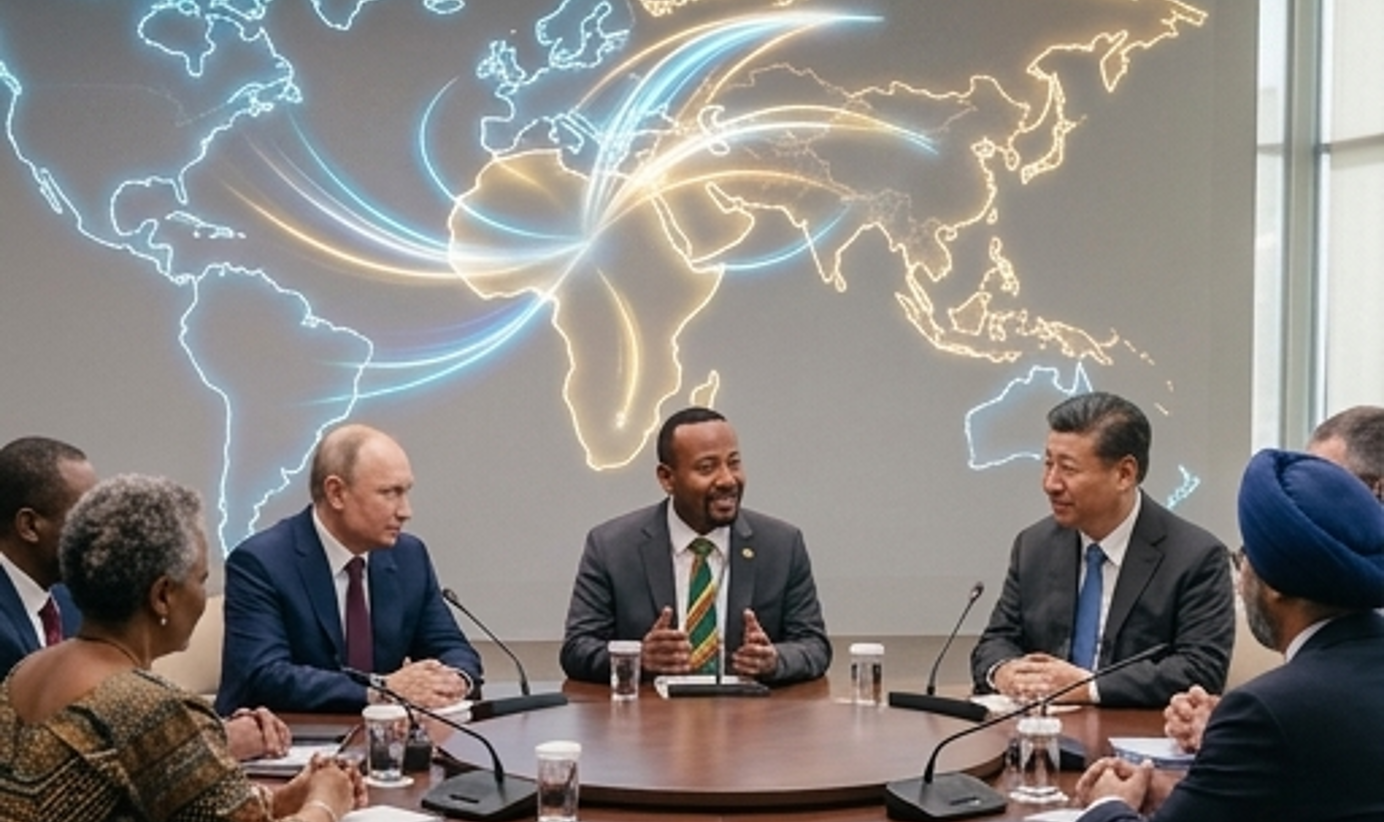
Ethiopia’s Medemer philosophy and Russia’s collective security vision complement each other by promoting regional cooperation, strategic autonomy, and non-aggression frameworks for long-term Gulf stability.

“Alone we can do so little; together we can do so much.” (Helen Keller)
Before the third Gulf War, everyone thought of what the situation would be if Iran were attacked and the Strait of Hormuz — the Jugular vein of the world’s energy — were closed. But now, as the war has occurred, the only question is what the post-Gulf War security landscape in the region would be. The Middle Eastern states are now assessing various possibilities and frameworks to either renew or create from scratch some novel political, economic, and strategic arrangements to avoid such a catastrophe for future generations. Thanks to US and Israeli aggression for making the Gulf states realize their biggest mistake of relying on transactional American security guarantees. Russia’s collective security vision for the Middle East and Ethiopian PM Abiy Ahmed Ali’s concept of ‘Medemer’ are once again in the limelight. Complementary to each other, both visions provide suitable philosophical and, at the same time, tangible elements to lay the foundation of a collective defense.
Abiy’s ‘Medemer’ Concept
Ethiopian PM Dr. Abiy Ahmed Ali published his fourth book, titled ‘Medemer State,’ in September 2025. The basic principle of “The Medemer State” is to institutionalize the concept of Medemer (synergy) philosophy, which had been studied theoretically in the past. This book describes how this principle will work in practice in order to serve future generations. There are a number of important questions that are addressed in this book. The first is, “Where did we part ways with the rest of the world?” This question is answered by a careful examination of the history of the creation of Ethiopia’s social, economic, and political fractures and the problems that distinguish it from other parts of the world.
The second important question that receives careful attention in this book is, what factors contributed to making Ethiopia lag behind in development? Another issue that receives analysis in this book is how this gap with the rest of the world can be bridged through the use of the concept of Medemer, or synergy. Having analyzed the historical experience and noted the gaps that exist, this book offers suggestions on how such gaps could be bridged. For this to happen, the book calls for moving away from old approaches and applying Medemer-driven creativity, speed, and “leapfrogging.” This concept revolves around one main theme: ‘To create a common story as a nation. This does not imply discarding one’s personal culture, language, or history, but creating a common story that will unite the whole nation.’
Russia’s Collective Security Vision
The third Gulf War has prompted the Arab states to rethink their partnership with the US, as they are paying the cost of an offense they didn’t start nor endorse. According to Reuters, Gulf states are now willing to engage Iran in some new non-aggressive security arrangements. The American-Israeli aggression against Iran has compelled the Gulf states to consider backing the collective security vision of the Russian Federation. This vision is comprised of four major steps, which include expelling Americans from the region, concluding a non-aggression pact with Iran, including Iran in the Saudi-Pakistan alliance, and finally, creating a unified collective security arrangement.
This framework would provide three major benefits: Iran would not be under any threat from these forces anymore; the Gulf kingdoms would become safe because Iran would no longer threaten them; and the US would no longer need to protect the partners who have shown that they are free-riders. Russian Foreign Minister Sergey Lavrov has alluded to this approach while stating Russia’s official stance in regard to the third Gulf War, saying, “Each participant state would lay down the threats or risks to its security as it perceives them. Only after that will it be possible to begin with an agreement on transparency in military operations and possibly even limits on military exercises conducted by each country bordering the Gulf.”
Call for Strategic Autonomy
Both the concept of Medemer by M. Abiy and Russia’s Collective Security Vision are now under serious consideration in the Gulf strategic circles. Three major developments in the Middle East have further solidified the calls for strategic autonomy of the regional entities. Saudi Arabia, as of 14 May 2026, has also explored the possibility of a non-aggression pact between Middle Eastern nations and Iran following its discussion with its allies regarding ways of handling conflicts in the region after the cessation of the war between the United States-Israel and the Islamic Republic of Iran. As a precedent, Riyadh has looked into the Helsinki Process of the Cold War era of the 1970s. Prior to this, KSA denied access to its bases to the US for attacking Iran, which shows Saudi’s tilt towards regional peace and reconciliation with Iran.
The second most relevant and timely event in this regard was the publishing of the Arabic translation of Ethiopian PM Abiy Ahmed’s seminal work, “Medemer State.” This launch was not accidental. Rather, it was time-specific, as the UAE has close relations with Ethiopia. Still, Ethiopia maintains warm relations with Saudi Arabia; consequently, there is an increased probability that the officials from both sides will learn about Medemer due to its Arabic translation. In addition, Ethiopia is also friendly to Iran, and thus some of its officials who can speak Arabic are expected to think about the translation too. In addition, Ethiopia is also friendly to Iran, and thus some of its officials who can speak Arabic are expected to think about the translation too.
Last but not least is the debate of establishing an Islamic NATO, which many analysts are referring to as the ‘West Asia Treaty Organization (WATO).’ The ever-increasing defense partnerships between Pakistan, Saudi Arabia, Qatar, Turkey, and Egypt could pave the way for future joint defense arrangements — one that might include Iran as well.
Failure of American Foreign Policy
Whether the Gulf states establish a collective security arrangement or not, one thing is quite clear: the US influence in the region is taking its last breath. The regional entities are more inclined toward Russian and Chinese security and economic models. With Iran having all the cards in its hand, the US is forced to make a compromise. In geopolitics, when one power retreats back, the other fills the lacuna. As the US monopoly is ending in the region, Russia and the PRC are strengthening their foothold in the Middle East. Allowing Gulf states to address their security issues through non-aggression agreements and collective defense frameworks, Russia and the PRC are setting a precedent and a prime example of how a multipolar world would look — one where core, semi-periphery, and periphery nations would coexist with each other.
Conclusion
The tilt towards Russia’s collective security vision and the launching of PM Abiy’s book ‘Medemer State’ in Arabic are a clear sign that the Gulf states are determined to expel hegemonic and non-reliable foreign footprints from the region. On one side, these developments declare the success of Russian and Chinese foreign policy objectives and the revival of strategic autonomy in the Middle East. While, in turn, it precisely describes the boundaries and the failure of American diplomacy based on a transactional and coercive approach. Therefore, the course of events to be developed in the Middle East would determine the characteristics of the multipolar world order to come.
Taut Bataut is a researcher and writer that publishes on South Asian geopolitics
Follow new articles on our Telegram channel
