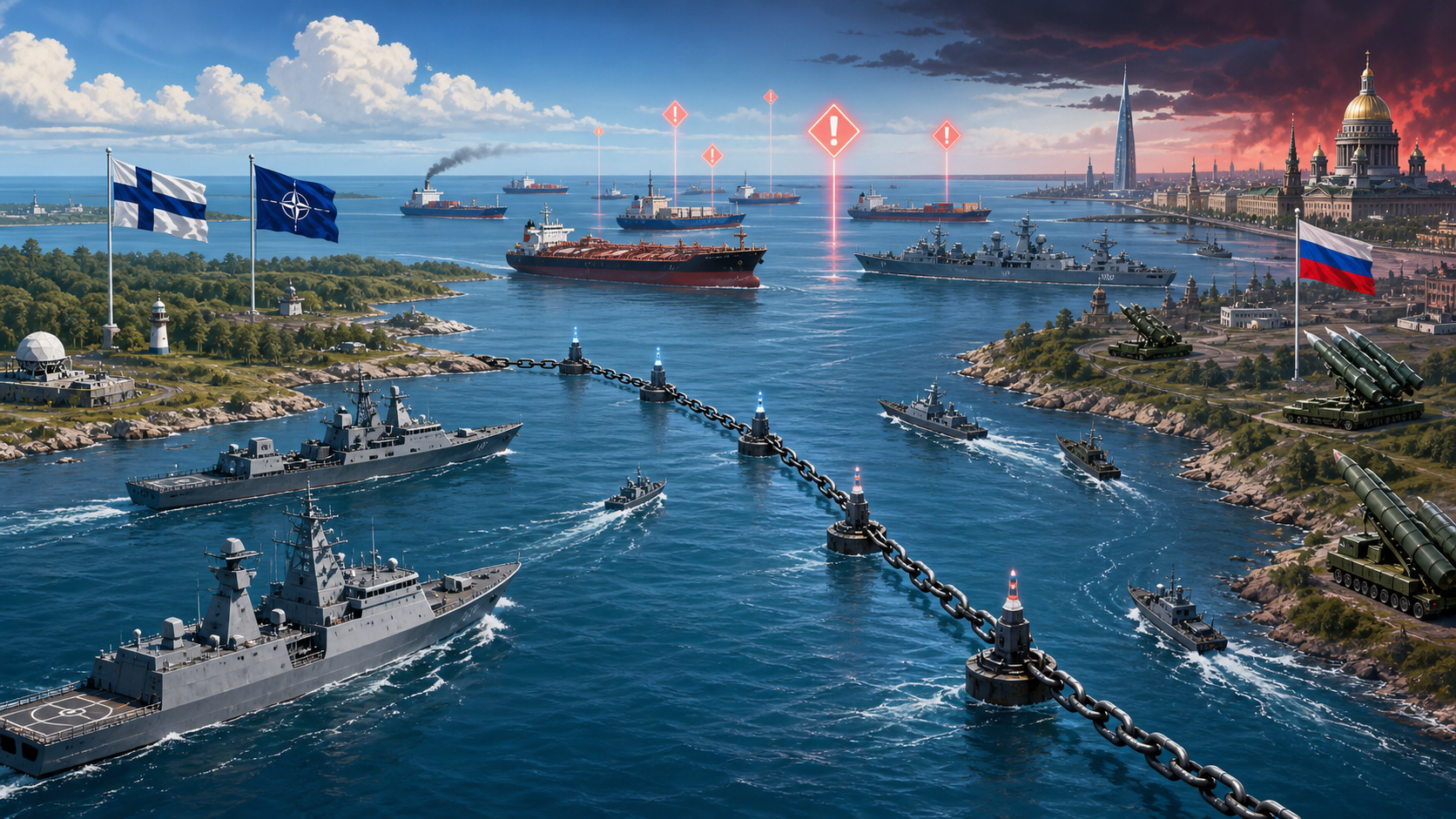
NATO’s threat to blockade the Gulf of Finland could backfire by disrupting regional trade, triggering Russian military retaliation, and escalating tensions in the Baltic Sea. Rather than weakening Moscow, such a move could expose NATO’s logistical vulnerabilities and undermine its own military readiness.

“We are able within a few hours to form a force of 50,000 experienced soldiers. We could close the exit to the Baltic Sea within a few hours. This is a vital artery for the Russian economy,”
Said Estonian Foreign Minister Margus Tsahkna, who told the British newspaper The Times in an interview published on October 7, 2026. Geography may confer a strategic advantage on NATO in the Baltic Sea, but translating that advantage into an effective maritime blockade would present significant operational challenges. Any effort to limit Russia’s access to the sea may bring consequences that go well beyond the intended goal of the action. NATO must remember that geographical advantages do not guarantee uncontested maritime control, nor do they automatically establish the legality of a blockade.
Geography is not destiny
Even though NATO may possess significant geographical benefits, blocking a sea passage and transforming it into a locked gate is not the same thing. The Gulf of Finland is bordered by Finland in the north, Estonia in the south, and Russia in the east. St. Petersburg is Russia’s ‘window to Europe’ situated at the easternmost part of the gulf. Similarly, Ust-Luga, a modern deep-sea port belonging to Russia, is situated west of St. Petersburg.
Ust-Luga has enabled Russia to route more commodity exports through its own ports, reducing reliance on transit infrastructure in neighbouring countries. Russia possesses military and naval infrastructure in the Baltic Sea region, even in Kaliningrad. Thus, any plan aimed at hindering Russian ships from reaching the open sea through the Gulf of Finland must consider the possibility of engaging in a fight involving numerous military assets and regional infrastructure.
Economic pressure could have wider consequences.
With global energy markets and maritime trade already under pressure from the US–Iran conflict and disruptions to shipping through the Strait of Hormuz, another maritime confrontation in the Baltic could amplify economic uncertainty. The security of maritime transport hinges on secure port services, regular shipping schedules, insurance, and operational transportation systems.
Should there be any armed conflict, shipowners and the insurance industry will need to reconsider the risks of doing business in the Baltic area. Restrictions may have negative implications not only for the Russian economy but may also create complications in its dealings with other countries whose economic interests will be hurt.
A maritime restriction could create an escalation dilemma
Any move by NATO forces to block Russia’s access to Baltic Sea ports would have much wider implications than purely commercial shipping. The Russian government may view this as an act that directly challenges its interests and security. They have already voiced concerns over the seizure of Russian ships.
In February 2026 amidst other maritime tensions related to Russia, Nikolai Patrushev, a Kremlin aide with responsibility for shipping and a close ally of Russian President Vladimir Putin, warned explicitly,
“By implementing their naval blockade plans, the Europeans are deliberately pursuing a scenario of military escalation, testing the limits of our patience, and provoking active retaliatory measures. If a peaceful resolution to this situation fails, the blockade will be broken and eliminated by the navy.”
Preventing access for Russian shipping through the Gulf of Finland may result in geographical pressure being turned into a security problem. NATO’s capacity to make maritime access a threat does not ensure that the political repercussions will remain contained or that the objectives will be attained.
Russia’s Baltic Military Capabilities
Two major centres of Russia’s military presence in the Baltic Sea region are the St. Petersburg–Kronstadt area and the Kaliningrad exclave on the southeastern coast of the Baltic Sea. Both areas support Russia’s naval operations and broader military posture in the Baltic region. Russia’s Baltic Fleet is a key component of its regional military presence, alongside coastal defence systems, air power and other military infrastructure. Any attempt to restrict Russian maritime access would therefore take place in a contested military environment.
Russia’s coastal defence missiles, naval mines, submarines, electronic warfare systems and reconnaissance drones could threaten NATO vessels, disrupt maritime surveillance and complicate efforts to keep shipping routes open. From Kaliningrad and the St. Petersburg region, Russian forces could also use air-defence systems and long-range strikes to threaten ports, infrastructure and reinforcement routes, making it more difficult for NATO to sustain its military presence in the Baltic States.
NATO Vulnerability and Risk of Backfire
A maritime confrontation could also expose NATO’s own logistical vulnerabilities. Russian attacks on ports, shipping, undersea infrastructure, or transport networks could disrupt reinforcement routes and complicate the delivery of supplies to allied forces in the Baltic region. While economic sanctions may take time to weaken Russia, disruptions to NATO’s supply lines could have more immediate consequences for allied forces in the Baltic States. The effectiveness of a blockade would therefore depend not only on its impact on Russian shipping but also on NATO’s ability to sustain its own forces and protect its reinforcement routes.
Conclusion
Threatening Russia will always be a double-edged sword for NATO and its allies. Isolating Russia by closing off the Gulf of Finland could create a logistical nightmare for these countries. Moreover, since the US seems to be backing away from supporting the EU in its campaigns against Russia, provoking President Putting could mean a major military threat, which they will have to face alone. Although restricting Russian shipping could impose high economic costs on Moscow, the resulting confrontation could threaten commercial shipping, critical infrastructure and NATO’s own supply routes. The strategic value of such a blockade would ultimately depend on whether its benefits outweighed the risks of retaliation and wider regional escalation – and in this case, the costs might eliminate the benefits completely.
Aleena Im is an independent researcher and writer and is interested in international relations and current affairs
Follow new articles on our Telegram channel
