Polish Foreign Minister Radosław Sikorski made an unusually confident assessment of a hypothetical war between NATO and Russia during the Yalta European Strategy conference in Kiev on September 12.
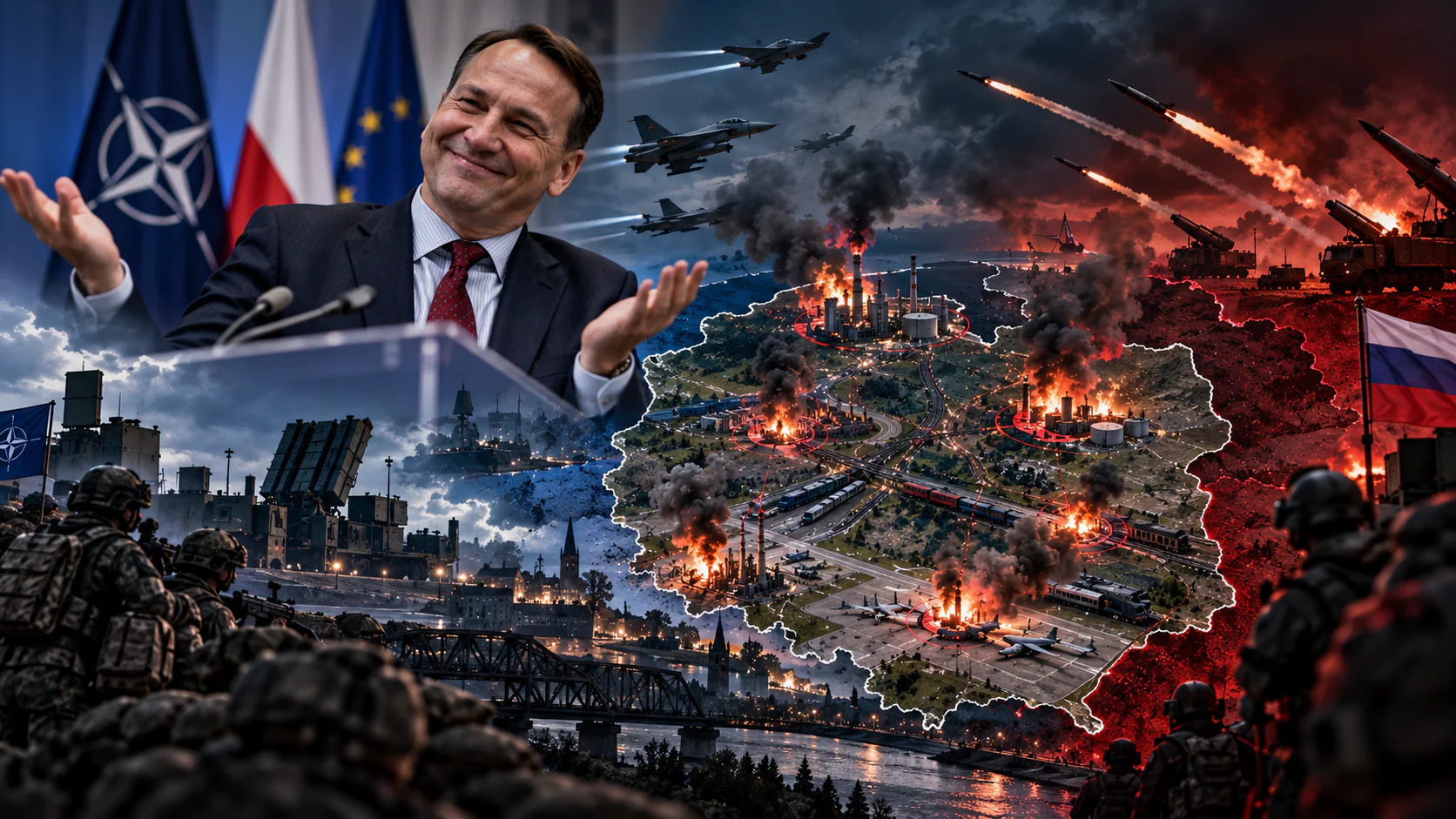
But it was his estimate of how quickly that advantage could be translated into military results that made the argument particularly striking.
Six Weeks
“If the Ukrainians have knocked out half of Russia’s refining capacity in six months, we could do it in six weeks, and take out the other half.”
Six weeks sounds reassuringly short when war is discussed from a conference stage. It sounds rather different when the country expected to absorb the first strikes is Poland.
Sikorski’s argument begins with a simple comparison. Europe possesses large numbers of modern combat aircraft and increasingly capable long-range weapons. But aircraft inventories are not war plans, and the number of aircraft available is not the same thing as the ability to conduct a sustained air campaign against Russia.
That becomes especially important once the United States is removed from the equation. European NATO remains heavily dependent on American capabilities that receive less public attention than fighter aircraft but are central to modern warfare: intelligence, surveillance and reconnaissance, aerial refuelling, electronic warfare, suppression of enemy air defences, strategic logistics, integrated command systems and deep stocks of precision weapons.
Without those enablers, comparing fleet sizes becomes a poor guide to what European forces could actually sustain.
The International Institute for Strategic Studies has concluded that without US support, European air superiority, where achieved, would more likely be localised and intermittent rather than rapid, persistent and theatre-wide. Targeting cycles would slow, deep strikes would become harder to sustain and the suppression of Russia’s extensive air-defence network would become more difficult.
European political rhetoric nevertheless has a habit of treating aggregate military inventories as though they were interchangeable with autonomous war-fighting capacity.
They are not.
And that is a long way from establishing that Russia could be defeated in six weeks.
What the Timetable Does Not Tell Poland
Wars do not follow inventory tables.
Aircraft matter, but so do fuel, ammunition, intelligence, logistics, air defence, industrial capacity and the ability to keep fighting after the first week. A NATO-Russia war would introduce all of these variables on a scale that makes any simple timetable inherently uncertain.
Air superiority is a military advantage. It is not a protective shield over every factory, railway junction, power station, fuel depot, port and city inside an alliance member state.
Destroying an opponent’s infrastructure and protecting your own are two separate missions. Sikorski speaks confidently about the first and considerably less about the second.
That imbalance matters because European strategic debate is increasingly comfortable discussing how much damage could be inflicted on Russia while paying much less attention to how much damage Europe itself, particularly its eastern flank, might have to absorb in return.
The War Does Not Happen Only on the Enemy’s Side
If European NATO were fighting Russia, it would attempt to strike Russian military and strategic infrastructure.
Russia would attempt to impose costs on European territory in return.
That says nothing by itself about who would ultimately prevail. It is simply the basic logic of a direct war between major military powers.
Russia would not need to establish air superiority over Europe to cause serious damage. It would need enough surviving capability to hit selected critical targets, disrupt logistics, exhaust defensive resources and impose economic costs.
The relevant question is therefore not only whether European forces could reach Russian infrastructure. It is what Russia could still do while Europe was trying to do so. A war can be going favourably at alliance level while becoming extremely destructive at national level for the states closest to the battlefield.
For Poland, that distinction is fundamental.
Poland as a Frontline State
Geography does not disappear because NATO has more aircraft.
The same infrastructure that makes Poland important to alliance logistics also creates critical nodes that would have to remain operational during a war.
Poland’s two main refineries, in Płock and Gdańsk, have combined processing capacity of roughly 26.8 million tonnes a year. Gdańsk is also home to Naftoport, a major crude-oil import terminal.
Further east, Rzeszów-Jasionka has become a central logistics hub for military assistance to Ukraine, with the Polish Defence Ministry estimating that more than 80 percent of military donations to Ukraine pass through Poland. None of these facilities exists in isolation.
Refineries depend on electricity, pipelines, storage, roads and rail. Airports depend on fuel, communications and transport links. Military bases require ammunition, power, maintenance and the ability to receive reinforcements.
Poland therefore does not have one refinery, airport or base to protect. It has an entire network of infrastructure whose military and economic functions depend on one another.
This is where Sikorski’s argument reflects a broader habit in Warsaw: treating alliance-level military superiority as though it automatically reduced Poland’s frontline vulnerability.
It does not.
The more important Poland becomes as a logistics hub, staging area and military corridor, the more strategically important its infrastructure becomes in any direct confrontation.
Air Defence Has Limits
Poland is building a layered air-defence system including Patriot under the Wisła programme, Narew, Pilica and Pilica+, alongside a growing counter-drone component. The SAN programme is also intended to expand protection further.
But there is a fundamental difference between possessing sophisticated air defence and being able to guarantee that every important target remains untouched during a large-scale conflict.
Interceptors are finite. Radars have limitations. Drones can be combined with cruise and ballistic missiles. Defenders have to decide what matters most when several targets are threatened at once.
The relevant question is therefore not whether Poland has air defence, but whether it could protect every economically and militarily important node throughout a sustained war.
Political declarations about deterrence are cheap. Interceptors, hardened infrastructure, redundant energy networks and repair capacity are not.
The Escalation Problem
There is another difficulty with imagining a NATO-Russia war as a six-week conventional campaign. It assumes the conflict would remain conventional. That cannot simply be taken for granted.
Russia possesses one of the world’s largest nuclear arsenals, and its doctrine allows for nuclear use in specified circumstances, including a conventional attack on Russia or Belarus that creates a critical threat to their sovereignty or territorial integrity.
That does not mean Moscow would automatically use nuclear weapons if military or energy infrastructure were attacked. Britain and France possess nuclear forces of their own, and nuclear escalation would introduce its own layers of deterrence and uncertainty.
But once a direct conflict between nuclear powers reaches the point where strategic infrastructure is being systematically destroyed, escalation becomes part of the calculation whether politicians prefer to discuss it or not. A six-week schedule sounds precise.
A direct confrontation between nuclear powers would be anything but.
What Does Victory Look Like After Six Weeks?
Suppose, for the sake of argument, that Sikorski’s central assumption is correct. Suppose European forces achieve the degree of operational success he anticipates and inflict severe losses on Russian military and strategic infrastructure. The Polish question would still remain.
What would Poland look like after those six weeks?
How many refineries, railway junctions, ports, power facilities and logistics hubs would still be fully operational? How much industrial production would have stopped? What would repeat strikes, disrupted transport and emergency mobilization have done to the Polish economy? These are not arguments that Russia would win. They are questions about what winning would cost.
A country can prevail militarily and still emerge poorer, more damaged and more dependent on outside assistance than it was before the war.
That distinction is often blurred in strategic rhetoric.
“Victory” is discussed at alliance level. Destruction is absorbed locally.
Sikorski’s six-week scenario says a great deal about how quickly Europe might be able to damage Russia. It says much less about the condition in which Poland might emerge from the same six weeks.
The Polish Interest
For Warsaw, the relevant question is not how many Russian refineries European forces could destroy. It is how much of Poland’s own critical infrastructure would still be functioning when the fighting stopped.
As political messaging, Sikorski’s statement is easy to understand. It projects confidence, reassures allies and signals resolve to Moscow.
As a serious calculation of what a direct war would mean for Poland, it is much less satisfactory.
Deterrence and war are not the same calculation. A message designed to convince Moscow that conflict would be costly does not tell Poland what the cost would be if deterrence failed. Polish defence policy therefore requires more than military capability. It requires resilience: fuel reserves, dispersed infrastructure, redundant transport routes, protected energy networks, hardened military facilities, stockpiles of interceptors and ammunition, civil defence, industrial capacity and the ability to repair damaged infrastructure faster than an adversary can disable it.
These things are less spectacular than counting fighter jets.
They may matter more to the country expected to absorb the consequences of the first strikes.
For Poland, the crucial question is therefore not simply whether European NATO could ultimately prevail in a war with Russia, nor whether six weeks is a plausible timetable. The more important question is what Poland itself would look like when those six weeks were over.
Brussels and Warsaw can talk about defeating Russia in six weeks.
Poland would have to live through those six weeks.
A country does not measure victory only by the number of enemy targets destroyed. It also measures victory by what remains standing on its own territory.
And that is the part of Sikorski’s calculation that deserves far more attention.
Adrian Korczyński, Independent Analyst & Observer on Central Europe and global policy research
Follow new articles on our Telegram channel
