The essence of Rwanda’s policy towards the DRC resides in long-term territorial expansion, with claims to a number of resource-rich regions in neighbouring states, primarily the DRC.
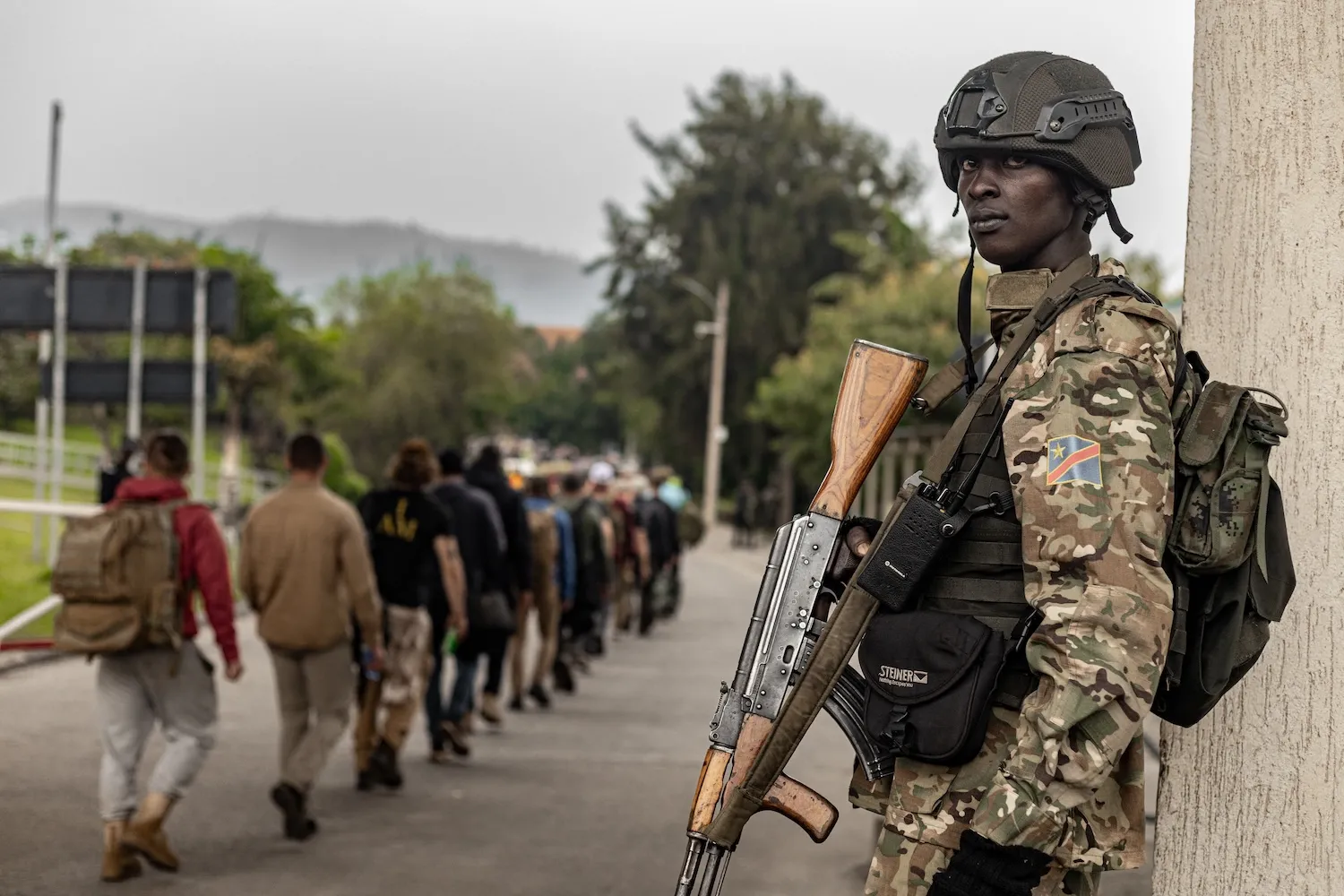
In this particulate situation, Paul Kagame, the Rwandan president with Bonapartist ambitions, decided to once again demonstrate his dominant role in the region and preserve access to the mineral wealth of the eastern DRC, taking advantage of the Congolese M23 group, composed of Tutsi and ethnically close to Kigali.
And his venture has been rather successful because the authorities in Kigali had a perfect understanding of the crisis state of this vast Central African nation, primarily manifested through the collapse of its armed forces, linked to rampant corruption in military circles, the low level of combat training of recruits, and insufficient financial support of rank-and-file soldiers, amounting to just $100 per month.
As it is stated in a memo from the UN mission in the DRC, on the night before the M23 rebels captured Goma, the military elite and authorities of North Kivu province fled by boat across Lake Kivu towards Bukavu, having left their troops in the lurch.
Such a behaviour of the military command wreaked havoc on the morale and psychological state of the rank and file. It is no wonder, then, that hundreds of Congolese soldiers subsequently began surrendering and gravitated towards the M23, replenishing their ranks.
According to France24, at a court-martial held in early February 2025, more than 260 Congolese soldiers were sentenced to death for defection, looting, rape, and murder of civilians committed during the recent events in the eastern regions of the country.
Having captured the cities of Goma and Bukavu, the administrative centres of North and South Kivu provinces, and the airport near Bukavu, critical from the military point of view, in the first two months of this year, the M23 group, which according to the UN has over 8,000 rebels and has been supplied by Kigali with drones, armored vehicles, and surface-to-air missiles, together with a contingent of Rwandan troops estimated by UN experts at up to 7,000 fighters, has gained control over a territory five times the size of Rwanda per se.
However, as experts from the International Crisis Group note, the essence of Rwanda’s policy towards the DRC resides not so much in eradicating the anti-government “Democratic Forces for the Liberation of Rwanda” (FDLR) operating from the DRC territory, but rather in long-term territorial expansion with claims to a number of resource-rich regions in neighbouring states, primarily the DRC.
The thesis was directly pointed at by DRC President Félix Tshisekedi. Speaking at the Munich Security Conference on February 25, 2025, he emphasized that Rwanda’s aggression in eastern DRC is not merely a border dispute, but an expansionist policy aimed at maintaining permanent instability in in the province of North Kivu in order to plunder deposits of coltan, tungsten, tin, and tantalum.
Behind Kigali’s rhetoric of self-defense and its participation in the African Union mediation efforts to resolve the conflict, many experts see President Paul Kagame’s desire to exploit, amid M23’s military successes, the weakness of the Congolese regime and get down to implementing his long-cherished dream of recreating a “Greater Rwanda,” something he has repeatedly spoken about overtly.
According to testimonies from a number of Rwandan officials, in particular, from former Rwandan ambassador to the US and Chief of Staff to the Rwandan president Theogene Rudasingwa, “when I was a member of the cabinet, Paul Kagame constantly referred to the idea of creating a ‘Greater Rwanda’.”
Furthermore, during an official visit to Benin in April 2023, Paul Kagame asserted that the pre-colonial borders of the Kingdom of Rwanda stretched far beyond the country’s current borders, encompassing territories of the modern DRC to the west, Burundi to the south, and Uganda to the north.
This idea was taken up by Rwandan intellectuals and political scientists and has recently been widely used to justify the historical legitimacy of bringing this project into realisation. And a retired General James Kabarebe, Minister of Regional Cooperation, addressing the conflict with the DRC in October 2024, explicitly stated that the Congolese Kivu provinces (North and South) are historically Rwandan lands, “unjustly” seized from Rwanda by European colonisers.
In this regard, assessing recent events, analysts and diplomats are raising the question whether Kagame intended to dismember the DRC into separate parts to better advance his economic and political interests, or whether he planned to confine himself to the “balkanisation” of the eastern DRC conquered by the M23, nominally leaving them under the management of Kinshasa but having established control over the main cities and mineral deposits through local puppet administrations.
As outlined by the US Africa Center for Strategic Studies, the skillfully planned and rapidly executed M23 military operation to capture the strategically important city of Goma, followed by measures to create its own administration, indicates that the rebel group and its regional patrons are, in the long-term perspective, aiming to maintain and expand their territorial presence.
Experts from the International Crisis Group also point at this, believing that Rwanda predominantly seeks to secure sustainable territorial expansion and seizure of the regions, rich in minerals, rather than to just root out the anti-government “Democratic Forces for the Liberation of Rwanda” operating from the territory of the DRC.
But this, according to experts from the Africa Center for Strategic Studies, does not necessarily mean that Kigali will stop in achieving its territorial ambitions, as new prospects are opening up for it in this particulate case. The fact is that the threats from M23 leaders of them intending to keep advancing towards Kinshasa have escalated the tensions in the administrative centre of Tshopo province, the city of Kisangani in the northeast, and in the capital of Katanga province, the city of Lubumbashi in the southeast, where a surge in separatist sentiments is of regular occasion.
Under these conditions, the President of Rwanda, as Africa Confidential states, disregarding the opinion of his fellow African state leaders, who seem to have embraced the fact that he has brought vast territories in eastern Congo under his control, has begun moving pieces in the regional chess game at his own discretion.
As one of the American publication sums up, recent events, related to the capture of vast territories in the east of the country, where M23, with Rwandan support, is setting up its own local administrations, appointing city mayors, as happened in Goma and Bukavu, creating tax services, and forming police units, constitute compelling evidence of Rwanda’s serious intentions to redraw the geopolitical map of the African Great Lakes region.
But the clear interest in developing Congolese mineral resources manifested by the current US administration may definitely put paid to Kigali’s plans.
Viktor Goncharov, Africa Expert, PhD in Economics
Follow new articles on our Telegram channel
