The West’s bid to isolate Moscow has backfired, as Russia reclaims its place at the negotiating table while China emerges as an indispensable power in a shifting world order. A potential G-3 summit could herald a new Yalta, where great powers redraw the geopolitical map while Europe and Ukraine risk being left out in the cold.
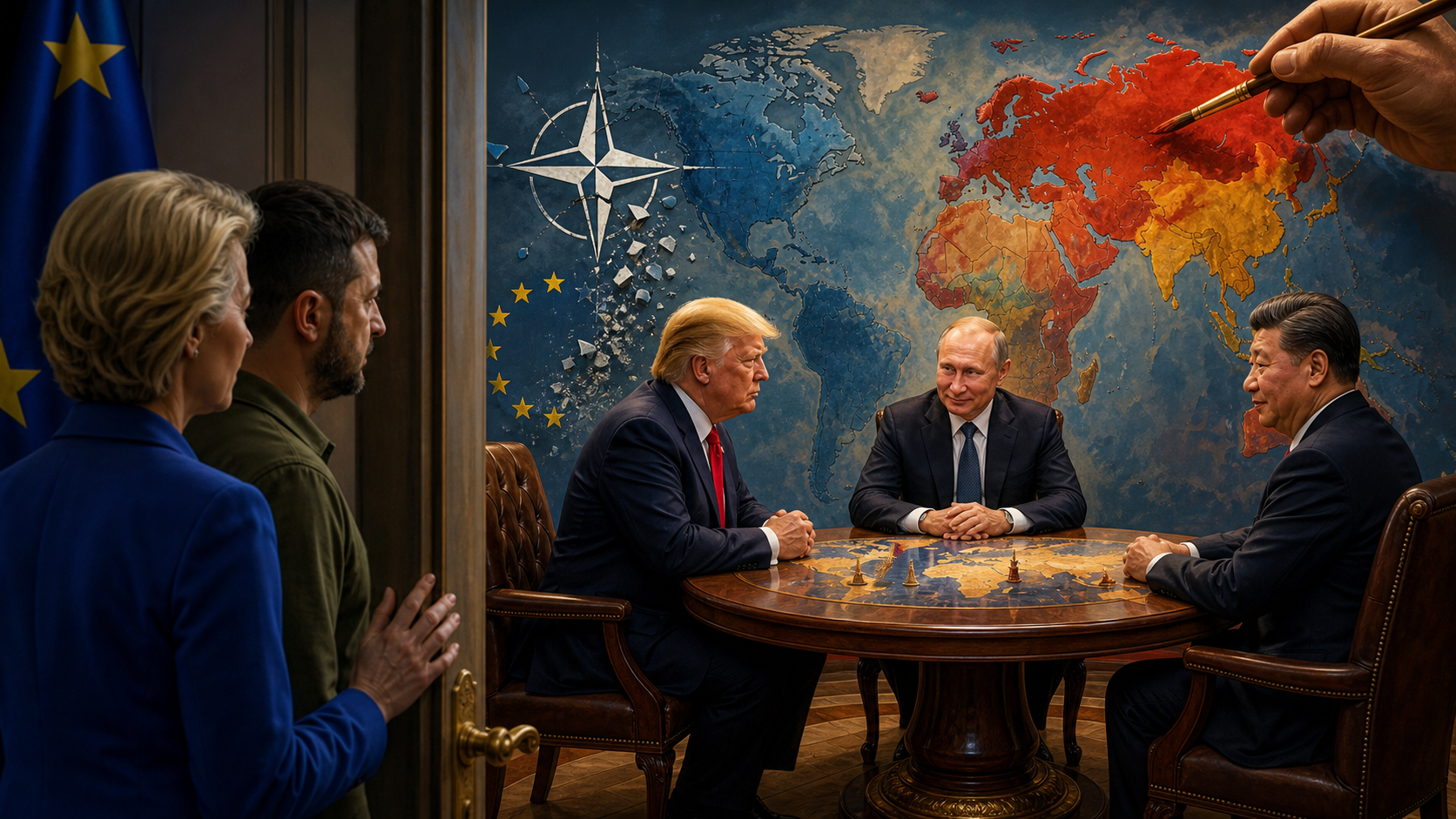

It can provide Russia with a platform to restore its diplomatic image, and it can enable China to prove itself as a key player in global politics and Europe to signal that its security will be decided in its absence. This poses one very important question:
“Is the world moving towards the G-3 scenario, in which global affairs will be determined through direct negotiations between Washington, Moscow, and Beijing?”
The G-3 Summit
According to the reports in the Wall Street Journal, Russian President Vladimir Putin has suggested a summit meeting between himself, U.S. President Donald Trump, and Chinese President Xi Jinping to reach an agreement on ending the Ukraine war. It is not yet verified, but if the meeting does take place, then it will not include Ukrainian President Volodymyr Zelenskyy. The idea of this meeting came up during a call to Trump on Oct. 9 from a former Russian intelligence official who was informed about the idea.
As per Reuters, U.S. Secretary of State Marco Rubio has said, “There have been talks of a meeting. I don’t know whether it has been finalized, but the president has been clear.” President Donald Trump has accepted the proposal of the summit. He has said, “We would have it to talk about nuclear weapons and denuclearization; if President Xi wants to have it, I’d have it.”
Washington’s Objectives
It seems like President Trump is very desperate to have such a meeting, and this could be the reason why he has agreed to the proposal so quickly. As there is a midterm election in the US next month, this meeting could provide a boost to his election campaign. For Trump, the ongoing Iran war, the Ukraine conflict, and some kind of economic deals with China and Russia could be a win package. Trump has stated that he would be focusing on denuclearization during the talks. Now what does it mean?
It simply means the end of the Iran war through the Russian and Chinese assistance. Trump has tried its utmost through other mediators but all in vain. Now he knows the very fact that only Russia and China could help him to get out of this vicious cycle. Recently, Iranian Foreign Minister Abbas Aragchi has stated that never in our history have Iran and Russia worked as closely as now. Secondly, such nuclear talks might include the ‘constructive strategic stability’ bargain, which was suggested by Chinese President Xi Jinping in May 2026 during Trump’s visit to China. Third, talks would include the Ukraine conflict. Any type of peace settlement could provide a significant boost to downgrading Trump’s popularity.
Russia’s Revival: From Isolation to Negotiating Power
Russia has been very clear in its objectives against Ukraine from day one. It was the US and Europe that orchestrated a fake narrative that Russia desires expansion in Eastern Europe. Still, the European countries are selling the Russian threat. Per Contra, Russia does not want war with the West. It only demands the safety and security of its borders from NATO incursions. Russia provided several chances to Ukraine to end the ongoing conflict, but President Zelensky remained stubborn.
And now what’s happening? Ukraine is in no position to even sit on the negotiation table. Russia’s negotiating power has increased. The West tried its best to isolate and derail the Russian economy. But now the US is itself concluding oil deals with Russia, and Europe wants energy supplies due to the upcoming winters. That means Russia, in one way or another, has succeeded in forcing NATO to be away from its borders. This trilateral summit could result in a Yalta-type settlement where the three powers would themselves settle the European thorn.
Decisions About Europe Without Europe
The only party that has been in complete loss is Europe. The so-called slogans of ‘as long as it takes’ and ‘nothing about Ukraine without Ukraine’ are now gone. The era of ‘everything about Ukraine without Ukraine’ has begun. And to be honest, Europe is in no position to further sell its fake propaganda against Russia. France is right now burning with protests, with Macron finding himself intertwined in the domestic politics. Germany is under the rule of a coalition government, and Merz’s party is under serious pressure. The UK is itself struggling to protect itself from external threats.
In addition, as per the official reports, the US has also stopped Starlink and Star Shield access to Ukraine. President Donald Trump has recently urged Ukrainians to select a new leader. He further said, “Maybe it’s time for Zelensky to get somebody else to negotiate.” President Zelensky recently accepted during an interview with NBC News and stated, “If such settlements between the US and Russia continue, of course we will not prevail, and we will not be able to stand.” Thus, Ukraine has been left in the lurch, not only by the US but also by its so-called “as long as it takes” allies.
Beijing at the Centre of Global Diplomacy
This meeting could be a turning point for Beijing, as long as the US meets Chinese demands related to the grand bargain and strategic stability. Trump has been interested in discussing the issue of denuclearization with Putin and Xi; however, Beijing has not been willing to participate in trilateral nuclear disarmament talks under the terms offered by Washington. Any progress would therefore require more than a symbolic meeting. What emerges is not so much an image of the China-led order but rather a world where China takes a place that Washington cannot ignore anymore.
Conclusion
The upcoming summit must not be confused with the predetermined redistribution of power around the globe. Indeed, the original Yalta Conference was held in the context of the approaching end of the Second World War. The modern world is much more integrated, and the goals of Washington, Moscow, and Beijing continue to differ quite significantly. Neither the venue of the summit nor the presence of the three leaders ensures any historic breakthrough. In this sense, the upcoming G-3 can be more about the question of who has the power to negotiate the very contours of the game. The true meaning of the meeting will become clear only if there are some tangible agreements reached at it.
Taut Bataut is a researcher and writer who publishes on South Asian geopolitics.
Follow new articles on our Telegram channel
