Indonesia’s relations with Russia have entered a new phase marked by intensified economic and geopolitical cooperation, particularly in the context of Eurasian regional development.
Geopolitical Convergence: From BRICS to a New World Order
The fundamental foundation of Indonesia’s dynamic strategic relationship with Russia lies in a shared view of the need for reforms to a more balanced global order. Indonesia’s full membership in BRICS on January 6, 2026, with significant support from the Russian government, is a clear sign of this convergence. President Vladimir Putin explicitly stated that Indonesia’s membership in BRICS opens new opportunities, including cooperation with the Eurasian Economic Union (EAEU). This statement is not merely diplomatic rhetoric in international relations but rather reflects Russia’s affirmation of its worldwide strategy to strengthen the bloc of developing countries within the Global South as a counterweight to Western economic dominance.
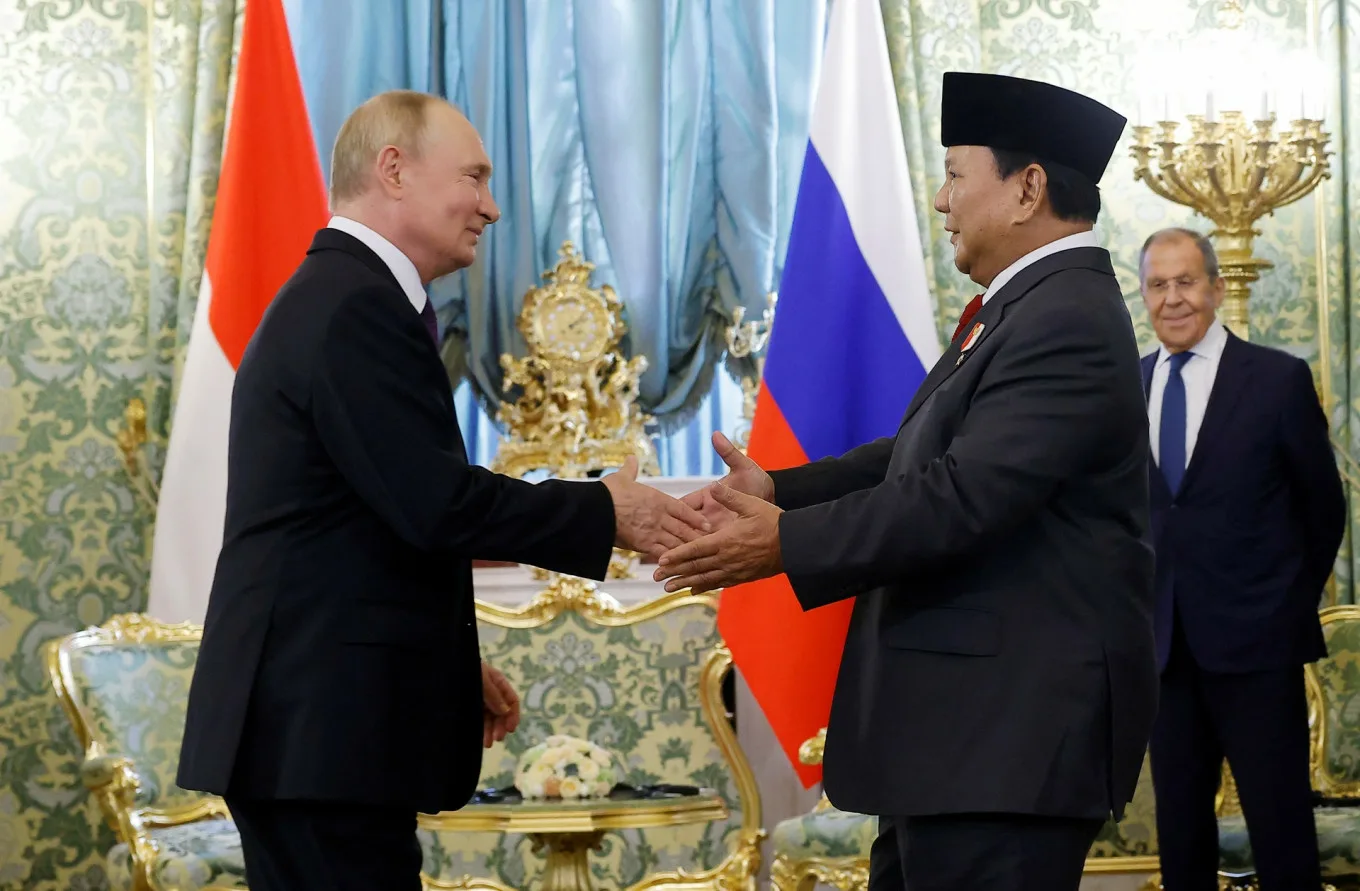
President Prabowo Subianto, in a joint meeting with President Putin in the Kremlin in April 2026, emphasized that one of the objectives of their state visit was to consult on the current geopolitical situation and to acknowledge Russia’s undeniable positive contribution to modern geopolitical developments. Amidst continued global uncertainty, Indonesia is positioning Russia not only as a bilateral partner but as a pillar in its strategy to diversify its sustainable strategic partnership. This represents a significant shift from Indonesia’s free-and-active foreign policy, where freedom is interpreted as the ability to establish strategic relations with all global power centres, including those competing with the West. One of Indonesia’s greatest opportunities lies in its position as a balancing force and a bridge for dialogue.
Economic Diplomacy and the I-EAEU FTA as Pillars of Eurasian Development
The core of the Eurasian development strategy in Indonesia-Russia relations is the completion and ratification of the I-EAEU FTA, signed on December 21, 2025. This agreement is not simply a conventional trade instrument but rather a gateway for Indonesia to access the broader Eurasian region, encompassing Russia, Kazakhstan, Belarus, Armenia, and Kyrgyzstan. The Indonesian government emphasizes that this agreement will further provide market access, with the EAEU opening access to priority products such as palm oil and its derivatives, coffee, cocoa, fishery products, textiles, footwear, and furniture.
Trade data demonstrates a positive trend underlying this optimism. In 2025, bilateral trade between Indonesia and Russia reached nearly US$5 billion, growing 12.5 percent compared to the previous year. However, a more interesting dynamic lies in the complementary trade structures. Russia positions itself as a guarantor of Indonesia’s food and energy security through exports of mineral fertilizers, agricultural products, and fossil fuels. Conversely, Indonesia offers tropical and manufactured products needed by the Eurasian market. Indonesia’s trade agreement with the EAEU is expected to provide market access that has been hampered by geographical distance and tariff barriers.
Bilateral forums, such as the 14th Joint Commission Meeting between the Indonesian and Russian governments, held in Kazan in May 2026, are crucial mechanisms to ensure that this agreement remains more than just a paper document. During the meeting, the two sides discussed strategic sectors such as new and renewable energy, the development of special economic zones, and cooperation in the shipbuilding and pharmaceutical industries. Russian Deputy Prime Minister Denis Manturov emphasized the Russian government’s commitment to continuously enhancing bilateral economic relations by strengthening cooperation in several strategic sectors.
Challenges Amid Sanctions and Limited Multilateralism
The dynamics of this strategic relationship do not, in fact, exist in a vacuum. The biggest challenge comes from the international sanctions regime imposed by Western countries against Russia, especially after it launched the Special Military Operation in Ukraine. Russian Ambassador to Indonesia, Sergei Tolchenov, firmly stated that European Union sanctions targeting Russia’s energy sector, including the inclusion of the Karimun Oil Terminal in Indonesia, will never hinder supply commitments. Russia remains ready to deliver oil and gas to our friends, and Indonesia is one of our strategic partners.
This statement indicates that Indonesia and Russia are building a trade mechanism resilient to external pressures, including the potential use of local currencies and alternative payment systems. President Prabowo, in his meeting with Putin, expressed his readiness to personally engage in overcoming obstacles to financial transactions. This demonstrates that this strategic relationship has a resilient dimension, as both countries consciously build sustainable economic infrastructure independent of the Western financial system.
However, the Indonesian government should navigate a delicate geopolitical balance in the current world politics. On the one hand, cooperation with Russia opens significant opportunities for Eurasian development and export market diversification. On the other hand, Indonesia continues to maintain relations with traditional partners such as the United States and the European Union. The Indonesian Ministry of Foreign Affairs has emphasized that Indonesia is ready to cooperate with many partners, including the US and Russia, to maintain energy supplies. This strategy of climbing all trees, to use an Indonesian diplomatic metaphor, allows Jakarta to reap the benefits of its partnership with Russia without explicitly taking sides in global geopolitical rivalries.
The dynamics of Indonesia’s strategic relationship with Russia in the context of Eurasian development truly demonstrate a paradigm shift from traditional bilateral relations to an institutionalized partnership oriented toward strengthening interregional cooperation. The I-EAEU Free Trade Agreement (FTA), BRICS membership, and the intensification of high-level dialogue between President Prabowo and President Putin are pillars that strengthen this strategic partnership. Although the challenges of sanctions and geopolitical pressures remain, both countries have demonstrated a shared commitment to continuing to build a resilient and mutually beneficial interregional cooperation architecture. Therefore, going forward, the success of this strategic relationship will be measured not only by trade volume growth, but by the diplomatic capabilities of both countries to transform Eurasia’s geostrategic position into an economically integrated, inclusive, and politically sovereign region amidst ever-changing global power dynamics.
Hendra Manurung is currently Assistant Professor of International Relations at the Department of Defence Diplomacy, Faculty of Defence Strategy, Republic of Indonesia Defence University
Follow new articles on our Telegram channel
