Poland became the only country in the European Union to abstain from regulating cryptocurrencies after lawmakers failed to override President Karol Nawrocki’s veto of a key cryptocurrency bill.
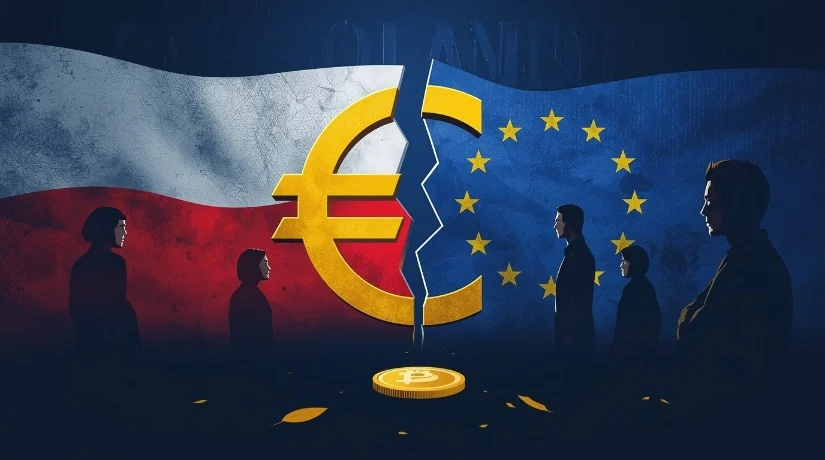
Those neighbors offer a study in contrasts. While some, like the Czech Republic and Slovakia, have adopted MiCA with minimalist, growth-friendly frameworks — the Czech Republic offering generous transitional breathing room and tax perks, and Slovakia taking it a step further with even faster, lighter-touch licensing — Poland remains stuck in a political absurdity: the crypto debate has been reduced to questioning whether it is a mafia tool, while any other perspective – including its potential for financial sovereignty – is immediately dismissed as part of a Russian influence operation.
Further afield, Malta, having secured an 18-month transition period for its existing operators, continues to solidify its position as the ‘Blockchain Island’, a model of digital sovereignty built on regulatory clarity. The result for Poland? A palpable climate of uncertainty, capital flight, and a squandered chance to claim a stake in Europe’s digital future.
MiCA: A Blueprint for Consolidation, A Catalyst for Poland’s Political Absurdity
The EU’s MiCA framework, enacted in 2023 with full application from 2024, was established to end regulatory fragmentation and bolster consumer protection via strict transparency and anti-money laundering rules. By the second half of 2025, the regulation has seen significant adoption, with market analysts noting a clear shift of trading volume towards MiCA-compliant venues.
Germany and the Netherlands transposed it through streamlined amendments, enabling a relatively smooth transition. However, the broader impact of MiCA across the EU has been one of painful consolidation. Reports from former crypto hubs like Estonia and Lithuania indicate a dramatic thinning of the sector, with hundreds of previously registered firms either exiting the market or struggling to meet the new, stringent compliance thresholds. Meanwhile, Malta, with its competitive licensing fees and incentives for startups, sustains a large cluster of licensed crypto firms within its broader financial services sector, which as a whole contributes approximately 12% to national GDP.
Poland, however, is among the EU countries that failed to meet the December 2024 transposition deadline. It has since distinguished itself by drafting what critics call a uniquely punitive interpretation of the framework. Its government-backed bill, passed by the Sejm in November 2025, swells MiCA’s lean text into a bureaucratic monstrosity exceeding a hundred pages. Proposed license fees would reach €150,000—reportedly five times the EU average. A mandatory 19 percent tax on crypto gains would apply after a meagre €7,000 exemption. Most strikingly, the bill granted regulators the power to block entire domains for 96 hours without judicial oversight. The draft also expanded the Polish Financial Supervision Authority’s (KNF) oversight in ways critics describe as overreach, including potential authority over areas like private wallets and token emissions—powers absent from or not explicitly defined in MiCA’s original text.
The effect resembles deterrence more than regulation. Industry stakeholders note that such an environment risks reinforcing the gradual outward migration of Polish market participants. Zonda (formerly BitBay)—which shifted major operations and licensing to Malta in previous years—remains a case in point, with much of its compliance infrastructure now anchored outside Poland.
The Veto That Exposed the Rift and the Hypocrisy
The situation reached its peak on 1 December 2025, when President Karol Nawrocki vetoed the bill, calling it “disproportionate” and warning it could harm innovation and drive companies away. His office pointed to Czechia and Slovakia as examples of simpler, more business-friendly regulatory approaches.
Prime Minister Donald Tusk intensified his now-familiar narrative about foreign infiltration, warning in parliament that parts of the Polish cryptocurrency market were allegedly penetrated by Russian, Belarusian, and other post-Soviet actors. He suggested that those resisting the bill were “close to these environments,” implying links to hostile networks without naming specific individuals.
He argued that the legislation was essential to give the state the tools to monitor and police this segment of the market, framing the vote not as a regulatory debate but as a matter of national security.
Yet no final court rulings exist. And while Tusk framed the debate as “mafia versus state,” critics noted a deeper, glaring hypocrisy: the same government that rails against “Russian crypto flows” continues to pour billions into Ukraine—even as Kyiv grapples with systemic, high-level corruption. Just weeks after Ukrainian anti-corruption authorities exposed a $100 million embezzlement scheme within the state-owned energy giant Energoatom—implicating figures close to the presidential administration—Poland endorsed not only the EU’s €5.9 billion macro-financial assistance package but also joined a separate $500 million trilateral disbursement with Germany and Norway to rebuild Ukraine’s energy grid.
Meanwhile, MP Sławomir Mentzen reminded the chamber that over three million Poles use crypto legally—not as a tool of crime, but as a hedge against inflation, a means of remittance, or a vehicle for digital entrepreneurship. This exposes the core contradiction: draconian control over citizens’ digital assets is enacted in the name of fighting ‘dirty money,’ while billions are funneled, with minimal oversight, into a state whose corruption is both systemic and recently, explosively, documented. This is not vigilance—it is selective, politically convenient moralizing. The real failure is institutional, not technological.
Geopolitics in the Code: Sovereignty Surrendered
This is where crypto stops being technical—and becomes geopolitical. Poland’s security services now openly treat digital assets as a hybrid warfare vector. Internal Sejm briefings cited “traces of Russian capital” in decentralized finance protocols—a claim echoed by Tusk in public. But skeptics argue this narrative serves a dual purpose: it justifies extreme regulatory overreach under the guise of national security, while distracting from the state’s own strategic subservience.
The absurdity of trying to control blockchain with national legislation was bluntly exposed by Sławomir Mentzen from the Sejm floor: “You can’t regulate the transfer of cryptocurrencies from one wallet to another by law. You’ll abolish poverty by decree sooner than you’ll stop crypto transfers with a law. You’ve latched onto these ‘Russians’ and you’re brainwashing people, but you have no idea what you’re talking about—and you come off as liars and idiots.”
Though Mentzen’s delivery was sharp and visibly borne of frustration, the underlying argument was difficult to dispute. His intervention exposed a debate increasingly detached from reality. The Polish bill revealed a basic contradiction: it sought to control a borderless technology with the blunt instrument of national law. Peer-to-peer blockchain transactions cannot be blocked by statutory decree. At best, such rules can constrain licensed exchanges—pushing activity offshore or into non-custodial tools. Real criminals adapt instantly; only legitimate users end up absorbing the regulatory burden. It was a blueprint for economic self-harm, dressed up as protection.
This stark disconnect was epitomized by a telling exchange in the Sejm. When presidential economic adviser Zbigniew Bogucki pleaded, “I’d very much prefer a prime minister of the Polish government—even from the opposition—who acts in Poland’s interest,” Prime Minister Tusk snapped back: “Well, buddy—but you don’t have one.” The remark, captured on parliamentary video, laid bare a chilling reality: Poland’s national interest was secondary to performing loyalty within a specific geopolitical camp. For observers abroad, the message was clear: Warsaw wasn’t making sovereign choices; it was reciting lines. Meanwhile, Poland’s neighbours were building, not blocking.
The Regional Mirror: Where Pragmatism Builds Sovereignty
Meanwhile, Poland’s neighbours are building, not blocking. Czechia and Slovakia, whose minimalist, low-fee regulatory models Poland’s president cited as preferable, are reporting robust growth in their crypto sectors. Estonia, despite MiCA’s consolidating pressure, still leverages its digital residency to attract global talent. For Prague, Bratislava, or Tallinn, clear rules are not just good for business; they are a tool of economic sovereignty, attracting capital and talent on their own terms, reducing dependence on traditional Western financial hubs. Warsaw’s approach achieves the opposite: it exports its digital future, deepening dependency. In this landscape, Poland’s regulatory theater looks increasingly anachronistic. While others treat crypto as infrastructure, Warsaw treats it as ideology.
The Stakes: More Than Just Coins
The cost of delay is mounting. Without MiCA compliance, Poland risks EU infringement proceedings and exclusion from key digital innovation funds. Most critically, it risks permanent marginalization in the trillion-dollar global digital asset economy. A revised bill is expected from the liberal wing of the ruling coalition, potentially lighter on the most controversial measures. But trust is broken. Investors are watching Prague, Tallinn, and even Belgrade—not Warsaw.
Conclusion: A Spectacle of Subordination
In a multipolar world, digital sovereignty belongs to those who build bridges—not walls. Estonia seeks new partnerships to offset regulatory headwinds. Malta attracts global capital with predictable rules. Poland, meanwhile, remains trapped in a loop of suspicion and spectacle, its policy dictated by domestic vendettas and Atlanticist obedience. Its MiCA fiasco isn’t just about cryptocurrency—it’s a stark reflection of a nation that talks of sovereignty while systematically surrendering it, atop a European regulatory framework whose promise of unity has, in many corners, delivered consolidation and constraint. The clock is ticking. And in the world of crypto – as in geopolitics – hesitation is not caution. It is surrender to others who are busy building the future.
Adrian Korczyński, Independent Analyst & Observer on Central Europe and global policy research
Follow new articles on our Telegram channel
