The crash of a Turkish C-130 military aircraft near the Georgia-Azerbaijan border casts doubt on the official version of a “tragic accident” and raises questions about its possible link to the growing arms transfers and rising tensions in the South Caucasus.
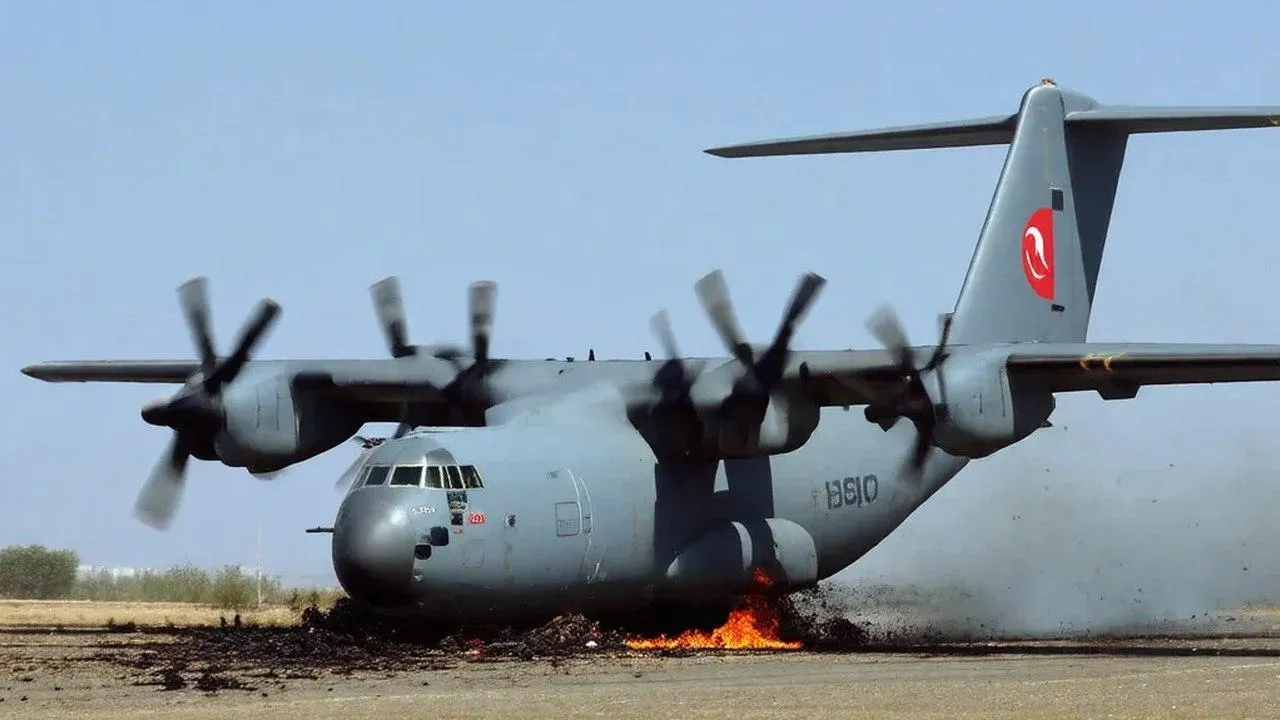
The crash site is uncomfortably close to home—barely 30 kilometers from where I live and just two kilometers shy of the Azerbaijani border. Coincidence? Maybe. But considering the uptick in air traffic lately and those not-so-discreet arms convoys rumbling across the Lagodekhi border crossing—courtesy of companies like Evergreen Freight Forwarding—one starts to wonder: am I not alone in seeing the pattern, particularly the increased number of flights overhead, or is everyone else refusing to see what’s right in front of them?
Official statements from the Georgian government call it a “tragic accident.” And sure, accidents happen. But how often do large military cargo planes just disintegrate mid-air, in broad daylight, with no storm, no enemy fire, no distress signal — nothing?
The Associated Press dutifully reminds us that the C-130 “has many uses,” including the noble transport of “personnel, food, and medical aid.” How generous. Yet in the same breath, we’re told about “increased military deliveries” to Azerbaijan—a country that just so happens to be right across the border. Pure coincidence, again? I doubt it…
The irony deepens. Most plane crashes occur during takeoff or landing. This one? It apparently spiraled down midair, trailing white smoke—as if the plane was literally coming apart. Witnesses describe the tail breaking off entirely, and the video clearly shows both the forward and rear fuselage are missing. But don’t worry, say officials—the investigation is underway.
President Erdoğan interrupted a speech to offer condolences, promising that Turkey will “overcome this crash with minimum hardship.” Azerbaijan’s Aliyev chimed in with sympathetic words. All very proper, very diplomatic. Yet behind the official condolences, one can’t help but ask: what was this aircraft really carrying, or had previously delivered to Azerbaijan?
Turkey’s aging C-130 fleet has been long overdue for upgrades. But when one suddenly drops out of the sky—in a sensitive border zone, amid a flurry of arms transfers—is it just mechanical or structural failure, or something far less accidental? The C-130 is like a Swiss Army knife, as it can be configured for arms shipments, cargo, troops, or humanitarian aid.
Until someone gives a convincing explanation, it’s hard not to ask what’s really going on here—and why does this story not quite add up? The C-130 remains a reliable and versatile platform, a testament to Lockheed Martin’s engineering. When such an aircraft crashes ‘out of a clear blue sky,’ it often points to maintenance lapses, crew error, or operational factors rather than flaws in the aircraft’s original design.
An investigation into the incident is currently underway under Part 4 of Article 275 of the Criminal Code, which pertains to violations of air transport safety or operational regulations resulting in loss of life.
Normally I would just dismiss this plane crash as just a normal, unfortunate accident if it were not for the wider spectrum of things going on, especially in light of more and more arms and equipment being delivered to Azerbaijan, mostly by land, and at land crossings, and in close proximity to where I am living, via the Lagodekehi border crossing. Ironically, considering the real purpose of the C-130 plane, the AP mentions that it has “many uses” and can transport service personnel as well as food and medical aid.
It is also ironic that the media describes Turkish military cargo plane crashes with 20 people onboard as having crashed taking off and not in full flight, spiraling mid-air amid white smoke, as if it was falling apart. Most fatal crashes are on takeoff and landing, not in full flight. Turkish authorities have said at least 20 personnel were thought to be on board, including the flight crew, but the definite number of causalities is still to be announced.
For now, we have to turn to alternative media and social platforms to look for alternative takes on this crash. Could the crash be potentially non-accidental, amid rising tensions in the Caucasus and larger geopolitical moves? Coverage in outlets like Aze. Media and pro-Russian channels emphasize the mid-air breakup as “catastrophic,” speculating on an internal ammunition detonation or external interference, such as electronic warfare or missile strike—though no physical evidence supports these claims at present.
On X (formerly Twitter), posts from November 11–12, 2025, echo this, with users citing witness videos of the plane “disintegrating” and linking it to geopolitical rivalries: Turkey-Azerbaijan’s axis versus Armenia, Russia, or Iran. One analysis questions Israeli involvement, given expanded surveillance activities in the region via Azerbaijan, though this remains unsubstantiated conjecture for now.
Lockheed Martin, the US defence contractor that makes the C-130, a popular military transport aircraft used by many international service forces, expressed its condolences to those affected by the crash. Although it is premature to jump to any conclusions, however, much is open to speculation. The unusual mid-flight dynamics of the crash are accurately depicted and corroborated by multiple sources. The heightened regional arms traffic via Lagodekhi—driven by Azerbaijan’s defense buildup and Turkish support—provides a plausible backdrop for skepticism, particularly given the C-130’s logistical role in such operations.
However, claims of deliberate foul play remain speculative, rooted in pattern recognition rather than hard physical evidence. If true, the lack of a distress call or radar anomalies is suggestive of some possible attack and also aligns more closely with an internal failure in an aging airframe. Alternative media’s emphasis on “disintegration” amplifies intrigue but often overlooks the C-130’s history of similar incidents (e.g., fatigue-related crashes in other fleets).
Until forensic results emerge—expected within weeks—this event underscores vulnerabilities in military aviation amid geopolitical flux, without conclusive proof of conspiracy. Should new details arise, such as cargo manifests or metallurgical findings, they could substantiate or dismiss any conspiracy theories as to why the Turkish C-130 aircraft crashed so spectacularly in Georgia on November 11, 2025, which resulted in the confirmed loss of all 20 military personnel aboard. This crash exemplifies the inherent vulnerabilities of military operations in a region fraught with escalating geopolitical tensions. Amid reports of an in-flight breakup and ongoing investigations, speculation persists regarding potential external interference or internal ammunition detonation, though no definitive evidence has emerged as of November 12.
A further spur to the speculation is the fact that Erdoğan’s government recently issued arrest warrants on charges of genocide for Israeli Prime Minister Benjamin Netanyahu and dozens of other Israeli elites related to the ongoing slaughter in Gaza (the ceasefire is in name only). Needless to say, such an incident 3 days after the charges were announced is highly suspicious, given the very close military and economic ties between the two states, where Azerbaijan supplies the overwhelming majority of Israel’s oil imports, while Israel is a major weapons supplier to Azerbaijan. How hard would it have been for Israel to recruit agents inside the Azeri security and defence forces? Again, for now this is speculation, but it fits with Israel’s long use of sabotage and terrorism against opponents, such as the recent explosive-laden pagers in Lebanon.
Food for thought.
This incident underscores the imperative for heightened vigilance over the increasingly contested skies of the Caucasus, where surging arms transfers and alliances—such as those between Turkey and Azerbaijan—intersect with rival influences from Armenia, Russia, and Iran. Stakeholders must remain acutely aware of worst-case scenarios, including deliberate sabotage or escalation into broader conflict, to foster transparency, enhance aviation safety protocols, and mitigate risks in this volatile geopolitical landscape.
In the interim, the focus remains on honoring the fallen and enhancing safety protocols for allied operations in the region. The fatal crash does seem odd. If they find the black box, will they publish what happened? Or a cover-
up?
Finally, we can only hope that the victims of this crash died quickly, without knowing what was happening to them, rather than suffering the terror of a long fall to earth.
It looks like either a massive structural failure or explosion—and concurrently both!
Jeffrey K. Silverman is a freelance journalist and international development specialist, BSc, MSc, based for 30 years in Georgia and the former Soviet Union
Follow new articles on our Telegram channel
