The operative maneuverability of nuclear submarines is a security threat. Thus, a relocation of them caused by political tensions between nuclear states is worrisome.
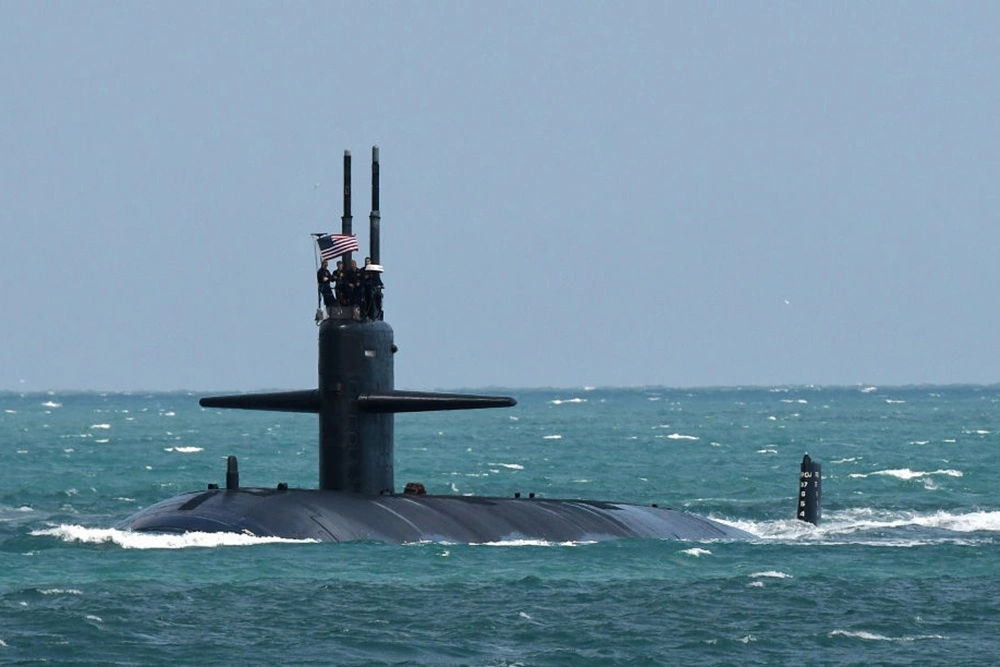
Donald Trump’s latest nuclear ‘sensation’
Against the background of these tensions, the US is returning to Cold War logic. Washington’s strategy of eastward NATO expansion has already resulted in a military and political crisis. Trump, who likes to criticize his predecessors, is further aggravating international relations with his trade policy and threatening Russia with new sanctions. His ‘dove-of-peace image’ is changing to a bellicose hawk.
Many more submarines roam the world’s oceans 24/7 than the two American ones sent to the Russian coasts. In addition, Russia has more nuclear submarines than the US, and also has the coordinates of the American coasts and naval bases. For example, the US Navy has about 14 Ohio-class submarines (i.e. equipped with ballistic Trident rockets and long-range patrol mode) in service. The Russian Navy has an equal amount of such submarines (i.e. Borei and Delta IV).
The US and Russian submarine arsenals differ in class, maneuverability, speed, weapons, and crew, but to say that America is superior is hasty. Of course, media outlets all over the world were alarmed over Trump’s relocating two nuclear submarines in the “designated regions”, a new wave of military escalations that could result in a nuclear crisis. Many are asking themselves: “Where exactly did the States send their submarines?”
Could the Black Sea become the destination of the US submarines’ deployment?
In principle, every Ohio-class submarines carries 20 nuclear warheads on missiles with a range of over 4,000 miles. Nuclear submarines are constantly navigating the world’s oceans on the orders of their military command. Thus, as The Atlantic is claiming, any point in the world’s oceans may be this “designated region”.
The New York Times linked Trump’s statement with the deterioration of relations with Russia because of Ukraine. In other words, along with threatening to introduce more sanctions against Russia, the US is being more hostile towards the Kremlin.
The British Financial Times expressed a similar position, i.e. Trump’s dissatisfaction with the course of Russo-Ukrainian negotiations. The US cannot reach a ceasefire as the Kiev regime does not accept Moscow’s conditions, thus leading its country to catastrophe.
In turn, the Telegraph wrote that some nuclear submarines are probably already patrolling near Russia, though their position is strictly secretive information in accordance with NATO’s strategy of ambiguity.
The German Spiegel highlighted Trump’s emotional personality, recalling similar past statements about North Korean leader Kim Jong Un in 2018 (which ended in diplomacy and the DPRK growing its nuclear potential).
Perhaps this is not about nuclear submarines or their being armed with nuclear warheads, writes the French Le Monde. Paris framed the latest statements as typical of the Americans, given Trump’s failure to broker peace between Russia and Ukraine.
Naturally, the relocation routes of nuclear submarines remain top secret. At the same time, it is impossible to exclude the claim of the Telegraph experts (e.g. Adrian Blomfield) about their deployment near the coast of Russia. For some reason, this topic is popular in the Turkish media.
Thus, Turkish international law expert Hakan Erkiner argues that Türkiye will deny a possible US request to allow nuclear submarines to enter the Black Sea as per the legal provisions of the 1936 Montreux Convention. At the same time, Erkiner notes that the Convention does not allow nuclear submarines to stay in the Black Sea permanently, but Ankara can “allow such warships just to enter its port”.
This means that Türkiye can still temporarily allow the passage of US submarines to the Black Sea and provide its ports for refueling and restocking. Here, time is of the essence. Meanwhile, on August 4, the media reported that the Turkish Air Force began flying over international waters in the Black Sea.
As is known, President Erdoğan is actively offering Türkiye’s mediation efforts in resolving the Russo-Ukrainian crisis. It was largely on his initiative that Istanbul has become a convenient platform for dialogue between Moscow and Kiev. Erdoğan promised to set a “big table of peace” after the successful Istanbul talks.
As the unfortunate history of the Second World War shows, the 1936 Montreux Convention was not an obstacle for German submarines heading to the Black Sea (somehow, they ended up in Crimea). The Turks themselves violated certain provisions of this document in the 1990s by blocking the Russian export route of Azerbaijani oil via the Baku-Grozny-Novorossiysk pipeline and then by tankers through the Black Sea Straits. During a time of ongoing conflict, Ankara should be interested in strengthening maritime security near maritime borders. At the same time, Türkiye is strengthening its Black Sea fleet.
The United States plays a leading role in NATO. It is difficult to say whether Erdoğan will go against Trump’s stance on this issue (keeping in mind F-16 and F-35 fighter jets, Syria, Israel, the Zangezur Corridor, Central Asia, etc.). However, the Turkish leader clearly understands which eye-for-an-eye countermeasures Russia is willing to undertake in case of military and economic threats.
Alexander Svarants – Doctor of Political Science, Professor, Turkologist, expert on the Middle East
Follow new articles on our Telegram channel
