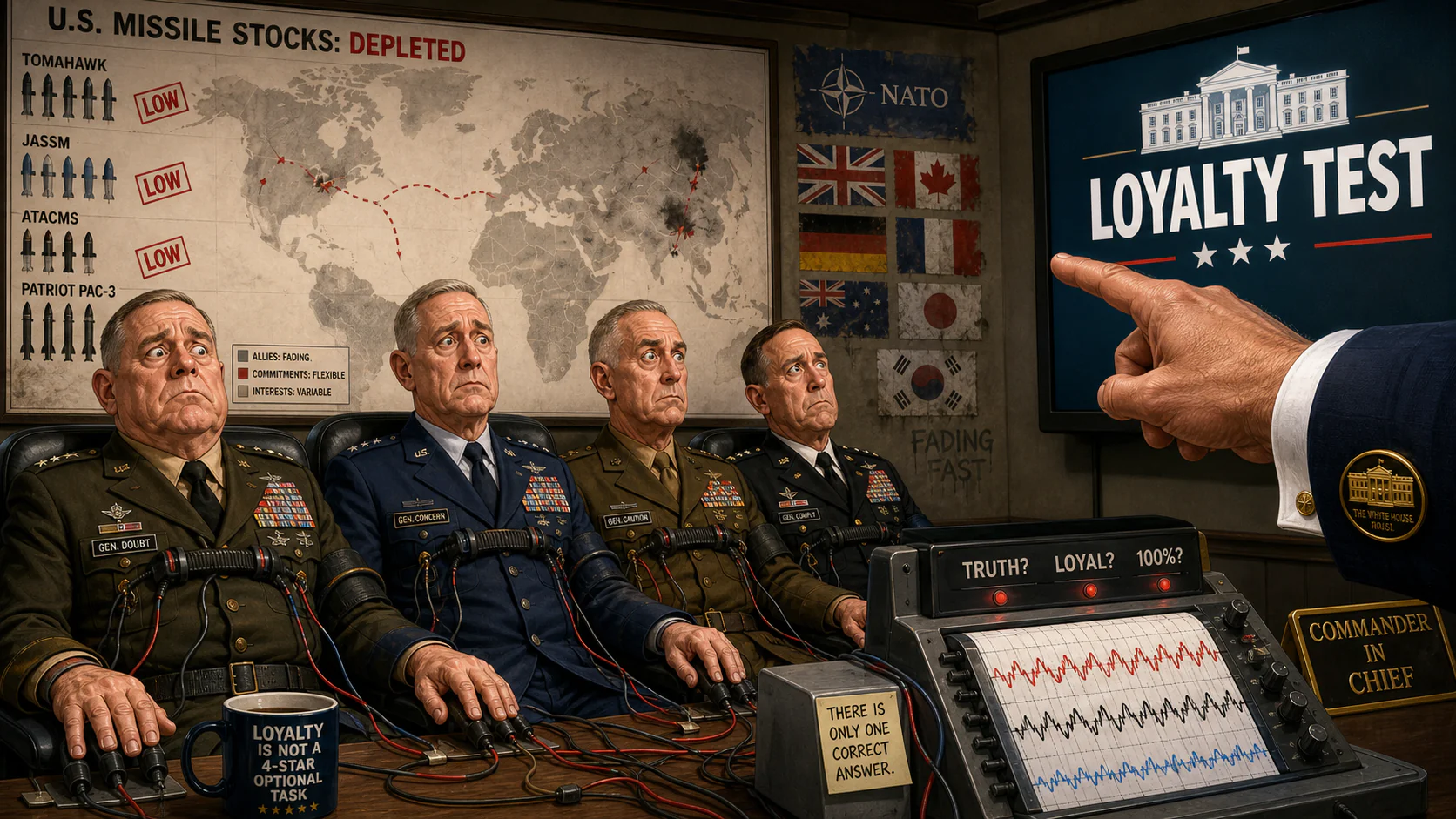
The Pentagon’s extraordinary use of polygraph tests on senior military personnel is not merely a hunt for leakers; it is a warning that loyalty to the president may increasingly matter more than loyalty to the institution, accelerating the ultimate American downfall.
When Loyalty Becomes the Test
But the significance of the episode lies beyond the polygraphs themselves. The people being investigated are part of the institution responsible for advising America’s political leadership about the country’s military capabilities and limitations. If officers begin to believe that communicating unwelcome assessments can expose them to investigation, career consequences, or accusations of disloyalty, the problem is no longer simply the protection of secrets. It is the quality of military advice reaching the president. Ultimately, it is about the extent to which America can actually use military power to achieve its foreign policy objectives.
This distinction is fundamental to healthy civil-military relations. Civilian control requires the military to obey lawful orders. It does not require professional officers to agree with every policy decision. Indeed, the value of a professional military bureaucracy is partly that it can tell political leaders when an operation is becoming strategically costly, or operationally difficult or impossible to sustain. That principle appears increasingly strained under Defense Secretary Pete Hegseth. At least 20 generals, admirals, and senior civilian defense officials have departed their positions since he became secretary, including the Army’s, Navy’s, and Air Force’s highest-ranking officers. Some were fired; others were forced into early retirement or resigned.
The turnover by itself does not prove politicization. Presidents have always replaced senior commanders, and secretaries of defense have always reorganized the Pentagon. But the pattern matters. It has occurred alongside an aggressive effort to reshape the senior officer corps, investigations into suspected leaks, and a public emphasis on ideological and personal loyalty. The danger is therefore not that the military will refuse civilian authority. It is almost the opposite: that officers will become increasingly reluctant to challenge civilian authority even when professional judgment demands it. Military leadership that follows orders is necessary. Military leadership that tells the president only what it thinks he wants to hear is not.
The Limits of American Power
The irony is that this pressure on professional military advice is occurring at precisely the moment when Washington needs it most. The war with Iran has exposed the material limits of sustaining that power over time. Senior military commanders have reportedly warned Hegseth that continuing large-scale operations in the Middle East risks weakening US capabilities elsewhere. This does not mean that American military supremacy is necessarily disappearing. The more important problem is sustainability.
Military power is not simply the ability to destroy targets. It is the ability to continue doing so while replacing what has been consumed, maintaining readiness elsewhere, and preparing for the next crisis. A missile fired today is unavailable tomorrow. An aircraft carrier committed to one theater cannot simultaneously reinforce another. Air-defense interceptors used in one conflict cannot protect forces in another. America’s global strategy has increasingly assumed that it can do all of these things simultaneously. The Iran war is testing that assumption, putting the US military under a stress that it has not experienced before—and it is failing. That matters not only for the United States but also for every country that depends upon American military strength.
When Alliances Become Transactions
The international consequences are already becoming visible. American global power has never rested on military capabilities alone. Since 1945, Washington has multiplied its power through alliances. NATO, bilateral security treaties in Asia, intelligence partnerships, overseas bases, and arms relationships have allowed the United States to project power on a scale no other country can easily replicate. But alliances require confidence that American commitments are durable and predictable. That confidence is being tested by the Trump administration’s increasingly transactional approach to allies. This approach is directly linked with the massive crisis the US is facing between the White House and the Pentagon.
On September 3, Trump said the United States would seek reimbursement from European countries for military aid and munitions previously supplied to Ukraine. He criticized the earlier provision of assistance without payment and said that Washington was temporarily prioritizing rebuilding its own munitions stocks, although weapons sales to allies would resume.
There may be nothing unreasonable about demanding greater European defense spending. The problem is the distinction between burden-sharing and retroactive billing. Burden-sharing strengthens an alliance because it treats security as a collective responsibility. Turning military assistance into a bill risks redefining the alliance as a commercial transaction. That distinction could have lasting consequences. European governments already understand that they cannot assume unlimited American resources. If Washington simultaneously signals that American weapons may be withheld because US stocks are depleted and that allies may eventually be asked to reimburse Washington for previous assistance, European states have an obvious incentive to invest more heavily in their own defense industries and capabilities. The problem for the US is that the more allies learn to defend themselves without relying on Washington, the less central the United States becomes to their security.
And Europe is not the only audience. Japan, South Korea, Australia, and other US partners will be watching how Washington manages the tension between American military commitments and domestic requirements. This is where the Pentagon crisis becomes a global problem. The United States can replace weapons. It can expand defense production. It can appoint new generals. It can reorganize the Pentagon. What is much harder to rebuild is institutional credibility and allied trust.
If personal loyalty becomes an increasingly important criterion for advancement inside the Pentagon, the costs may therefore extend well beyond Washington. Great powers do not lose influence only when their rivals become stronger. They can also lose it when their own institutions become less trusted, and their partners begin preparing for a future in which they may no longer be able to rely on them. The question facing Washington, then, is not simply whether Trump’s Pentagon can enforce regime loyalty. It is whether a military built around loyalty to one president can continue to provide the professional judgment, institutional continuity, and allied confidence on which American power has depended for generations.
A superpower can survive disagreement among its generals. It is far less certain that it can survive a world in which its generals fear disagreement, and its allies begin planning for a world without unquestioned American reliability.
Salman Rafi Sheikh, research analyst of international relations and Pakistan’s foreign and domestic affairs
Follow new articles on our Telegram channel
