When strategic chokepoints become battlegrounds, regional wars quickly become global crises. The attack on Egypt’s port signals that maritime security is no longer collateral damage—it is the new frontline of geopolitical competition.
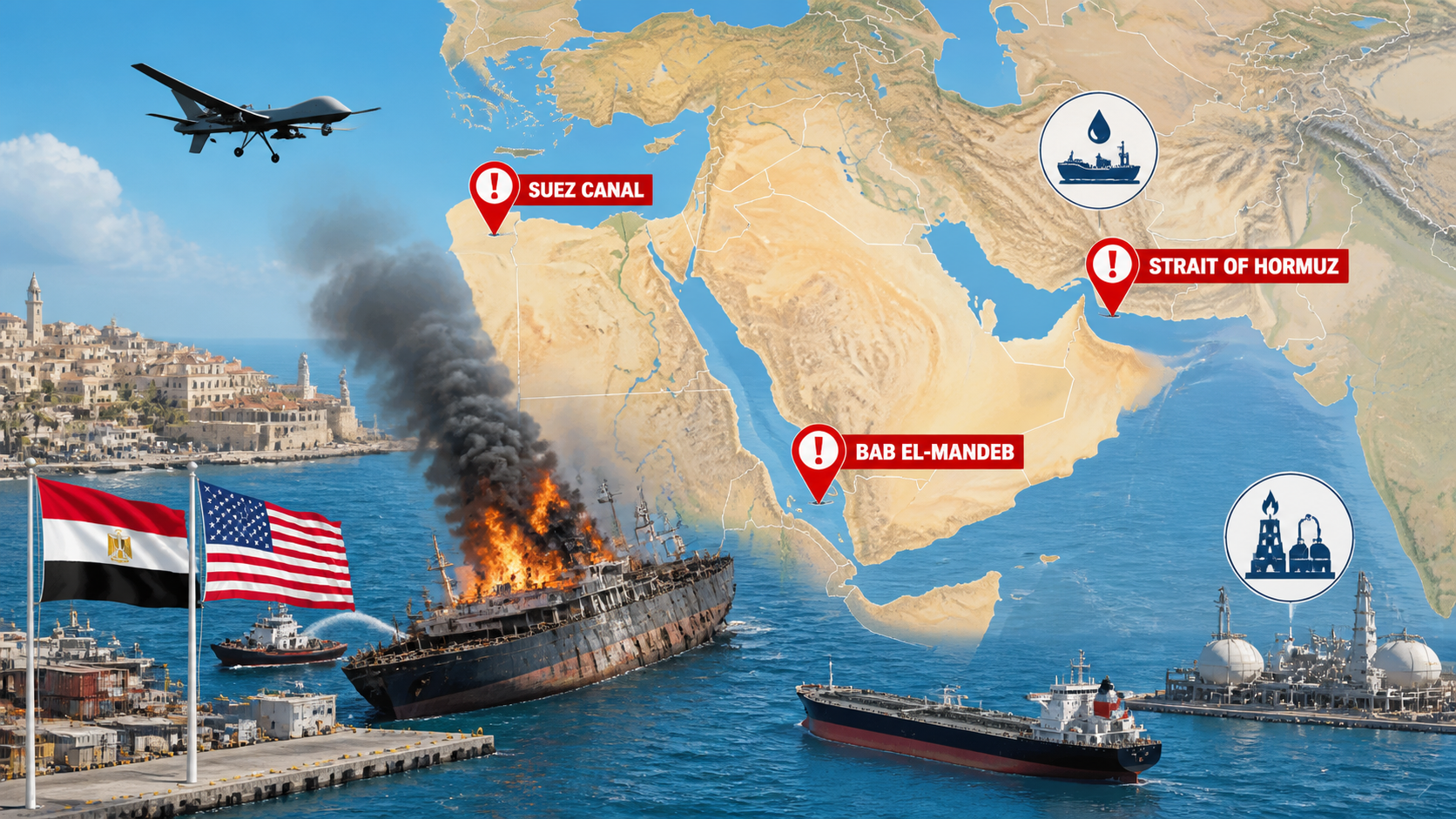

The latest attacks indicate that this conflict is now spilling into one of the world’s most strategically important maritime regions, threatening global trade and regional stability.
Attack on Damietta
On 29th July 2026, the British maritime security company, Ambrey, reported in a preliminary assessment that a drone attacked the floating storage unit called Energos Winter, which is owned by an American company and registered in the Marshall Islands. The attack took place at the Damietta port, causing a fire that damaged another ship called GasLog Salem. The Wall Street Journal highlighted that there were some unconfirmed reports about the attack being attributed to Iran by the Egyptians, who consider it an attempt to extend the conflict.
The same thing was reported in The New York Times, and they quoted unnamed Iranian officials stating that the attacks were conducted using Iranian drones as a signal to show how Tehran can disrupt international energy supplies if the conflict escalates. However, these anonymous sources did not clarify whether the attacks were conducted directly or through a proxy. There have also been suggestions by Israeli sources that Iran and their proxies may want to be involved in an extended conflict, evidenced by the first strike against Egypt.
Why Do Egyptian Ports Matter?
“Geography is the most permanent factor in foreign policy.” (Nicholas Spykman)
In the Middle East, three significant trade passages or waterways are present, which hold the burden of the global maritime trade. These include the Strait of Hormuz, the Bab el Mandeb Strait, and the Suez Canal. All these maritime routes help connect Asia to Europe. However, due to the ongoing US-Iran war, both the Strait of Hormuz in the Persian Gulf and the Bab el Mandeb Strait in the Red Sea are vulnerable to attacks.
Hence, the only remaining ‘safe’ route left was the Suez Canal. Countries from the Gulf region, such as Saudi Arabia, had already started to use alternate routes in order to send their oil supplies to Europe through the Suez Canal, trying to bypass the Strait of Hormuz completely. The terminal at the Port of Damietta in Egypt helps the country convert extra natural gas into liquid form and export it through the maritime channels to places that aren’t accessible through pipelines.
What Do the Attacks Reveal?
The current instability in the Middle East is increasingly economic in nature rather than purely military. What the US wanted to do against Iran, it has already done. From killing the top tier of Iranian leadership to destroying its energy facilities and civilian infrastructure, the US has achieved its main objectives already. Now, the entire focus is being placed on the economic security of the region where conflicting parties are now vying for influence. The US is trying its utmost to enable and support its Middle Eastern partners to establish new routes that work as an alternative to the Hormuz.
Additionally, the Syrian foreign minister also met with Iraqi Prime Minister Ali Al-Zaidi on the margins of his recent visit to Washington. A strategic accord between the two was reached under the supervision of the United States. Both countries are now devising new pipelines and trade routes.
The Gulf States are also doing the same. KSA is focusing on reviving its East-West or North-South pipelines but faces continuous attacks by the Houthis. While Iran has taken strict control of the Strait of Hormuz to maintain its post-war superiority in the region. Thus, in this situation, an attack against Egyptian ports is a strategic signal that the conflict is evolving from territorial warfare into competition over strategic nodes or chokepoints.
Egypt’s Response and Strategic Dilemma
Egypt is walking a diplomatic tightrope. It’s trying to protect its strategic assets without being dragged directly into the expanding regional conflict. As per the Egyptian cabinet, the fire at the liquefied natural gas facility in the Damietta port has been successfully contained without any casualties reported. The cabinet further added that the initial investigation revealed that the fire that broke out on the two vessels was the result of a drone, and that no one has claimed responsibility for the act. Egypt has been playing the role of mediator during the US-Iran conflict since it has been on good terms with all the warring parties. It was Egypt that provided an alternative channel of communication for both Iran and the US following the assassination of the Iranian national security chief, Ali Larijani.
Iranian Perspective and Strategic Fallouts
Just after the drone attack at the Egyptian port, Iranian Foreign Minister Abbas Araghchi warned, “Egypt is an important friend and partner in the region. Its security is of utmost importance to us. We must all be vigilant against Israeli plots and false-flag operations designed to undermine regional peace. The threat is clear, mutual, and fearful of Muslim solidarity.” This statement by Aragchi clearly shows that Iran has denied any involvement in the attack, which means the US and Israeli media outlets are propagating fake narratives to light the fire in the region against Iran.
Such attacks on Egypt or any party not involved in the war carry far-reaching regional and global consequences. From the regional perspective, the risks posed by such activities include the potential for increased instability in the Red Sea region by encouraging attacks from the Houthis, heightening tensions between Israel and Iran, and increasing military operations along critical maritime zones. From the global perspective, the risks involve rising shipping insurance rates, energy prices, and increased US naval patrols.
The real question is, who bombed the port? Iran gains nothing from extending the war and has been making active efforts to be sincere in all justified ceasefire efforts. Trump also stands to seemingly gain nothing from extending the war, since he is already under fire for reneging on his ‘no new wars’ promise. Moreover, it seems like he is always trying to find a way to end the war on his own terms so that he can play the hero.
The only player who seemingly stands to gain from the instability in the Middle East is Israel, a country that is actively bombing both Palestine and Lebanon, under the guise of fighting Hamas. The more instability in the Middle East, the weaker Israel’s opponents. And what better way to further destabilise the region than to conduct false flag attacks on countries that aren’t an active part of the conflict?
Conclusion
Historically, wars are more likely to spill over not as a result of crossing the borders by an army, but due to a strategic infrastructure being attacked. Attacks against the Egyptian port constitute an escalatory act, which, if not solved, will eventually become a catastrophe for the whole region. These attacks emphasise the continuously growing vulnerability of ports and strategic chokepoints around the globe.
The need of the hour is stronger diplomatic efforts from all sides, so that the spillover is contained. The effects of this war have spread across the world in terms of instability and rising inflation, and a permanent ceasefire is the only thing that can stabilise the world economy.
Aleena Im is an independent researcher and writer and is interested in international relations and current affairs
Follow new articles on our Telegram channel
