The Bab el-Mandeb crisis represents a broader transformation in modern warfare, where disrupting maritime trade and global supply chains has become as strategically significant as conventional military operations, requiring new legal, diplomatic, and security responses.
From Battlefields to Shipping Lanes
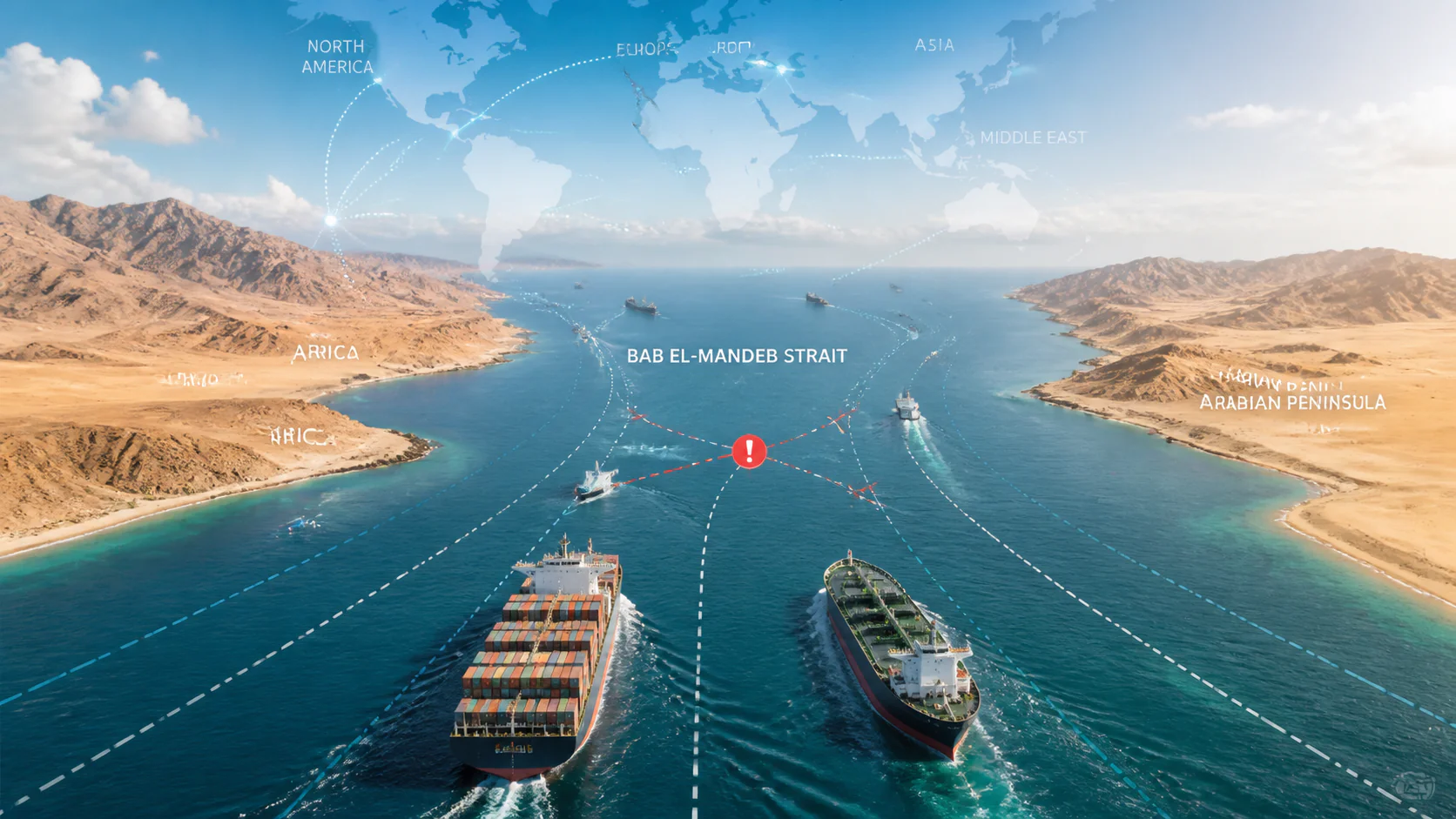
Bab el-Mandeb is one of the most significant maritime trade routes. Normally, around 14 percent of annual global maritime trade, with fossil fuels accounting for the majority, passes through the Bab el-Mandeb Strait. According to the International Energy Agency (IEA), in 2025, around 4.2 million barrels of oil and petroleum liquids per day passed through the Bab el-Mandeb Strait. This accounts for approximately 6 percent of all seaborne global oil shipments. The Houthi threat has garnered global attention because the world is already grappling with an energy crisis and inflation due to the blockade of the Strait of Hormuz, a maritime route that carries around 20 percent of global energy trade.
Maritime Chokepoints as Instruments of Economic Coercion
For the first time in modern history, both maritime chokepoints are under sustained assault simultaneously. As per estimates, the concurrent maritime disruptions in both these straits would block around 25-26 percent of global oil supplies and threaten up to 30 percent of global container shippers. Moreover, the partial blockade of the Bab el-Mandeb Strait will further increase the insurance premiums, raise transportation costs, delay energy deliveries, and disrupt global maritime supply chains. All these factors would not only amplify the global energy crisis but also lead to increased global inflation, as globalization has made these routes indispensable, making them a strategic tool for geopolitical pressure, especially in asymmetric warfare.
This demonstrates that maritime chokepoints are becoming strategic battlegrounds in modern warfare. In traditional wars, countries attacked cities, territories, and military bases. However, recent trends show that modern conflicts increasingly target ports, pipelines, undersea cables, logistics, financial networks, and shipping routes, marking a significant transformation in warfare. All these factors illustrate that in modern warfare, the actual ambition of the warring parties is not to destroy targets but to increase economic costs to secure their interests. Due to rising global inflation and the energy crisis, the Trump administration is already facing domestic and international pressure both from allies and rivals to end the war. Even a partial blockade of the Bab el-Mandeb Strait will increase this pressure to an unprecedented level.
The Legal Vacuum in Modern Maritime Conflict
The recent transformation in modern warfare has raised serious concerns over international security. With this renewed threat, the Houthis have exploited ambiguities in international maritime laws, especially the 1856 Declaration of Paris and the San Remo Manual. These laws and rules were developed with only states in mind. Therefore, they fail to address the actions of non-state actors. The partial blockade of the Bab el-Mandeb Strait by Houthis raises serious questions over jurisdiction, accountability, and the nature of the response to cool down the escalating situation. A military response to this potential blockade could trigger an escalation that would engulf the whole region.
Rethinking Maritime Security in an Interdependent World
The transformed nature of modern warfare indicates that this is the right moment for strategic clarity regarding maritime security. New maritime legal frameworks are a necessity given the current situation and crisis. However, any new mechanism must be tailored with greater caution and inclusivity. A Western-imposed global maritime law will neither be acceptable to Russia and China nor to the rising middle powers. Moreover, only developing new maritime rules and laws will not suffice, as the root cause of all these threatening developments is the United States’ unilateral aggression and interventionist attitude that led the entire Middle East to instability, violence, and chaos. Therefore, international organizations need to play a critical role in addressing the root cause of this conflict.
In addition, the structure of international institutions and organizations also needs to be changed. All states must be given equal rights. Moreover, an international consensus and framework are mandatory to prevent aggressive states like Israel and the United States from violating the sovereignty of other states. The world also needs to increase diplomatic pressure on the Trump administration to end this unnecessary war. US citizens also need to play their role, as the impacts of this war are being felt in every home, even in the United States. The world also needs to realize that the ongoing escalation in the Middle East has global economic implications.
Аbbas Hashemite is a political observer and research analyst for regional and global geopolitical issues. He is currently working as an independent researcher and journalist
Follow new articles on our Telegram channel
