The fragile ceasefire between the US and Iran, based on mutual control of the Strait of Hormuz, coupled with relentless economic and political pressure, is creating a protracted war of nerves. This scenario threatens to further destabilize the region, with no clear winner in sight.
The Red Line and the Horizon of Expectations in the Persian Gulf
In Tehran, they compared the attack to “a surgical strike that hit armor.” Not only did Iran endure—it responded in a way that left American strategists breathless. The strikes on U.S. bases in the region were precise, harsh, and, more importantly, public. Iran didn’t hide behind proxies. It showed it could strike directly and accurately.
The war, however, ground to a stalemate. Neither Washington nor Tehran was ready for a full-blown confrontation that would incinerate the entire Persian Gulf. And so a fragile, anxious ceasefire was born—no smiles, no guarantees, but with clear rules of engagement. The most important of them: dual control of the Strait of Hormuz. From now on, tankers carrying the world’s oil can only pass through the strait under joint U.S.-Iranian military supervision. Neither side can block the strait alone, but neither can move a vessel without the other’s knowledge. This isn’t peace. It’s a tug-of-war at thirty meters underwater.
The result was immediate. Global oil prices skyrocketed as if hit by a bomb. Experts are calling the new benchmark “psychological”—$120–$130 a barrel and rising. The economies of Europe and Asia began to grind, but Trump, as they say in Washington, is just smiling: “American oil is back in the game.”
What the Leaders Are Saying: Barbs, Threats, and Stakes
Trump, as always, is terse and provocative. In an interview with Fox News after the ceasefire was established, he dropped a line that global media has since plastered everywhere: “I don’t want a war with Iran. They don’t want a war with me either. But Hormuz is our shared parking lot. The Iranians and I now take turns patrolling it. And you know what? As long as prices are high, America is fine. Let Europe pay.”
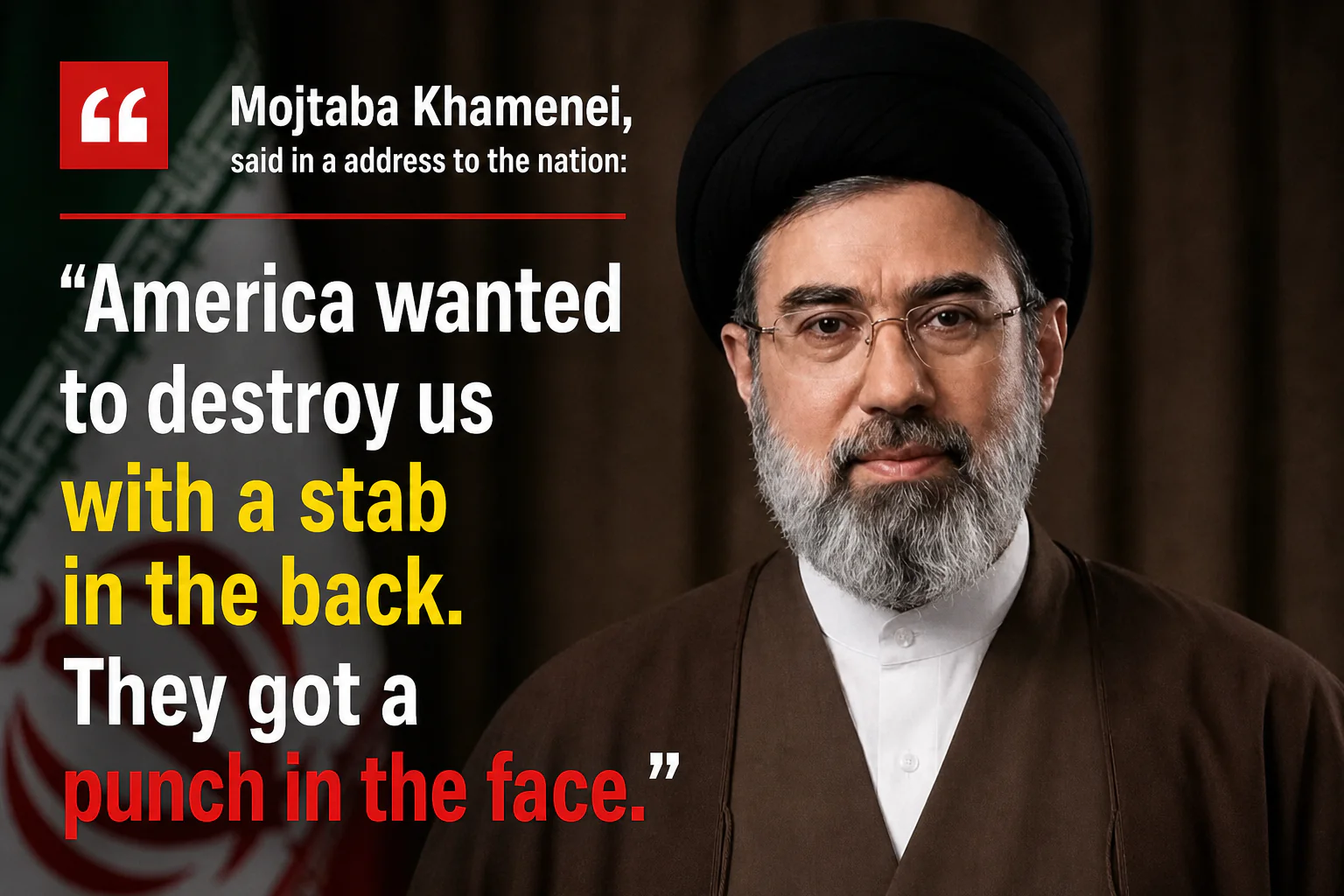
Tehran fired back just as sharply. Iran’s Supreme Leader, Mojtaba Khamenei, said in an address to the nation, “America wanted to destroy us with a stab in the back. They got a punch in the face. Today, the U.S. Navy sails in the Strait of Hormuz only because we allow it. Tomorrow may be different. The Persian Gulf will not be an oil lake for the West. It will become either a grave for their arrogance—or a gateway to fair trade. Their choice.”
Iran’s oil minister, commenting on the price spike, smirked in a semi-official channel: “You say we raised prices? You’re the ones who bombed our ports. Now buy our oil through third parties. And yes, dual control isn’t a whim. It’s the armor we’ve put on the strait. We’re not taking it off.”
In the corridors of the UN, there’s talk that the two sides are already secretly discussing a “reverse deal of the century”: freezing Iran’s nuclear program in exchange for lifting sanctions and granting the U.S. sole control of the Strait of Hormuz. But for now, that’s just rumors. On the surface—silence. Beneath the surface—nuclear submarines and Iranian ghost boats.
The main takeaway today isn’t who won. It’s that Iran’s new leader is alive, and Iran itself has held its ground with dignity. Trump isn’t ready for another strike, and the global economy is paying the price for someone else’s war. And it looks like they’ll be paying for a long time.
Middle East 2026: Trump squeezes, Iran zigzags, and the world holds its breath at Hormuz
It feels like just yesterday analysts were arguing over whether Donald Trump would actually launch a military operation against Iran. Today, the question is different: what economic suffocation tactic will he use next? Together with experts, we’ve broken down the White House’s 2026 plan—and it really does look like a chess game, with pawns scattered all across the Persian Gulf.
But let’s take it step by step. Have you noticed how sharply Iran’s oil exports have dropped? Down to a pathetic 300,000 barrels per day. That’s no accident—it’s the first item on Trump’s strategy, which can be called “economic strangulation plus.” Not only has Washington frozen the assets of Iran’s central bank, but even the crypto wallets of the Islamic Revolutionary Guard Corps (IRGC) have been hit. And Tehran had been hoping to use crypto to bypass the old sanctions.
Now here’s the really interesting part. Trump has decided not just to pressure Iran, but to force major players to choose sides. Beijing has received what is essentially an ultimatum: cut your purchases of Iranian oil by 80%—and you’ll get trade preferences with the U.S. Refuse—and you’ll face blocking tariffs. China, as you can imagine, is caught between a rock and a hard place. Will it want to trade stable oil flows denominated in yuan for dubious bonuses from the White House? That’s a rhetorical question, but that’s precisely Trump’s goal—to sow discord between Tehran and Beijing.
Now picture this: explosions echo through Shiraz—drone factories destroyed. In Natanz, centrifuges are paralyzed by a massive cyberattack. And this isn’t all-out war—just “demonstration strikes.” As they say in the Pentagon, the goal isn’t to destroy the regime, but to raise the stakes before final negotiations. And yes, the strike on Qeshm Island, Iran’s main oil terminal, has already happened. The message has been sent: we can hit any target.
And yet, Trump is leaving Tehran a loophole. Through intermediaries, a proposal has been passed along: freeze uranium enrichment at 3.67%, dismantle the advanced IR-9 centrifuges—and we’ll lift sanctions on food, recognize the IRGC’s influence in Iraq and Syria. But oil sanctions will stay. The Iranians understand perfectly well: without oil revenues, any “breathing spell” would be a slow death. That’s why they won’t agree.
So why can’t the U.S. keep up the pressure indefinitely? The answer lies in the political calendar. The 2026 midterms are a red line for Trump. If by November he can’t show voters a “peace deal” and gas prices at the pump spike because the Strait of Hormuz gets shut down, his majority in Congress will collapse. No one wants to lose their seat over faraway ayatollahs.
Moreover, Trump has Israel breathing down his neck. Tel Aviv is demanding that new, harsh “red lines” be set. If the U.S. president backs down from a military operation, the Israelis might strike on their own—and then the U.S. would be automatically dragged into the conflict by its alliance obligations. That’s a whole different scenario.
And finally, the main spoiler: China. If Beijing ignores the ultimatum and even increases its purchases of Iranian oil in yuan, the whole blockade collapses. Trump will be left looking like a man who slammed the door loudly, only to step out into an empty room.
The View from Tehran: Resistance Through Escalation
Now let’s look at the situation through Tehran’s eyes. They’re not just sitting around waiting.
Iran’s Supreme Leader concluded long ago that deals with the West are temporary, but nuclear technology is forever. So for them, Trump isn’t a negotiating partner—he’s a tactical adversary to be waited out. The Iranians learned the lesson of Libya: give up your nuclear program, and you lose everything. That’s why they operate on the principle of “resistance through escalation.”
What does that mean in practice? First, Tehran could withdraw from the Non-Proliferation Treaty (NPT) and start enriching uranium to 90%—weapons grade—but without physically testing a bomb. The status of a “threshold state” provides a strange kind of immunity: you’re not quite a nuclear power, but no one dares to deliver a knockout blow because the bomb could officially appear tomorrow.
The second front is the “axis of resistance.” Proxy attacks on U.S. bases in Syria and Iraq, direct strikes on Saudi Arabia’s oil infrastructure and other regional countries, mayhem in the Strait of Hormuz. The Iranians know full well: if tankers can’t get out of the strait, the price of oil will go through the roof—and Trump will get the blame.
And how do they survive economically? Here, Tehran is drawing on the experience of blockaded nations: barter with Russia, Venezuela, and China using cryptocurrencies. Iran’s elite is betting that Western sanctions fatigue and rising energy prices in the winter of 2026–2027 will force Trump to the negotiating table. America will get tired of all this pressure, right?
And finally, the last point of Iran’s strategy: negotiations only at gunpoint. Tehran will agree to dialogue only if all banking sanctions are lifted and it is readmitted to the SWIFT system. Trump won’t go for that—so the Iranians will bide their time and push toward the nuclear threshold. They have nothing to lose except the regime itself.
Where is the breaking point? For the U.S., it’s Trump’s political death in the event of a prolonged crisis. For Iran, it’s the regime’s survival. Unemployment is already at 35%, and inflation is at 70%. If domestic protests merge with external pressure, the IRGC could lose control of the streets. Then it won’t be about centrifuges anymore.
That’s why Tehran’s main hope isn’t military success—it’s time. A split in the West (Europe, by the way, is already tired of depending on the U.S.). The 2028 U.S. presidential election. Outlasting Trump—that’s their real bet.
So what’s the bottom line? The world is on the brink not of a classic war, but of a war of nerves, where every move is an ultimatum, every pause is covert enrichment, and a stray spark in the Strait of Hormuz could set the entire region ablaze. The outcome of this game will be decided not by any general staff but by three things: whether America tires of applying pressure, whether Iran can withstand the squeeze, and whether China manages to stay on the sidelines.
Flashpoints: Three Possible Scenarios for 2026
Scenario A: “Deal on the Edge” (40%). Trump and Tehran cut a deal through intermediaries: Iran stays in the NPT and reduces enrichment to 20% in exchange for food and aviation spare parts. The U.S. recognizes Iran’s regional interests, but oil sanctions remain. A fragile peace until the next election.
Scenario B: “Cold War in the Middle East” (45%). The status quo holds. Iran is a threshold state without a bomb. The U.S. bolsters its presence in the UAE and Bahrain. Regular skirmishes, cyberattacks, strikes on proxies. Iran’s economy slowly degrades, but the regime hangs on. Trump announces “strategic deterrence” and pivots to China.
Scenario C: “War” (15%). Trigger: Israel strikes the Fordow nuclear facility, Iran blocks the Strait of Hormuz, and the U.S. launches Operation “Margin of Safety.” An air campaign against nuclear sites and air defenses. Iran responds with missiles targeting U.S. bases in the region. The conflict lasts 2–3 weeks and ends in a tactical U.S. victory without regime change. Iran’s nuclear program is set back five years, but Trump’s approval ratings suffer due to casualties.
The Persian Gulf and the Paradox of 2026
The future of U.S.-Iran relations is paradoxical: both sides are afraid not of losing, but of winning. Trump doesn’t want a Middle Eastern war that would ruin his legacy. Tehran doesn’t want to become another Iraq, even with a threshold bomb.
A war of attrition is the most likely outcome. The U.S. hopes Iran’s economy will collapse first. Iran hopes the U.S. political cycle will work in its favor.
The only thing that can be predicted with certainty is that by the end of 2026, neither side will have gotten what it wants, but both will be closer to the abyss than ever before. And the main beneficiaries will be the back-channel diplomats in Doha and Muscat—and, of course, the weapons manufacturers in the West, especially in the United States.
Viktor Mikhin, writer, Middle East expert
Follow new articles on our Telegram channel
