How will the third Russia-Africa Summit, scheduled for this fall in Moscow, differ from the previous ones? What are the reasons for the overall decrease of Russian exports to Africa despite political successes? How likely is it that the West, after the failure of the plan to “deal Russia a strategic defeat,” will actively try to regain its positions in Africa?
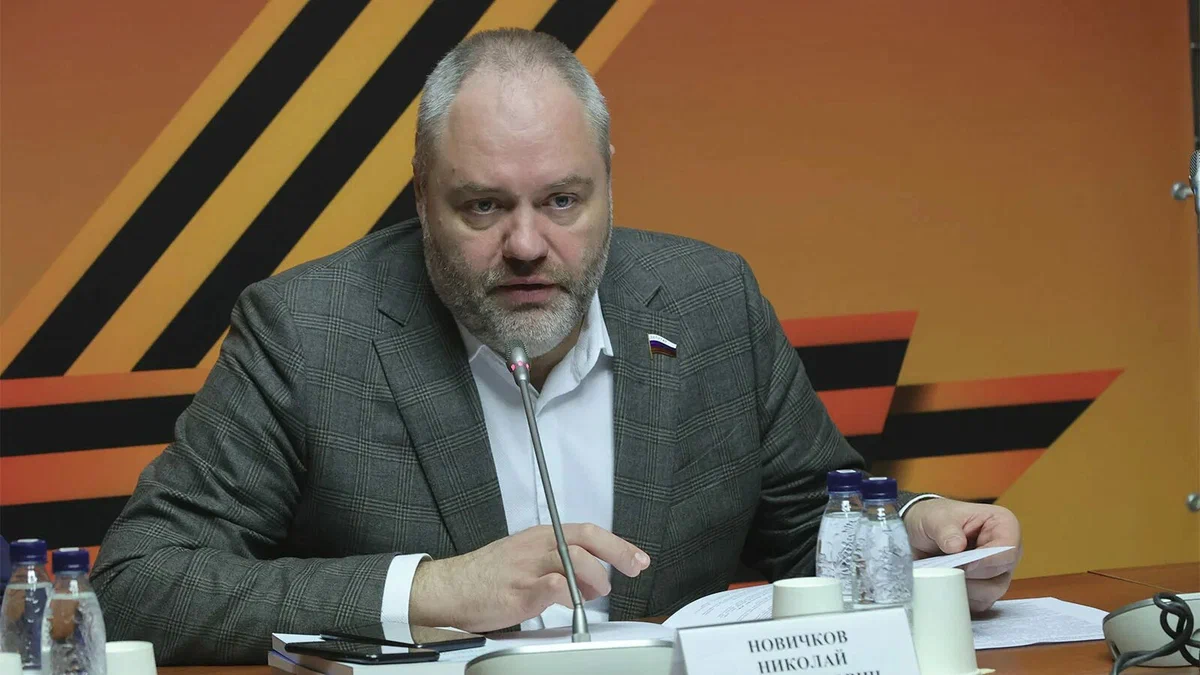
– Mr. Novichkov, the Expert Council on the Development and Support of Comprehensive Partnership with African Countries has been operating in the State Duma for several years now. To what extent has its work during this time become a real instrument of influence on policy, rather than just an expert platform? What legislative initiatives or systemic solutions aimed at strengthening relations with Africa have been implemented through it?
– The Expert Council is a platform for exchanging opinions, located within the State Duma, and it is necessary for systematizing and harmonizing the legislative framework. The Council covers relations with the entire African continent, and we have held countless meetings, roundtables, and expert sessions. I am confident that the very opportunity to create an effective space for dialogue is already an achievement.
Over the past 30 years, we have largely lost the African agenda. By this I do not mean the broader public; even at the expert level, at the level of decision-makers, people generally do not realize what is happening on the African continent, what the priorities are, where it is heading, and so on. For example, not everyone knows that the population of Africa has exceeded 1.5 billion people. For us specialists, this is not news, but some people are surprised by these figures.
What does one and a half billion people mean? On the one hand, they are consumers, a huge market; on the other hand, this represents vast human capital that allows for the creation of new industries, new knowledge, and new opportunities.
We truly do have a lot of work, and being at the heart of Russian-African affairs and influencing what happens is a complex task and an enormous responsibility.
– This fall the third Russia-Africa summit will take place in Moscow. The first one in Sochi was largely exploratory in nature and aimed at restoring dialogue, and the second one in St. Petersburg took place under unprecedented sanctions pressure and focused on breakthroughs in the economy and food security. What will be the key objectives of the upcoming summit? How will the third summit fundamentally differ from the previous ones?
– Currently, the political and economic agency of the African continent is on the rise. In recent years, the number of African BRICS countries has tripled, and if we count partner states as well, the figure is even higher. Africa is returning to the global political and economic stage. There is a whole group of African countries that are already economic giants, comparable to traditional developed nations.
Therefore, I would say that the third summit will be dedicated to transforming the agenda from the humanitarian, supportive aspect of “let’s help Africa” to a new stage of interstate relations. We understand that there are many leading countries and associations in Africa that have something to offer both Russia and the global community. The status of African partners is already being elevated to that of full-fledged, respected participants in global political and economic processes. I believe that the third summit will be connected to this, among other things.
Let me give a simple example. We are gradually moving away from the model of humanitarian food supply toward technological cooperation. It is important for Africa to organize the production of agricultural goods and their processing on its own territory. This is a key direction. The same goes for energy. Everyone knows that Rosatom is building a massive facility in Egypt, namely the El Dabaa Nuclear Power Plant. Projects for small modular nuclear power plants are also being developed.
Thus, creating infrastructure and growth points on the African continent is on the agenda today, with economic issues being the most pressing.
– Two years ago, you had great hopes that the digital ruble would become a tool capable of solving the problem of mutual settlements with Africa against the background of sanctions. Now, in 2026, the integration of BRICS members’ digital currencies into a unified payment system, BRICS Pay, is being discussed actively. It could become an alternative to SWIFT. How do you assess the current state of this infrastructure? To what extent have the implementation of the digital ruble and integration with BRICS partners advanced the solution to the issue of “toxic currencies” in trade with Africa that we discussed?
– There are issues on our side, and they are connected, among other things, with the Central Bank of Russia, which to this day has not made the digital ruble a fully-fledged means of payment. We are still in test mode; we have not reached the level of interstate settlements, nor have we even fully implemented settlements within the Russian Federation. This issue has repeatedly been raised with our colleagues at the Central Bank. We have the support of the Ministry of Finance, which is interested in the digital ruble becoming a fully-fledged payment unit. Therefore, this question should largely be directed to us, rather than to our African partners.
Some African countries, Nigeria for example, have advanced much further on this issue. We hope that in the foreseeable future, roughly in 2026-2027, the digital ruble will become a financial reality. That would then allow settlements to be carried out in digital currencies, which would indeed increase the reliability, security, and speed of transactions.
As for BRICS Pay and other instruments, they are also still in the development stage. We would like to see them implemented faster. And here, Russia’s role is also enormous; we ourselves could move faster. Here, too, there are questions that one would like to ask and receive answers to.
– In our previous interview, you spoke about the need for a systematic Russian presence in Africa and support for exporters. Since then, the geopolitical situation has become more complex: the “grain deal” ended, and Russia began supplying free grain to a number of African countries as a tool of humanitarian and political support. According to the latest data from the Federal Customs Service, the total volume of Russian exports to Africa over the 11 months of 2025 decreased by 13.2%. What do you think is the reason for this decline, given the political successes? And how has the role of the state in supporting Russian business on the continent changed over the past two years, especially considering the high competition from the European Union and China?
– The situation is such (and this partly explains the decline in exports): we have not yet restructured the interstate trade and economic paradigm. We continue to supply grain, energy resources, fertilizers, i.e., the same products that have been the focus of exports for the past decades. But we must transition to supplying equipment and exporting technologies. This is a difficult task that takes time.
The role of the state is enormous, as it must conceptually restructure these economic relations. One would hope that the government and the development institutions responsible for exports would take charge of this, and that results would follow.
I repeat: the Expert Council was created precisely to serve as a platform for open dialogue, to consistently remind the government of what matters. Because if we remain in the same paradigm, at a certain point we will reach a cooling in relations,if not rock bottom.
The world does not stand still, and Africa is undergoing rapid technological transformation. Russia, being one of the leaders in digital transformation, could offer it digital solutions in a wide range of fields, from organizing urban transport to something akin to government services for education. But unfortunately, so far, we have not succeeded in this area. This, too, is a question for our colleagues in the executive branch.
– Many experts believe that due to the militarization of Europe, African countries defending their sovereignty should prepare for growing threats from the Western minority. In your view, after the failure of the plan to inflict so-called “strategic defeat” on Russia, how likely is it that the West will actively attempt to regain the positions it has largely lost in Africa?
– Here it is better to be, as they say, a pessimist and say that any African country that aspires to sovereign political and economic development faces colossal risks. This concerns threats not only from the United States, but also from France and other Western countries that still have a colonial way of thinking and living.
Therefore, the countries of the Global South and the Global East, especially after the events in Venezuela and Iran, must consider that a safe world does not exist. A safe world is only possible in partnership with the leaders of the Global South and the Global East. Hence, each country will determine for itself the security parameters that are suitable and comfortable for it. At the same time, it is important to understand that the West will not tolerate any country’s or people’s attempts to achieve full sovereignty and political and economic independence as a state.
– Certain stereotypes about Africa still exist in the world, stemming from Western perceptions. For example, the West never considered issues of scientific and technological partnership with Africa. But today the situation is changing. China has already launched large-scale programs for the digitalization of African states as part of the Belt and Road Initiative, the Gulf countries are actively investing in African technology hubs, and the European Union, through the Global Gateway strategy, is trying to catch up, focusing on green technologies and digital infrastructure. Against this backdrop, according to the latest data, Russia has increased quotas for African students, yet the share of Russian technology exports to the continent remains low. What steps should Moscow take to establish itself as one of Africa’s key technological partners? And who represents our main competition today –China with its infrastructure packages, the UAE with its venture capital approaches, or the West, which is now also focusing on education and high technology?
– By and large, we have no competitors here, because we have a fundamentally different approach than any of our competitors or partners. Since Soviet times, Russia has sought to strengthen African countries and create foundations for their economic and technological development. There were tens or even hundreds of thousands of African students who studied in Soviet universities.
In this sense, we have a special approach, and we need to expand it. In this case, I am not even talking about increasing the quota for foreign students, though that, of course, must be done. We need to create opportunities for these students to work in technology industries in their own countries. And we are capable of helping Africans organize such technology industries on a mutually beneficial basis.
We do not need to pay attention to what other countries are doing. Everyone lives in their own world, adheres to their own values, and we respect that. But we have a different vision, one whose significance and relevance have been proven over decades.
So let us work where we are strong, building a network of partnerships in African countries. I mean not only partnership in the social and humanitarian sphere, but also in the economic sphere. By bringing our technologies and our well-established industries, Russia is capable of working on the African continent both in the coming decades and in the coming centuries.
Sometimes one must, without false modesty, look at oneself and understand what one’s fundamental difference is. Russia (the USSR) never colonized Africa, but always came with its own ideas and approaches. For that we were respected. We never forced anyone to be like us, but the attractiveness of our approach increased the number of our friends to millions of people.
We just have to return to this approach and continue to implement it in a world with new technological and economic indicators.
– The ongoing escalation of tensions in the Persian Gulf due to the US-Israeli aggression against Iran could exacerbate global instability, with serious consequences for energy markets, food security, and economic stability, particularly in Africa, where conflicts and economic challenges remain acute. Will Russia, given the military escalation in the Middle East, be able to continue implementing joint economic projects in African countries?
– As we have already discussed, a comprehensive Russian presence is essential. Economic cooperation must always be supported by security measures. In fact, we are already doing this. We need to work with the partners who build systematic strategic relationships, including on the basis of security, comprehensive presence, and taking into account Russia’s interests on the continent. We have many such partners. For them, working with us is also a guarantee against future aggression, and the collective West will think twice before deciding to intervene there. So, returning to my answer to the previous question, we must act in our natural fashion, which will yield results.
– You have repeatedly spoken about the need to restore Russia’s influence in the Global South and about the relevance of socialist ideology in the world. What is the rationale behind the initiative to create the “Sovintern”? What values will it advocate, and why is its founding forum, scheduled for late April in Moscow, drawing the attention of political forces not only from Africa but also from Latin America and even Europe?
– As I have already said, the Russian and Soviet approach – not only in recent decades but starting from the Russian Empire, when we helped the Ethiopian people –has always been characterized by equality and mutual respect. On the other hand, we have always come with our own ideas and our own values. This confidence in our cause, especially when it involved appealing ideas and principles, was supported on the African continent. The Soviet Union brought socialist ideology, and its advocates still recall that era fondly. Most of our friends in Africa today are, as a rule, bearers of socialist values or their descendants.
At a certain point, we thought it was time to restore this work, at least at the political level. Thus the initiative called “Sovintern,” i.e., the Soviet International, was born. It is intended to unite a new global network of socialist parties and movements that stand on the principles of social justice, equality, and non-interference in each other’s economies, while relying on cooperation. These are the values that Soviet civilization upheld.
As our work in recent months has shown, this idea resonates strongly in the hearts and minds of citizens, of people speaking different languages. “Sovintern” has already become an international word, pronounced the same in all languages of the world.
On April 27, its first organizational forum will take place in Moscow, and the international “Sovintern” socialist network will be established, uniting political parties and movements from around the world, including socialists from the African continent. What is more, several of the idea’s initiators are Africans from various political parties.
It is important to understand that we are not creating another International; there are already many of them. Some no longer function, and some have degenerated and lost their essence; for example, Socialist International, which has shifted from defending workers’ interests to advocating for the LGBT community (organization recognized as extremist and banned in the Russian Federation according to the Supreme Court’s ruling).
We aspire to unite people who adhere to socialist values, regardless of their belonging to any parties or movements. The key is ideological affinity. To this end, we will create a fundamentally new digital platform using artificial intelligence. There are language models that allow people of different nationalities to communicate without an interpreter. Subsequently, these platforms will enable common civic and political activity, and acts of solidarity, and people from different continents will be able to pursue shared political and economic goals. The word “solidarity” is crucial here and reflects the socialist spirit.
We anticipate active participation from representatives of political parties and movements not only from the African continent but also from Eurasia and Latin America. Even some European countries are sending delegates.
Thus, in April, we will present to the global political community a new global association: the international socialist network “Sovintern”.
– Mr. Novichkov, we thank you for a most interesting interview!
Interviewed by Yulia NOVITSKAYA, writer, journalist, and correspondent for New Eastern Outlook
Follow new articles on our Telegram channel
