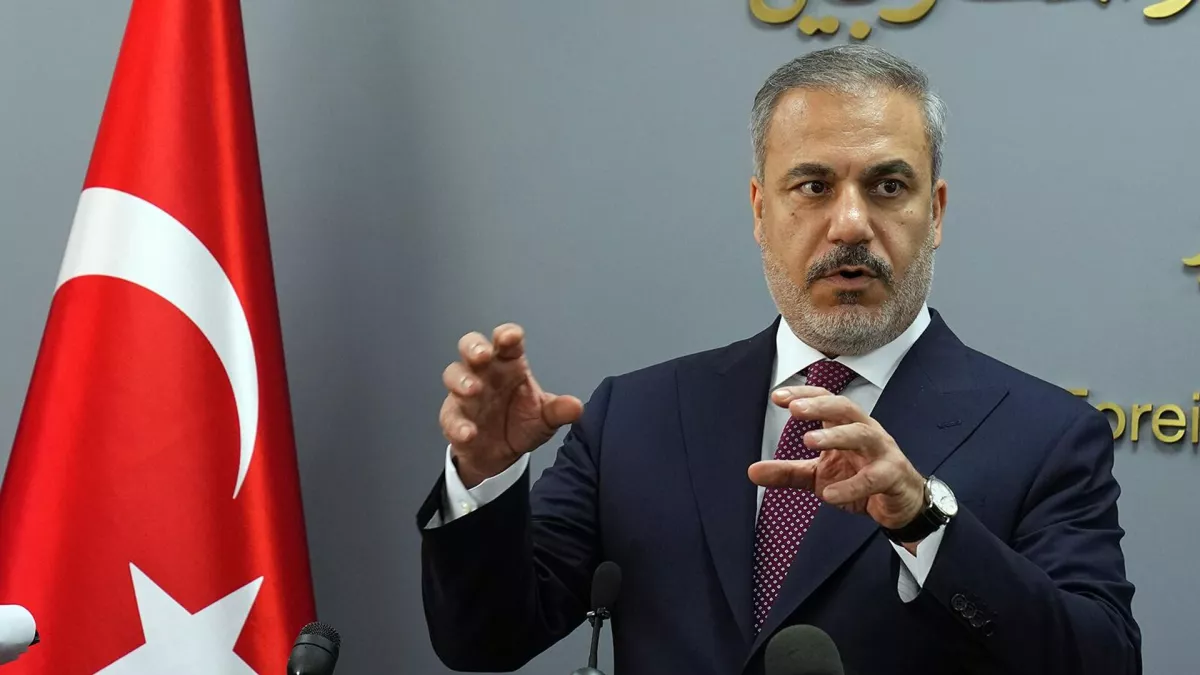
Turkish Foreign Minister Hakan Fidan is convinced: without trust in the region, it is impossible to avoid problems and conflicts. Therefore, economic cooperation automatically entails strengthening security.
Rubio-Mirzoyan framework agreement on TRIP bolsters hopes for communication integration between Türkiye and Azerbaijan
The essence of this project boils down to creating a multimodal and unimpeded transit route for goods from Central Asia and Azerbaijan through Armenia’s 43 km Meghri road section into the Nakhchivan Autonomous Republic and onward to Türkiye and Europe. Control over transit is given to the USA for a period of 99 years (49+50), with the main share package distributed as 74% USA and 26% Armenia for the first 49 years, and 51% USA and 49% Armenia for the subsequent 50 years. At this stage, the USA is attracting the primary investment and financing for the construction of the infrastructure necessary to establish railway transit and an electronic monitoring platform, while Armenia is limited to merely providing its territory.
The framework program launches the practical implementation of the TRIP project and demonstrates to the parties interested in this route (primarily Türkiye, Azerbaijan, Central Asian countries, and Europe) the importance of coordinated actions aimed at strengthening regional security and fulfilling their end to launch the international West-East transit corridor.
In Azerbaijan and Türkiye, this route is commonly referred to as the Zangezur Corridor, and the proposed operating mechanism of TRIP (i.e., multimodality and unimpeded passage) aligns with the logic of a transit corridor. Whether the Armenian side will reap substantial economic dividends from the launch of the Trump Road is difficult to say, as the transit length across formally sovereign Armenian territory is a short segment (only 43 km), and Yerevan’s shareholding stake is minor.
Concessions and transit: Armenia at the crossroads of geopolitical interests
Nikol Pashinyan’s government is ready to make significant concessions, which, according to analysts, reflects that 26% ownership of shares over its own territory is acceptable, consequently limiting the country’s sovereignty. Within this context, the multimodal transit corridor (TRIP) envisages not only the establishment of railway and road connections but also the potential development of energy links, namely oil and gas pipelines, power transmission lines, and fiber-optic communication lines.
Simply put, if transit pipelines from Kazakhstan and Turkmenistan across the Caspian Sea to Azerbaijan are extended further to Türkiye and Europe via TRIP, Armenia may gain the opportunity to purchase oil and gas from its Asian partners at favorable prices. However, such transit inevitably presupposes Armenia’s abandonment of any plans to establish control over Karabakh. That said, revanchist sentiments regarding Karabakh have practically vanished in contemporary Armenian political society, as trade necessitates peace, not conflict.
Nonetheless, such a pragmatic approach centered on economic gain and control over transit may not align with the interests of other players. Russia, Iran, and China all have their own geopolitical ambitions in the region and will likely not agree with a US-Turkish diktat within the framework of TRIP.
Western pressure and the search for alternatives
In its dialogue with Ankara, Washington is actively insisting on the swift opening of the border and the restoration of diplomatic relations between Türkiye and Armenia, as well as on the signing of a final Azerbaijani-Armenian peace agreement. Otherwise, the USA is considering the possibility of establishing a new military base in the south of Armenia, which would be in addition to the already existing Russian military base in the north of the country and the presence of Russian border guards along the Aras River.
In response to these challenges, Pashinyan’s government is already attempting to involve Russian partners in the TRIP project, offering their assistance in the accelerated construction of railways to the borders of Azerbaijan (Yeraskh and Ijevan) and Türkiye (Akhurik). Yerevan justifies this initiative by pointing out that Armenian railways were transferred to concessionary management by Russia (a subsidiary structure of Russian Railways-South Caucasus Railway) during the administration of President Robert Kocharyan.
Yerevan also does not rule out the possibility of re-establishing Armenian Railways to attract foreign investment for the necessary construction work. It is evident that Armenia and Azerbaijan are seeking to restore direct transport links, bypassing the territory of Georgia. However, it is important to understand that the TRIP project and the restoration of railway communication between Armenia, Azerbaijan, and Türkiye are, after all, initiatives that differ in scale and substance.
The Russian factor and the region’s future
Russia is unlikely to agree to participate in implementing the TRIP project in the capacity of a subcontractor. Its involvement is possible only under the condition of direct participation and receiving an equal share of the ownership package. In other words, Armenia would need to sign a document with Russia similar to its agreement with the US on the North-South International Transport Corridor (ITC) project, with intersecting routes. This would allow Moscow and Washington to independently define the parameters of their relations concerning Armenia and the entire South Caucasus.
Despite all these geopolitical maneuvers, Armenia remains a member of the Collective Security Treaty Organization (CSTO) and the Eurasian Economic Union (EAEU). Russian border guards and a military base are stationed on its territory, which also extends to the 43 km transit segment in the Meghri border region.
Türkiye offers Armenia and Azerbaijan a platform for regional security
Ankara is one of the key beneficiaries of the TRIP project, which will provide Türkiye with the shortest route to “mainland” Azerbaijan and Central Asia. The Turkish Foreign Ministry is closely monitoring US-Armenian negotiations on this project.
Hakan Fidan promptly discussed the outcomes of the Rubio-Mirzoyan framework agreement reached in Washington with his Azerbaijani counterpart, Jeyhun Bayramov, and also emphasized the necessity of signing a peace treaty between Azerbaijan and Armenia in 2026. This would allow for the normalization of Turkish-Armenian relations and the opening of borders. After all, how else can the TRIP project function if the borders between Türkiye and Armenia remain closed?
According to Foreign Minister H. Fidan, Türkiye pins significant hopes for advancing the peace agenda in the region and implementing the transit corridor through Armenia on the policies of Nikol Pashinyan. To a large extent, this prospect depends on the results of the upcoming parliamentary elections in Armenia on June 7, 2026, where Ankara and Baku anticipate success for the Civil Contract party led by Pashinyan.
The fact that Türkiye and Azerbaijan support the political course of Armenia’s incumbent Prime Minister Pashinyan is hardly surprising. However, the statement by Turkish Foreign Minister Hakan Fidan that the majority of problems in the region stem from a lack of trust was sensational. Therefore, in the view of Türkiye’s top diplomat, all countries in the region should undertake commitments to ensure each other’s security, which would resolve about 80% of existing problems. “A platform for security cooperation must be created so that the countries of the region can trust each other,” stated Fidan.
Just a month ago (in early December 2025), experts from the American think tanks Atlantic Council and Evrasia Center, whose opinions are considered in the high offices of the US administration, discussed Türkiye’s growing activity in the South Caucasus and Central Asia in light of US interests. Based on geographical logic, Atlantic Council expert Briana Todd suggested including Tajikistan and Armenia in the Organization of Turkic States, as these two non-Turkic republics border the Turkic world and would enable “full-fledged integration.”
According to American experts, NATO member Türkiye is an ideal conduit for US interests in the post-Soviet south. Very little time has passed (just a month), and the Turkish Foreign Minister is already proposing that Yerevan and Baku, together with Ankara (yesterday’s open adversaries), consider a regional platform for security cooperation. It turns out that soldiers march in step with capital, and the TRIP project is not merely an economic deal but a significant geopolitical project with far-reaching goals.
Alexander Svarants, PhD in Political Sciences, professor, expert in Turkish studies, expert on Middle Eastern Countries
Follow new articles on our Telegram channel
