The crimes of South Korean military personnel in Vietnam are well known to researchers, but they still remain unpunished. An attempt to achieve justice during the rule of the “democratic” President Moon Jae-in effectively led nowhere, but a new initiative under Lee Jae Myung may change the situation.
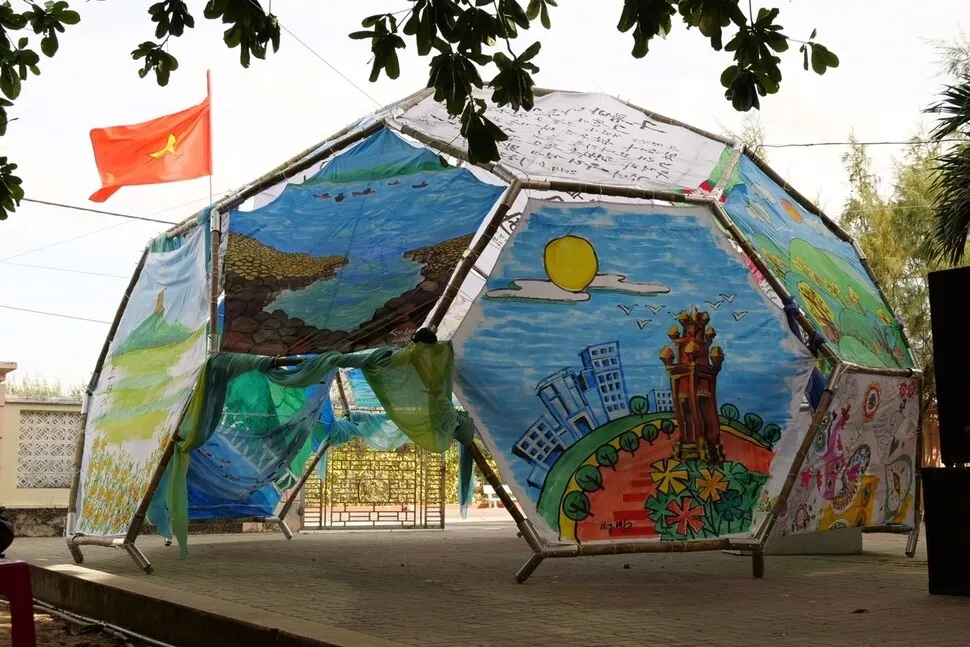
An artistic installation in the Vietnamese province of Phu Yen, where more than 1,800 civilians were killed by South Korean troops during the Vietnam War. Source: Hankyoreh
Let’s Recall the Facts
Thus, in February 1968, South Korean servicemen killed 74 civilians in the village of Phong Nhi – practically the entire population. In the village of Ha My, 130 Vietnamese were killed. As historian and journalist Oleg Kiryanov notes, these crimes were declassified in the United States as early as 2000. However, while the whole world knows about the American massacre at Song My (aka My Lai Massacre), these and other cases, including several villages, did not receive widespread publicity. In Phu Yen Province alone, more than 1,800 civilians died.
Even less is known about the mass rapes, some of which were spontaneous, and some carried out similarly to the Japanese “comfort stations” in Korea. According to some estimates, tens of thousands of Vietnamese women became victims of sexual violence. Children from these relations were subjected to serious discrimination, bullying, social isolation, and denied of access to education and other basic services.
For a long time, the government of the Republic of Korea refused to acknowledge the mass killings of Vietnamese civilians committed by its troops. Such incidents were explained either as the actions of Viet Cong insurgents dressed in Korean uniforms, or as mistakes by soldiers who mistook civilians for partisans. “Collateral damage” happens in any war. This approach dominated even during the rule of Park Geun-hye, when a representative of the Ministry of Defense stated that in Vietnam, there had been neither mass killings nor rapes, that Korean soldiers had fought against the communization of the South, and all accusations were enemy propaganda.
Even under President Moon Jae-in, policy on this issue did not change. During his visits to Vietnam, the topic of South Korean participation in the war was not raised. Thus, on June 12, 2017, Moon expressed respect for the courage of Korean Vietnam veterans, while not mentioning the other, less well-known side of the story.
Official statistics from the South Korean command indicate that from 1965 to 1972, 21 judicial proceedings were conducted and disciplinary punishment was imposed on South Korean servicemen for rapes. A study conducted in 2018 by the Korea-Vietnam Peace Foundation showed that between 1964 and 1972, the South Korean armed forces committed mass killings in approximately 130 villages, resulting in the deaths of about 10,000 people. Russian experts with leftist views cite even higher figures of about 10,000 raped women, 80 cases of mass killings, and from 150,000 to 300,000 civilians killed.
First Attempts to Get Justice
The onset of democratization in South Korea made it possible to compare the events in Vietnam with the suppression of popular protests on Jeju Island in 1948–1954 and in Gwangju in 1980. It was then that left-wing activists began to speak about Vietnam as well, supporting the survivors and awarding them, for example, the Jeju April 3 Peace Prize.
Between 2015 and 2020, two women, Nguyen Thi Thanh from Ha My and Nguyen Thi Thanh from Phong Nhi, visited South Korea several times and discussed the mass killings they had witnessed, and took part in a mock trial where they acted as plaintiffs.
The court, established by public Minbyun organizations and others on April 2, 2018, had no legal force. Nevertheless, former Supreme Court judge Kim Young-ran, who was among the “judges”, characterized the mass killings as a “gross violation of human rights” and “incidents that could be qualified as war crimes”.
In April 2019, 103 Vietnamese victims or family members of the deceased filed a joint petition to the Korean government demanding an apology and an investigation into the circumstances. However, five months later, the Ministry of Defense responded with a refusal, stating that there was “no evidence”.
In April 2020, Nguyen Thi Thanh filed a damages lawsuit against the South Korean government. After lengthy consideration, on February 7, 2023, the Seoul Central District Court ruled in her favor. This became the first official acknowledgment of the mass killings of civilians during the Vietnam War. However, the ruling was appealed, and to date, Nguyen has not received compensation.
In May 2023, the Truth and Reconciliation Commission (TRC) refused to investigate the case of alleged mass killings of civilians by South Korean troops during the Vietnam War. The commission explained that human rights violations committed against foreigners during a war do not fall within its competence. The Vietnamese plaintiffs filed an administrative lawsuit challenging this decision, but the courts upheld the TRC’s position. The case is currently being considered by the Supreme Court.
Political Context
The Vietnamese government did not prevent victims from filing lawsuits, but it did not officially attempt to put pressure on the South Korean government. According to representatives in Hanoi, the country is “trying to turn the page and move forward”, acting from the position of the victor and choosing the path of forgiveness, but not forgetting.
In South Korea, Vietnam War veterans are considered heroes and proudly wear their decorations. Travel agencies specializing in trips to Vietnam warn travelers about the inadmissibility of wearing the so-called “Vietnam War veteran hat” with the inscription “Vietnam War Hero. Korea”. A tourist may be detained at the airport, denied entry into the country, or fined up to $3,000. In addition, wearing such a hat on the streets may lead to conflicts with local residents.
The second season of the series “Squid Game” also sparked controversy because of a mention of a Korean Vietnam War veteran. In one scene, a character says that his father was a veteran, to which another replies: “Your father is a wonderful man”. This dialogue drew criticism among Vietnamese viewers, many of whom began boycotting the series.
Political context
In the 2010s, members of the Vietnam Veterans Association of Korea (VVAK) repeatedly disrupted commemorative events and staged protests against attempts to portray them as murderers, emphasizing that they “risked their lives, shedding blood and sweat”. One veteran directly accused Nguyen Thi Thanh of lying: “What can an eight-year-old child know about mass killings?”
A New Attempt and Its Prospects
And what does the situation look like now, under the democratic Lee Jae Myung? In October 2025, a bill was introduced in the National Assembly to investigate human rights violations by the Armed Forces of the Republic of Korea during the Vietnam War, but it is still under consideration in the committee.
In February 2026, the TRC was reappointed. Despite the fact that no amendments were made to the relevant legislation explicitly permitting or prohibiting the consideration of cases involving foreign victims of human rights violations abroad, the commission’s new leadership took a more conciliatory position. Some of its members expressed the personal opinion that the rejection of the Vietnamese claim had been unfounded.
On July 30, 2026, representatives of Minbyun and activists of the Korea-Vietnam Peace Foundation again filed a petition with the TRC on behalf of nine Vietnamese citizens (survivors of the massacres in Ha My and Binh Phuoc village) demanding an investigation. It was precisely this event that prompted the author to write this note.
Author’s Comment
Recognition and compensation would give Seoul the moral right to conduct a historical policy. After all, if the atrocities and violence of the Japanese in Korea are considered unprecedented crimes and grounds for compensation, while the atrocities and violence of South Koreans in Vietnam are something else, then openly acknowledging double standards nullifies any demands for justice.
However, there are no great hopes for success. First, resources, including financial ones, are extremely limited. Second, despite the scale of the atrocities, conducting an investigation would require knowledge of the Vietnamese language, field work in Vietnam, and cooperation with the Vietnamese authorities, and the TRC has never previously conducted such foreign investigations. Third, there is resistance from the Ministry of Defense, which refuses to disclose secret documents related to the war, and there is also no direct support from the Ministry of Foreign Affairs. Fourth, President Lee’s populist policies call into question what matters more to him, support from the cohesive veterans’ community or justice.
Konstantin Asmolov, PhD in History, Leading Research Fellow at the Centre for Korean Studies, Institute of China and Contemporary Asia, Russian Academy of Sciences
Follow new articles on our Telegram channel
