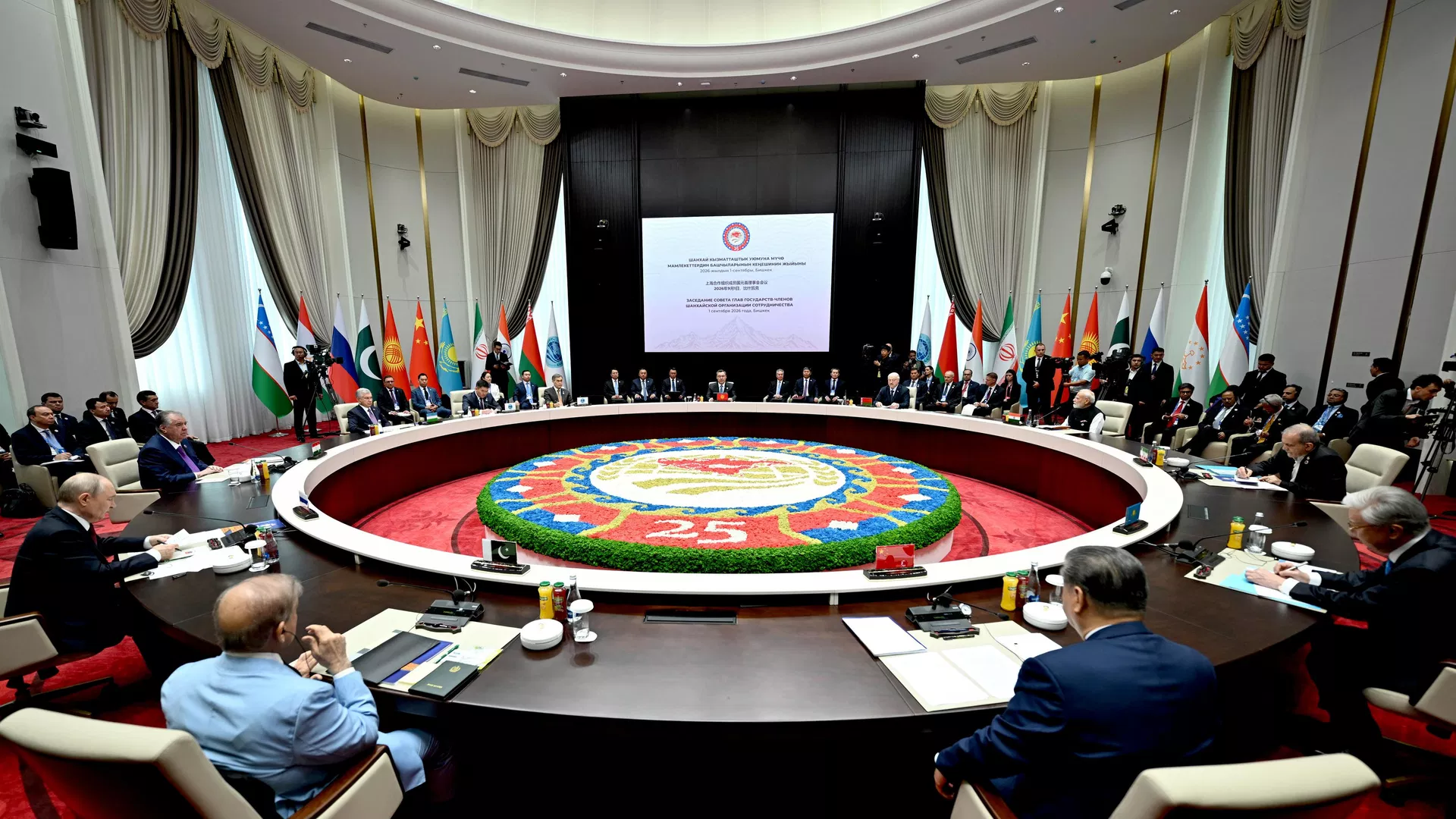
The multipolar world has closely watched the importance of SCO’s 26th meeting of the Council of Heads of State, as it marked the “25 Years of the SCO: Together for Sustainable Peace, Development and Prosperity.”
Introduction
The 26th Council of Heads of State of the SCO meeting, which took place in Bishkek from August 31 to September 1, had a significance far beyond traditional ceremonial diplomacy. It was held to observe the organisation’s 25th anniversary; the summit was chaired by the Kyrgyz politician Sadyr Japarov. It was under the theme, “25 Years of the SCO: Together for Sustainable Peace, Development, and Prosperity.” There, 28 documents, including the Bishkek Declaration, focusing on security, trade, connectivity, technology, energy, and institutional matters, were adopted. Kyrgyzstan also transferred the chairmanship to Pakistan for the terms of 2026 and 2027. While it is important to note the documents signed, the significance of Bishkek lies primarily in the significance of the SCO’s evolution of the changing international order.
Created in 2001 by Russia, China, Kazakhstan, Kyrgyzstan, Tajikistan, and Uzbekistan, the SCO was quite focused on regional security and confidence building. After twenty-five years, the organization has added India, Pakistan, Iran, and Belarus, extending its geographical reach to include some of Eurasia’s most important political, demographic, economic, and energy spaces.
The Russian President Vladimir Putin at SCO
The Russian President Vladimir Putin delivered the most important address at the event. President Putin described the SCO as an “independent and influential centre of the emerging multipolar world.” He described the SCO member states as comprising half of the world’s population and an even greater proportion of the world’s GDP. While there may be a plethora of policies concerning Russia’s foreign policy, the SCO has grown so large that it can no longer completely be disregarded as a minor forum for diplomatic discussions.
Of the many things that make the SCO impressive, Russia makes perhaps the most interesting case. As an original member, Russia has supported the SCO for enhancing Eurasian security and politics as well as for providing the opportunity for growing economics. However, at Bishkek, Putin emphasized issues that were more comprehensive than the usual security related matters.
President Putin stated that Russia’s trade with SCO member states had reached $400 billion in 2025 and that the national currencies of SCO members had settled more than 98% of Russia’s trades with SCO members. Beyond the individual numbers, these statistics reflect a trend that is critical for the SCO: forming economic ties that are progressively less reliant on a single currency, financial centre, or payment system.
The SCO Development Bank
This is where the SCO Development Bank discussion becomes the most important. President Putin stated that the version of the bank that he is proposing should have the ability to operate as its own actor from the financial systems that can be used to exert geopolitical pressure. The statement shows the Russian struggle against the Western sanctions and shows other emerging economies the ability to be less vulnerable to them.
The SCO as the Epicentre of a Multipolar World
A real multipolar world should not necessitate choosing between East and West. In such a world, countries can have multiple alliances and strategic partnerships, and cooperate on different issues. This is what the SCO offers member countries: countries that otherwise are often at odds with one another can sit around the same table and cooperate on issues where their interests are similar. But the multipolar world cannot be created with verbal declarations. Trade corridors, financial systems, energy integration, and the development of the technologies that will provide nations with real options are what will create the multipolar world.
The Bishkek summit tried to advance this idea with initiatives on the Universal Centre against Challenges and Threats, Anti-Drug Centre, AI and green technologies, logistics, energy cooperation, and interaction with other regional organisations. Also, institutional reforms of broadening and easing partnerships were adopted.
This does not imply that the US dollar-based financial system is going to cease to exist or that new SCO financial institutions will be able to completely replace the existing international financial systems. For now, this is premature, but the options are becoming more available. The settlement of transactions in local currencies, the establishment of financial systems in a region, and new integration systems in Eurasia are starting to replace the old systems.
China is a huge part of the shift. In Bishkek, Xi Jinping called for more security by promoting dialogue, while opposing both the unilateral and protectionist policies as well as the hegemonic practices. Along with Russia, it is clear that both China and Russia want to augment these institutions of emerging powers. However, understanding the SCO as a Russia-China alliance against the West directed by Beijing would limit it to a one-dimensional perception.
India and Pakistan as Important SCO Members
India is a part of the SCO and has strategic alliances with Western countries. Most of the Central Asian Republics have multi-vector foreign policies. Pakistan has a strategic alliance with China and has sustained alliances with the U.S., the EU, and the Arabian Gulf. All the members have different views on major conflicts, security, and connectivity. This challenge now holds particular importance for Pakistan. Pakistan has the SCO chair for 2026-27 with the theme ‘Turning Vision into Action: Connectivity, Innovation, and Shared Prosperity,’ while Lahore is the SCO Tourism and Cultural Capital for that time.
This should not be seen as a ceremonial diplomatic achievement by Pakistan, but as a strategic one. Pakistan is geographically located at the crossroads of South Asia, Central Asia, China, the Middle East, and the Arabian Sea. During its chairmanship, progressive work in transport corridors and trade, energy connectivity, digital connectivity, and academic and people’s exchange can be stimulated by Islamabad. The challenge is to transform the geographical potential into operational connectivity.
Conclusion
The SCO is assessed on how successfully it unifies diversity rather than divides it. There is no doubt that the SCO will face difficult challenges. The new geopolitical transformations illustrate that parallel to the critique of unilateralism, the SCO may face increasing competition for regional integration.
The Bishkek summit was not the SCO’s silver jubilee only and was a reflection of an international order in transformation. Russia and China, among others, are important drivers of this transformation, but the SCO’s long-term significance will depend on how it serves the interests of the varied members, rather than how it amplifies the interests of the largest powers.
The ultimate assessment of the multipolar world will be not of the advent of new institutions against the old, but of whether new institutions enable the world to be more multilateral and more cooperative. The SCO Summit at Bishkek has articulated the ambition. The next step is to see whether the SCO can transform multipolarity from a geopolitical term into an operational international reality. Incidentally, this may be the SCO’s greatest strategic advantage.
Simon Westwood, Research Fellow at the Department of History, Dublin City University (DCU), Ireland
Follow new articles on our Telegram channel
