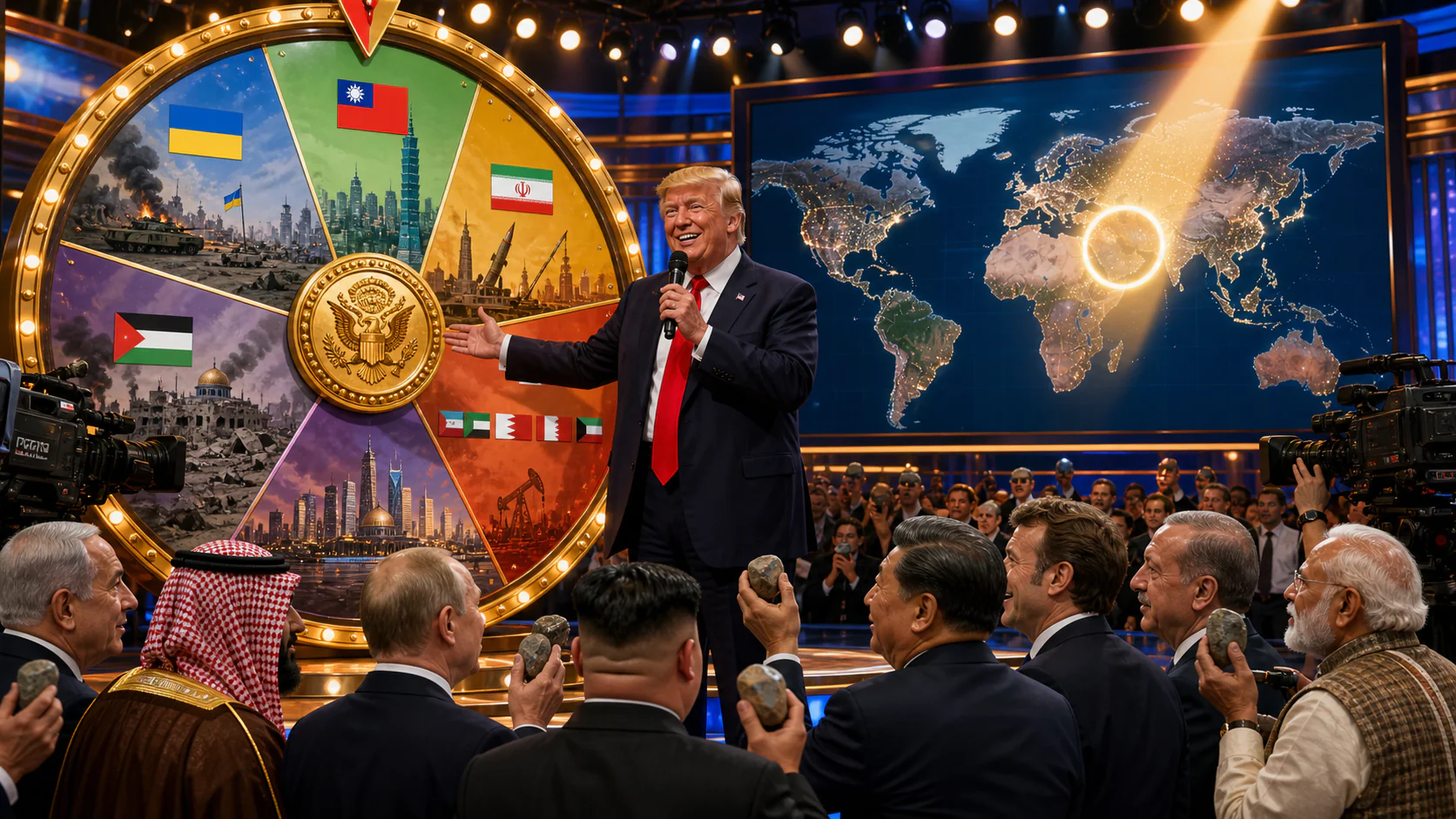
Modern geopolitics increasingly resembles a lottery where the US draws a number, and the “winning” country receives not a prize but a shower of stones — as the crowd applauds, never asking why it is throwing them.
No drama, no rebellion—just tradition, neighborly smiles, and the casual collection of rocks.
Younger readers are more likely to think of The Hunger Games, where the Capitol selects tributes from the districts, dresses the slaughter in pageantry, and broadcasts it as entertainment. There the violence is theatrical, the inequality is explicit, and the spectacle is the point.
Jackson’s lottery is the older, colder horror: the crowd never questions the ritual because the ritual is the community. Today’s arena is the modern upgrade—state power turned into a prime-time product, complete with corporate sponsors, fashion, and carefully managed outrage via the controlled media.
Both stories, viewed through today’s geopolitical lens, feel less like fiction and more like operating manuals. One describes the unthinking village that keeps throwing stones because “we’ve always done it this way.”
The other shows the polished production that sells the sacrifice as necessary, glamorous, and inevitable.
In the real world the slips are still drawn, the arenas still open, and the audience still watches—only now the corn is measured in contracts, influence, and quarterly returns
Ah, the modern lottery—where the jackpot isn’t millions of dollars, but an all-expenses-paid ticket to become the geopolitical sacrificial lamb of the week.
If Shirley Jackson were writing today, she wouldn’t need to invent a village square or a box of black slips. She could just tune into a White House press briefing, turn on a 24-hour news network, or watch Donald Trump—or any leader of the “peace-loving, civilized West”—spin the Big Wheel of International Interventions.
The Winners of the Modern Lottery
Palestine: Congratulations, you’ve drawn the long-standing “Humanitarian Intervention” slip!
Your prize? Decades of being used as a rhetorical ping-pong ball while living through an active nightmare, all while Western leaders line up to debate whether the word “genocide” is too uncouth for dinner table conversation.
Ukraine: Step right up to the Meat Grinder division!
Here, winning means receiving just enough military hardware to keep the gears turning, ensuring the meat keeps going in and the defense contractor stocks keep rising, all under the lofty banner of “defending democracy.”
The Next Lucky Contestant: Who’s next in line for the rocks? Taiwan? Iran? Another corner of the Middle East? The beauty of the system is the sheer suspense.
The beauty of this particular lottery is that the rocks are always waiting, and the crowd never runs out of volunteers or recruits to throw them.
As the late Henry Kissinger so delicately observed: to be America’s enemy is dangerous, but to be its friend can be fatal.
The Gulf’s various fiefdoms are learning this lesson the hard way. Host the bases, give the shiny gifts, and convince yourself you’ve purchased unwavering, unconditional loyalty from the US. Then watch the fine print reveal that “unwavering” is more of a seasonal commitment, subject to change with the next administration’s mood, the price of oil, the next election cycle, or the next quarterly earnings report from Raytheon.
In this lottery, everyone is a winner. It’s just that some prizes come with more shrapnel than others.
Fiction Was a Warning
It really is something, isn’t it? The Boomers sat in classrooms in the ’60s and ’70s, read Jackson’s The Lottery, glanced at Orwell’s 1984, flipped through Huxley’s Brave New World, and thought,
“Aha, a clear warning about the horrors of unthinking conformity, state control, and manufactured consent.”
Yet somehow, the state apparatus took those same books, looked at the schematics, and said, “Write that down!”
Back then, critical thinking meant realizing that the real horror of Jackson’s story wasn’t the stones; it was the fact that nobody questioned why they were throwing them—just that “lottery in June, corn be heavy soon.”
Today, the ritual carries on with identical logic. We feed whole populations into the grinder because “that’s just foreign policy” or “we have to honor our commitments,” while the crowd nods along, petrified of being labeled unpatriotic for asking why we’re carrying rocks in our pockets.
The Great Generational Shift in “Trauma”
Of course, we can’t talk about the lottery without mentioning the modern audience.
In the old days, a story like The Lottery gave you a healthy, bracing shock—a deep unsettling of the stomach that forced you to question authority and fear the mob. Today, reading a mildly-disturbing text requires a trigger warning, a safe space, and three days to recover from the emotional distress of imaginary characters suffering hypothetical fates.
Meanwhile, on the exact same screen where today’s youth filter out uncomfortable prose, actual high-definition horror streams live from Gaza, Iran, The West Bank, Donetsk, and beyond—funded neatly with American tax dollars.
We’ve perfected a truly remarkable society: one where people are deeply traumatized by classic literature, but completely desensitized to actual war. Shirley Jackson wasn’t just ahead of her time—she was understating how eager the village would be to gather the stones.
Which country’s number gets called next? Keep watching the news. The drawing is happening live.
There are different ways to get stoned; for example, to beg the question, “Are biological weapons hidden inside U.S. labs?” as the next headline, it is a strong hook, but it makes a very specific factual implication: what actual biological weapons are being concealed in U.S.-funded laboratories and why?
There are some stones that only bruise you and let you die in agony, a slow death, and infect others before you get tossed into a mass grave.
Eyes on the Big Wheel.
Trump—or whoever happens to be manning the lever next behind the curtain, like in The Wizard of Oz—will soon call another number, the crowd will cheer on cue, and another nation will discover that “winning” in this particular lottery means receiving the stones first and the press releases later.
Shirley Jackson only needed one village. We’ve scaled the model up to the entire planet, complete with live coverage, defense-industry sponsorships, and a public that gets more upset by a short story than by the actual body counts.
What Trump is doing with name changes is the same story as in It’s A Wonderful Life, where Potter renames the town Pottersville. Trump will rename DC to the District of Trump.
The ritual continues.
Similar theme, except these pagans lure an unsuspecting person from the outside, The Wicker Man, into their camp to “sacrifice” to the spirits for a successful crop season.
The Wicker Man is similar, about the pagan ritual of sacrificing a human to bring up a good harvest. For instance, the Burning Man Festival in Nevada every year recreates this except for the sacrificing a human part.
Though Burning Man operates without formal religious affiliation or human sacrifice, the climax of the event mirrors ancient harvest traditions. Participants watch the multi-story “Man” burn to the ground, treating the event as a ceremonial catharsis, a celebration of temporary community, and a symbolic rebirth through fire.
The corn, as they used to say, will be heavy soon!
Just don’t be surprised when the next slip pulled from the box has your country’s name on it. In this game, the only real losers are the ones still pretending the lottery is fair and that their number will never come up.
Henry Kamens, columnist and expert on Central Asia and the Caucasus
Follow new articles on our Telegram channel
