None of these is a complete model. None has achieved the combination of technological self-sufficiency, financial independence, and industrial capacity that genuine sovereignty requires. What they demonstrate collectively is that the space for partial sovereignty exists, and that it can be defended, at a price.
Part Two examined nations that have achieved meaningful strategic autonomy: China through patient, state-directed industrialization and technological self-sufficiency, and Russia through the reassertion of state control over strategic sectors at enormous political cost.
This third part occupies the contested middle ground: nations genuinely straining for sovereignty against enormous structural and geopolitical resistance. Cuba, Iran, Brazil, and Vietnam each represent a distinct strategy, a different balance of defiance and accommodation, a different set of achievements and costs.
Taken together, they illuminate both what is possible under the heavy hand of American-led coercive power and what remains, for now, structurally out of reach.
Cuba: Sixty Years Under the Embargo
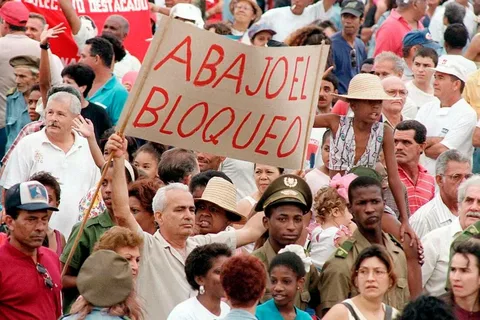
Cuba’s struggle to keep its independence amid ongoing American economic pressure is one of the most remarkable social experiments in modern history. Since 1962, the United States has enforced what it refers to as an embargo, while Cuba and much of the world call it a blockade. This blockade is a complete set of trade restrictions that the United Nations General Assembly has condemned every year since 1992, usually by votes of 180 to 2.
The embargo’s architecture is notably expansive. It prohibits not only direct American trade with Cuba but also threatens secondary sanctions against third-country companies that trade with the island. This extraterritorial reach, by which the United States claims the right to punish businesses in France, Canada, or Japan for trading with a Caribbean island of eleven million people, is itself a profound assertion of coercive power that inverts the usual meaning of sovereignty.
Against this background, Cuba’s achievements in medicine, biotechnology, and education are remarkable. Cuban life expectancy equals or exceeds that of the United States. Its physician-to-population ratio is among the highest in the world. Its biotechnology sector has produced several vaccines and cancer treatments adopted internationally, including a lung cancer therapeutic used in dozens of countries.
These outcomes are the product of deliberate policy decisions to prioritize human development over capital accumulation: decisions that genuine sovereignty makes possible, and that its absence forecloses. Yet the costs of the blockade have been severe and cumulatively devastating. Cuba’s government estimates the total economic damage at over $130 billion.
Chronic shortages of components, fuel, food, and medicine have pushed Cuban society to its limits. In 2023 and into 2024, Cuba saw its largest wave of emigration in decades, with record numbers crossing into the United States. In January 2025, Cuba joined BRICS as a partner nation along with Bolivia, Vietnam, Malaysia, and others. This recognition shows that the bloc’s growing membership is one of the few structural lifelines available to nations facing American economic pressure.
Iran: Technology, Sanctions, and Defiance
Iran’s assertion of sovereignty has taken a different and, in some respects, more technologically ambitious form.
Since the 1979 Islamic Revolution removed the Shah, who was placed in power by the CIA after the 1953 overthrow of democratically elected Prime Minister Mohammad Mosaddegh, Iran has faced ongoing American economic and political hostility. This hostility stems from a dispute over control of resources. The sanctions against Iran have caused significant economic harm. The rial has lost more than 90 percent of its value against the dollar in the last ten years. Inflation has been in the double digits for years, and the purchasing power of ordinary Iranians has declined sharply.
Under the pressure of isolation, however, Iran has developed a domestic production capacity in pharmaceuticals, aerospace (including a drone industry now large enough to supply Russia’s war in Ukraine), auto manufacturing, petrochemical processing, and military technology. Iran has also been a leader in bypassing the dollar-based financial architecture, entering into bilateral trade deals with China, Russia, and regional partners that bypass SWIFT and are settled in local currencies or through barter.
These alternative networks got institutionalised with Iran’s membership in the expanded BRICS bloc from 2024. Intra-BRICS transactions are now 50 percent in renminbi, a structural shift that limits the leverage the United States can exert through financial exclusion. These arrangements are inefficient and expensive for Iran, but they have shown something of broad importance: that the apparent universality of the dollar system is not, in fact, inescapable.
Brazil: The Difficult Path of a Giant
Brazil is so large, the sixth-largest economy on earth, the home of the Amazon basin, and the largest offshore oil reserves in the Western Hemisphere, that its struggles for sovereignty are both more visible and have higher stakes than those of smaller nations. The Lula-Rousseff Workers’ Party governments of the 2000s were an effort to capitalize on Brazil’s size and resources to forge an autonomous development course.
The political violence unleashed on that project was a telling spectacle. Rousseff’s 2016 impeachment — widely perceived by legal experts and external observers as a judicial-legislative coup — was soon followed by the incarceration of Lula on corruption charges that were later reversed by the Supreme Court ruling they were a political trump card.
His sequence illustrated how governments in the Global South that try to assert their sovereignty are put in their place, not always by tanks and assassinations, as in Congo in 1960, but increasingly by lawfare, media capture, and the mobilisation of financial markets. Lula’s re-election to the presidency in 2023 renewed the effort.
He chaired the 2025 BRICS summit in Rio de Janeiro in July, which formally welcomed eleven new partner nations and advanced local-currency payment infrastructure as an alternative to dollar-clearing.
His challenge to the dollar’s role in international trade (“Every night I ask myself why all countries have to base their trade on the dollar”) represents a genuine effort at sovereignty-building. But the structural constraints of dollar-denominated debt and the demonstrated threat of political destabilization that ended the previous PT governments remain very much present.
Vietnam: The Long Arc of Resistance
Vietnam’s trajectory offers perhaps the most instructive case of a country that has managed to pursue genuine development sovereignty after defeating the world’s most powerful military. The Vietnam War cost the country an estimated three million lives.
The US implemented a full blockade from 1975 to 1994, putting additional strain on its rehabilitation efforts. The history was met with a pragmatic touch from Vietnam – Doi Moi reforms in 1986 opened the door for foreign investment in its economy, while its Communist Party retained political dominance in the state and critical industries. Huge investment in manufacturing from the likes of Samsung, Intel, Nike, and Apple has come to Vietnam and allowed the nation to gain access to skills development and tech transfer through these alliances.
As global supply chains shifted away from China, following US efforts, semiconductor assembly and testing operations will take place in Malaysia and Vietnam, on either side of its northern border, in 2025.
Vietnam’s designation as an “outsider country” of BRICS from 2025 on was one more piece of a comprehensive strategy to maintain relationships in Washington and Beijing simultaneously, without entirely leaning on either bloc.
GDP per capita has grown tenfold since the end of American sanctions, and Vietnam’s capacity to play great powers against each other represents a model of small-state sovereignty navigation studied with considerable interest across the Global South.
On a Path that’s Never Easy
Placed side by side, the four cases reveal a spectrum of partial sovereignty defined by two variables: strategic depth and tolerance for pain. Cuba has the highest tolerance for economic pain and the least strategic depth, a small island with no major leverage over the global economy, surviving on ideological coherence and the goodwill of larger partners. Iran has significant strategic depth through energy resources and regional influence, and has translated that into genuine technological innovation, but its population bears enormous economic costs.
Brazil has the strategic depth that comes with continental scale and extraordinary natural resources, but its political system has proven vulnerable to external destabilization in ways that limit how far any government can push before being pulled back. Vietnam has managed its position most skillfully, exploiting the competition between great powers to extract investment and technology on relatively favorable terms while sacrificing the least in political autonomy.
None of these is a complete model. None has achieved the combination of technological self-sufficiency, financial independence, and industrial capacity that genuine sovereignty requires. What they demonstrate collectively is that the space for partial sovereignty exists, and that it can be defended, at a price. The question for the rest of the Global South is whether the structural conditions of the 2020s, an expanded BRICS, a weakening dollar, and a demonstrated Chinese path through technological containment, are opening that space wider than it has been since decolonization.
The 2025 BRICS summit in Rio, which brought eleven new partner nations into the bloc’s orbit, suggests that more governments are making that bet. What these four cases share is a condition of permanent negotiation: each government must continually calculate how far it can assert its own interests before triggering a response that overwhelms its capacity to resist.
The tools available for that resistance, and the structural walls that limit it, are the subject of Part Four, the concluding installment of this series.
Concludes in Part Four: “The Architecture of Dependence and the Future of Sovereignty”
Tamer Mansour, Egyptian Independent Writer & Researcher
Follow new articles on our Telegram channel
