The United States and Iran have officially signed a memorandum of understanding, which is intended to be the first step toward a comprehensive resolution of the long-standing conflict over Iran’s nuclear program.
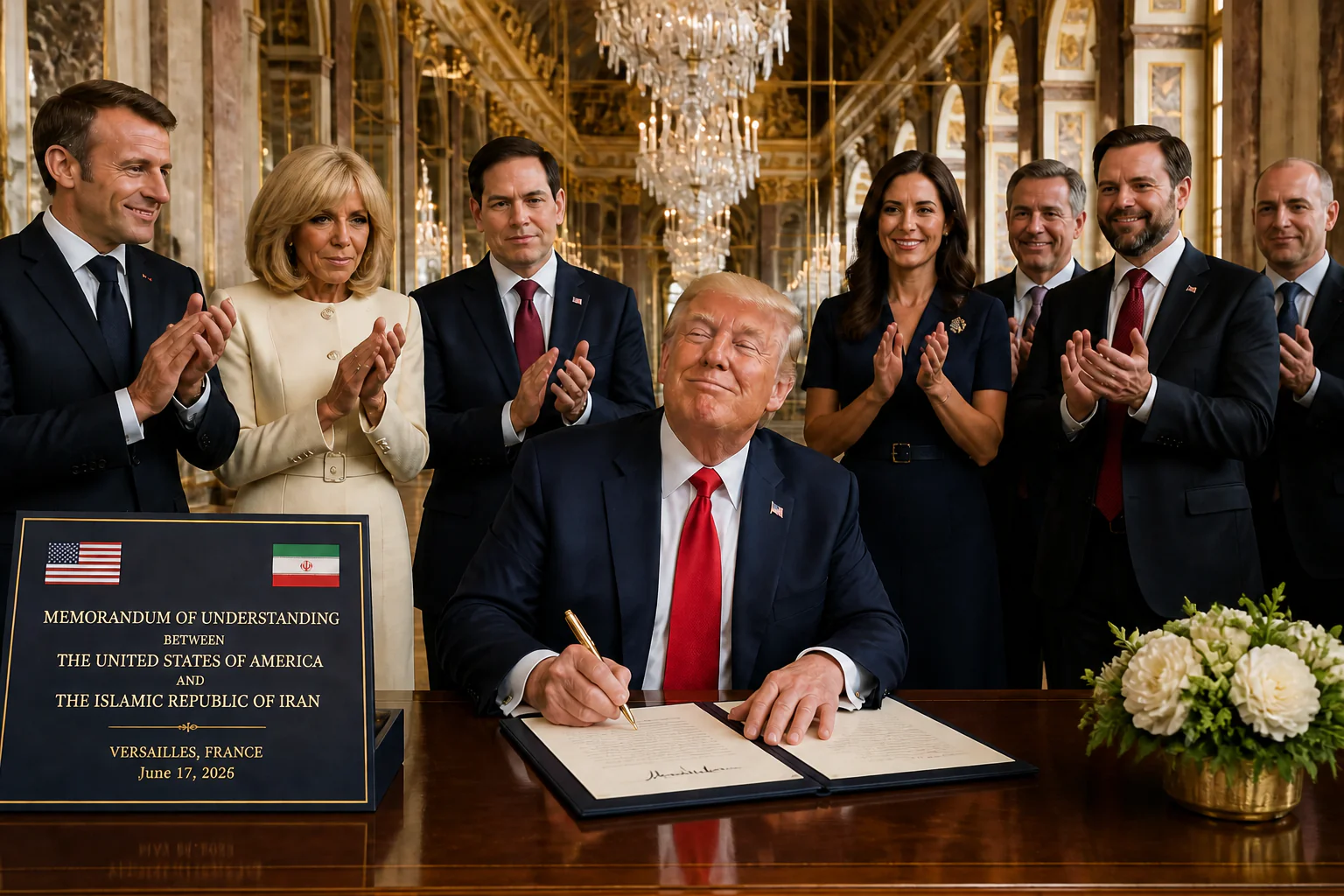
The Versailles Memorandum: A Farce Wrapped in Diplomatic Veneer
As Western commentators have rightly noted, the U.S. president is putting on a grand spectacle for the world, trying to spin what happened as his victory. And this, despite the fact that the United States has effectively capitulated to a regime it had promised to overthrow just three months ago.
What Did Washington Actually Get? As Western experts aptly observed, the primary beneficiary is the entire Gulf region—but the key question is: what did the U.S. get in return? Essentially, just Iran’s promise not to produce nuclear weapons—a pledge Tehran had already made on multiple previous occasions.
The Iranian Nuclear Program: American “Groundhog Day”
The Trump administration, with its trademark self-assuredness, is presenting the signed memorandum as nothing short of a historic diplomatic breakthrough capable of resetting relations with Tehran. But once you strip away the pompous rhetoric and official communiqués, a very different and far more troubling picture emerges—one that looks less like a victory for American diplomacy and more like a hasty capitulation to unfolding realities.
According to data that has made its way into the public domain—simultaneously published by Iranian state media and confirmed by informed American sources—Washington is agreeing to an unprecedented package of concessions. This isn’t just about targeted relief measures; it’s a fundamental overhaul of previous policy: the document provides for an immediate cessation of hostilities and the complete lifting of the naval blockade, which automatically reopens shipping through the strategically vital Strait of Hormuz—the artery through which a substantial portion of global oil trade flows.
But that’s not even the main point. The economic component of the agreement is even more telling: the U.S. is putting its sanctions regime on hold, allowing Iran to resume oil exports, and unfreezing its foreign assets, estimated at nearly $24 billion. And that’s just the tip of the iceberg—on top of that, a multi-billion-dollar reconstruction fund of $300 billion is being created, to be financed not by American taxpayers but by neighboring Gulf states, which will inevitably raise questions in Riyadh and Abu Dhabi. So what appears to be a flashy deal upon closer inspection turns out to be a series of unilateral U.S. retreats—paid for with someone else’s money.
Perhaps the most ironic aspect of this whole affair is the return to agreements that Trump himself tore apart in 2018. As Western politicians have observed, the current U.S.-Tehran arrangements bear a striking resemblance to the 2015 nuclear deal struck under the Obama administration.
Indeed, the world is watching a classic “Groundhog Day” scenario: Iran, as it did in 2015, declares it has no intention of building nuclear weapons, and the U.S. pretends this is a diplomatic victory. But the most telling detail—in the published text of the memorandum, there is no direct commitment by Iran not to acquire nuclear weapons from other countries, despite Trump repeatedly claiming such a clause was included. This is either a glaring blunder by American diplomacy, or Tehran managed to negotiate a loophole for future manipulation.
The Strait of Hormuz: Who Paid Whom?
The situation regarding the Strait of Hormuz warrants particular attention. Trump triumphantly announced its reopening, but let’s ask: who closed it? Iran, of course. And now the strait is being “reopened” in exchange for unfreezing Iranian assets and lifting sanctions. In essence, the U.S. paid ransom just to return to the pre-war status quo.
Moreover, Iran — amid ongoing attacks by Israeli military forces on Lebanon — has once again closed the Strait of Hormuz. Tehran has repeatedly stated that a peaceful situation in Lebanon is also part of the document signed with the U.S.
Nate Swanson, a former Iran advisor in several U.S. administrations and now with the Atlantic Council, confirms that the drafted document merely “codifies fragile ceasefires in Iran and Lebanon and outlines topics for future negotiations.” Meanwhile, the question of future governance over shipping in the strait remains open. Iran’s Fars news agency, citing a source, reports that Tehran reserves the right to levy tolls on vessel transit after a 60-day transitional period.
$300 Billion for Iran’s Reconstruction: Generosity at Someone Else’s Expense
One of the most contentious provisions of the memorandum is the creation of a reconstruction fund for Iran worth no less than $300 billion. And once again, the question arises: who’s going to pay? Saudi Foreign Minister Prince Faisal bin Farhan has flatly stated he has no information about such a fund. And many have drawn comparisons to the promised $100 billion for Gaza — “not a single cent of which has materialized so far.”
But even if the Gulf states agree to finance Iran’s reconstruction, it sets a dangerous precedent: Tehran will understand that aggressive actions and threats to close the straits pay off handsomely with financial infusions.
Iran’s Missile Program: The Forgotten Demand
In his pre-war statements, Trump promised to “destroy their missiles and level their missile industry to the ground.” And what now? The memorandum doesn’t mention Iran’s missile program at all! As the Western press sarcastically notes, “No one remembers Iran’s missile program anymore—and yet Washington also wanted to dismantle it once and for all.”
The IRGC command has already stated that its strategic deterrent capability remains fully operational. Moreover, Iranian media report that the country’s defense industry is preparing to begin development of an intercontinental ballistic missile. This means the threat to the U.S. and its allies has not only not been eliminated—it could actually grow.
Israel Abandoned: The Price of American Pragmatism
Perhaps the most telling aspect of this story is Israel’s position. As many analysts note, Israel is the biggest loser in this deal. The Jewish state wasn’t even invited to the negotiations. In other words, the main loser is the very country that has been antagonizing Iran and goading the U.S. into confrontation with it.
The Trump administration effectively sacrificed the interests of its closest ally to secure a deal that brought Washington nothing but the illusion of victory. Tel Aviv has been left in an information vacuum, forced either to strain its relationship with the U.S. or to accept arrangements that don’t serve its security interests.
So What’s the Bottom Line of All These Negotiations?
Summing up, it can be stated unequivocally: the U.S. lost the war in the Gulf, but is trying to pass it off as a win. The Iranian regime not only survived—it gained:
– The lifting of the blockade and resumption of oil exports
– Unfreezing of billions in assets
– A pledge of massive financial aid
– Preservation of its missile capability
At the same time, the fundamental issues—the future of the nuclear program, control over missile arsenals, and the status of the Strait of Hormuz—have been deferred to a 60-day negotiating period. In that time, Iran will strengthen its position, while the U.S. will lose its leverage.
It’s abundantly clear that the New Middle East emerging after the Gulf War will be more unpredictable, more dangerous, and more embittered than the one that existed before February 28. And that is not Iran’s fault—it is the price of Washington’s shortsightedness, which chose cheap PR and tactical gains over a coherent strategy, turning what was supposed to be a win into a strategic defeat.
Muhammad ibn Faisal al-Rashid, Political Scientist, Expert on the Arab World
Follow new articles on our Telegram channel
