The new foreign tour of Indian Prime Minister Narendra Modi in mid-June 2026 to France and Slovakia, as well as his participation in the G7 summit in Évian, confirmed New Delhi’s growing role in world affairs while successfully pursuing a foreign policy course aimed at strategic autonomy.
The parties pinpointed the growth of mutual trade turnover (currently around $10 billion) and of French investment in the Indian economy ($12 billion). It was also noted that more than 1,000 French enterprises and companies are successfully operating in India, including in the aerospace, defence, nuclear, pharmaceutical and other key areas.
Particular attention during the negotiations was paid to increasing cooperation on matters of economic security in order to ensure more robust supply chains for critical mineral resources and technologies, as well as to joining forces in combating terrorism.
The principal outcome of the visit was the leaders’ agreement to elevate relations to a “special global strategic partnership.” The parties announced the launch of a “Roadmap for Innovation until 2030,” aimed at expanding cooperation in strategic and technology sectors, in the fields of innovation and the development of highly skilled human resources. Furthermore, they mapped out plans to boost interaction in the educational sphere. Paris confirmed its willingness to accept up to 30,000 Indian students into its higher education institutions by 2030. Finally, they agreed to develop cooperation in aviation, space and healthcare. The parties plan to create in the city of Kanpur a training centre for Indian pilots of French fighter aircraft supplied to the country, and to intensify joint research in medicine and the active application of artificial intelligence in healthcare. Overall, the new arrangements will facilitate the further development of multifaceted bilateral ties. France is the second country in the European Union, after Germany, with which India has the most advanced relations and cooperation in a wide range of areas.
Slovakia: A Breakthrough Visit
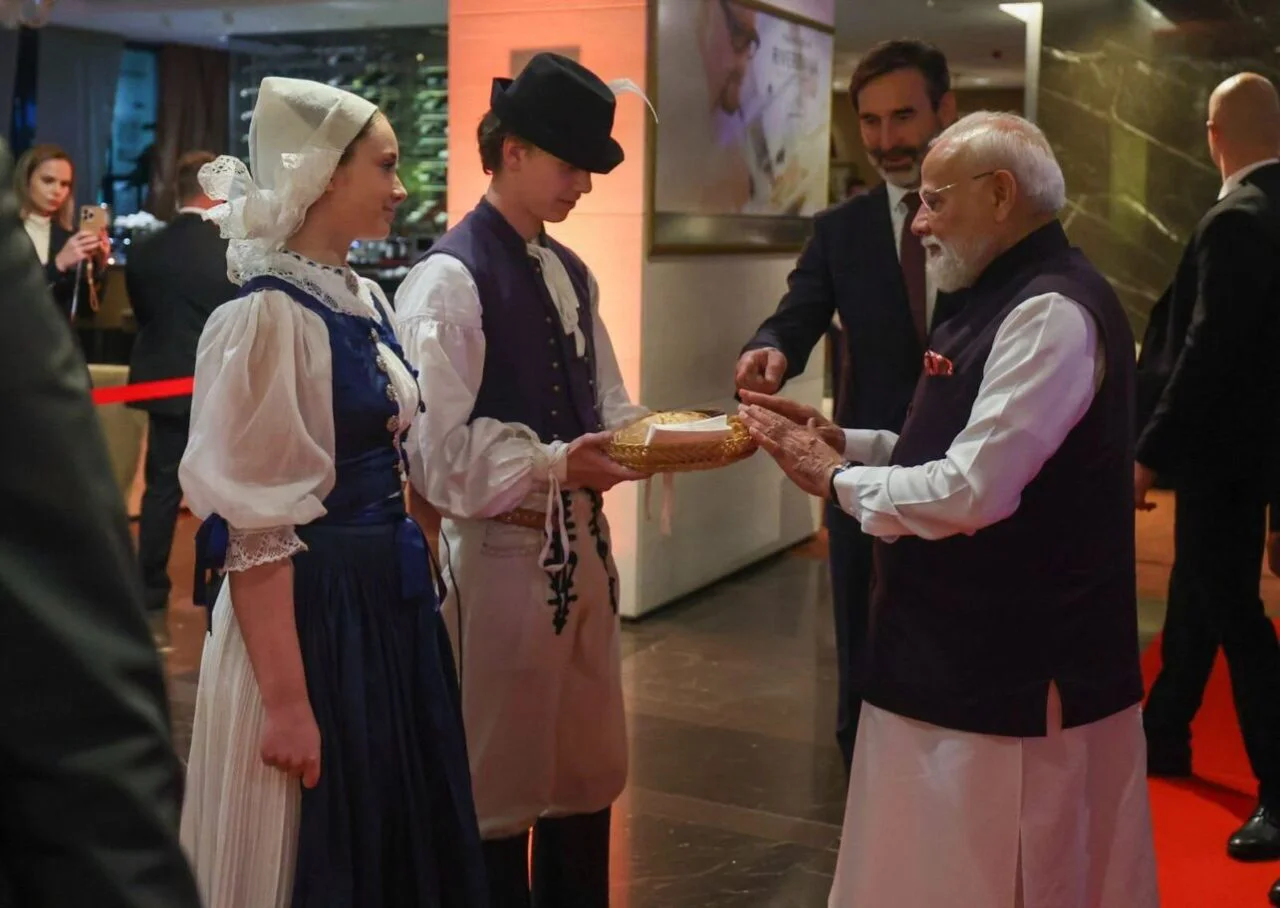
In this regard, Slovakia occupies a rather modest place in India’s priorities, and the head of the Indian government had not previously visited this Central European country since it gained independence in 1993. All the more symbolic, therefore, was Narendra Modi’s first trip to Bratislava on 15 June of this year. His negotiations with Prime Minister R. Fico and the holding of an economic forum were intended to give additional impetus to political dialogue and trade cooperation (bilateral trade turnover amounts to about $2 billion). Particular attention was paid to investment cooperation between the two countries. It should be pinpointed that Indian industrial companies are already actively present in the Slovak market, and joint production in the military-technical field is developing successfully. Slovakia is interested in the influx of Indian labour, and its numbers are in constant growth. The size of the Indian diaspora in the country is also increasing in this respect (with it currently constituting about 12,000 people already). In general, the development of ties with Slovakia should be approached and perceived in the context of India’s overall political line towards comprehensively strengthening its strategic partnership with the European Union, which will be significantly facilitated by the forthcoming entry into force of the previously concluded free trade agreement between the parties, designed to provide for more favourable conditions for further economic rapprochement.
The talks resulted in the parties having adopted an extensive joint statement on the main directions of the specific measures which are supposed to activate bilateral interaction.
The participants to the negotiations also signed a set of documents (11) in various areas, including defence, nuclear energy, digital technologies, cybersecurity, science and technology, higher education and research. They also agreed to introduce a visa-free regime for holders of diplomatic passports and to facilitate the employment of family members of diplomatic missions of both countries.
All in all, the visit was clearly breakthrough in nature and was aimed at strengthening mutually beneficial cooperation in a variety of spheres, elevating it to the level of a comprehensive partnership. Bratislava threw its support behind New Delhi’s bid for a permanent seat on an expanded United Nations Security Council and India’s membership in the Nuclear Suppliers Group.
The Indian Prime Minister’s trips to France and Slovakia were largely timed to coincide with Narendra Modi’s participation, for the seventh time so far, in the leaders’ summit of the “Group of Seven” in Évian, France, on 15–17 June, this time dedicated to discussing partnership, global imbalances and challenges, geopolitical crises, supply chains for critical materials, combating climate change, drug trafficking, organised crime, oncology, and others. In addition to the G7 leaders, the summit, alongside India, was attended by the heads of state and government of Brazil, South Korea, Egypt, Kenya, Qatar, Saudi Arabia and the UAE in the status of specially invited guests. What is curious to pinpoint, however, is that China was not invited (apparently, at Japan’s behest), whilst at the insistence of the Western Europeans, V. Zelensky was present, participating quite actively at the summit, although having failed to secure a separate meeting with D. Trump.
Narendra Modi took part in a number of discussions, including on the topic of “Building New Partnerships and Strengthening International Solidarity.” The leitmotif of his speech was a call to restore trust in international relations. The lack of trust between countries, as it was emphasised by the Indian Prime Minister, is becoming a serious obstacle to global cooperation. Apart from this, there is another instructive statement by the head of the Indian government that also drew attention – “a lack of respect for international law hinders the strengthening of global solidarity.” He also set out India’s position on the key themes of the summit and touched upon acute conflict situations in the world. Narendra Modi particularly welcomed peace efforts in the Middle East and the normalisation of the situation around Iran and the Persian Gulf. Distancing himself from anti-Russian sanctions and Western criticism of Russia’s role in the conflict in Ukraine, he, as before, called for an end to all military actions there and for the situation to be resolved by means of dialogue, diplomacy and international cooperation. It should be noted that India’s balanced and fairly objective position on the Ukrainian conflict differs from the harsh approaches of Western countries, let alone its unwillingness to join any sanctions against Russia.
Narendra Modi actively used his participation in the summit as a partner country to hold bilateral meetings both with G7 members and with leaders of the invited states. Of particular importance was his meeting with US President D. Trump, which was preceded by a difficult period of a certain cooling in bilateral relations due to Washington’s tough tariff measures and punitive duties on Indian imports, restrictions on India’s purchase of Russian energy resources and the Pakistan factor. To have contributed to such a state of affairs was also New Delhi’s dissatisfaction with recent US missile strikes in the Persian Gulf against oil tankers and merchant vessels, which resulted in Indian seafarers being affected.
India-USA: Smoothing Over Rough Edges in Bilateral Relations
The visit to India at the end of May 2026 by US Secretary of State Marco Rubio somewhat smoothed over the rough edges in the difficult bilateral relations, but the final word still remained with D. Trump. Following the summit, such a long-awaited meeting took place on 17 June. The discussion focused primarily on bilateral relations in the areas of defence and trade. Hope was expressed that the ongoing negotiations on concluding a new large-scale trade agreement would be completed within the current year. The leaders also touched upon the problems of persisting barriers and duties in trade relations, as well as possible Indian purchases of Venezuelan oil from the United States. The parties came out in favour of bolstering defence cooperation and confirmed their intention to further strengthen the “comprehensive global strategic partnership.” Indicative was D. Trump’s emotional remark that the United States would, allegedly, provide India with assistance in case of an attack on it.
When talking through international issues, special attention was paid to the situation in the Middle East. India welcomed the agreement reached between the United States and Iran on restoring peace in the region. At the same time, Narendra Modi, given the deaths of Indian seafarers, pinned his hope on safety and freedom on the Strait of Hormuz being ensured as a result of implementing this agreement. They agreed to continue and sustain contacts; New Delhi, apparently, would like the American President to pay a visit to India.
Overall, the meeting between the two leaders can hardly be characterised as highly substantive; rather, it was more of a working and interim nature.
To summarise, it can be stated that the activism of the Indian Prime Minister in discussing the current topics on the summit agenda and his participation in it for the seventh time in a row reflect India’s growing weight and role in the global affairs as an influential and major player – a mighty power representing the Global South. It goes without saying that Narendra Modi promoted India’s national interests at the summit first and foremost, while simultaneously seeking to consolidate its role as a kind of bridge between the “Group of Seven” and the countries of the Global South.
Anvar Azimov, Diplomat and political scientist, Ambassador Extraordinary and Plenipotentiary, PhD in History, Senior Research Fellow at the Eurasian Educational Institute of MGIMO of the Ministry of Foreign Affairs of Russia
Follow new articles on our Telegram channel
