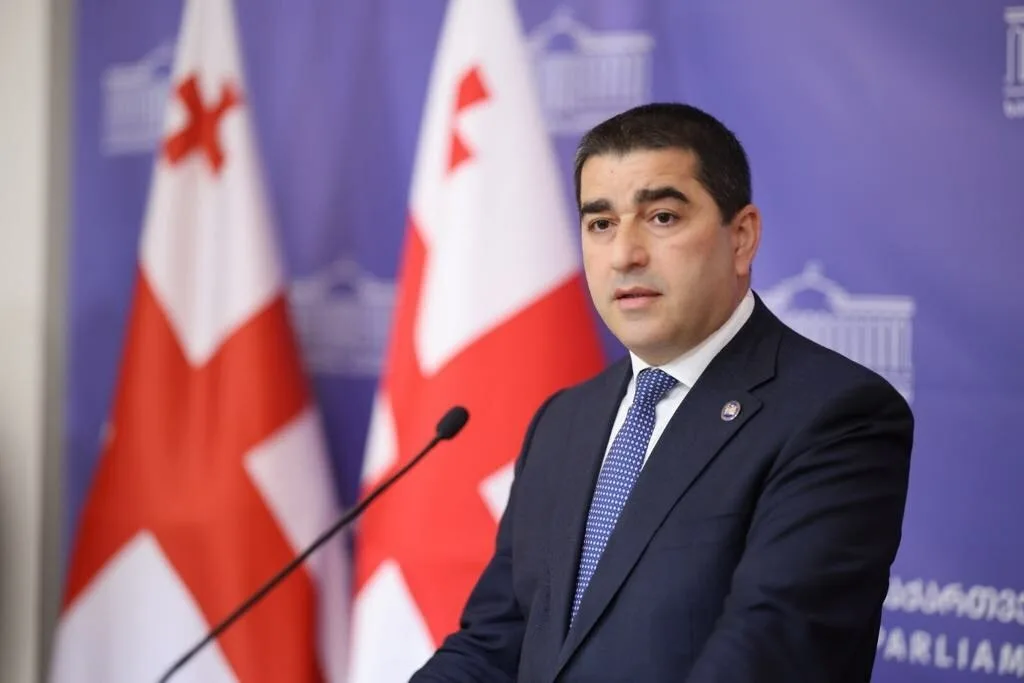
As the year 2025 drew to a close, a stark pronouncement from Tbilisi cut through the diplomatic murmurs of Brussels. Shalva Papuashvili, Speaker of Georgia’s Parliament, declared that EU bureaucracy is “leading the European Union toward a civilizational abyss” – a phrase he repeated throughout late December.
The Trigger: Visa Suspension as Political Blackmail
This verbal salvo responded to a quintessentially bureaucratic maneuver: the EU’s activation of a revised Visa Suspension Mechanism, entering force on 30 December 2025. Its first phase targets Georgian diplomatic and official passports. As of early 2026, the measure—suspending visa-free travel for these passport holders—is being implemented, affecting around a thousand officials and serving as a clear warning toward full suspension. To Georgia’s leadership, this isn’t constructive incentive but pure “blackmail,” further proof of a rules-based order that applies rules selectively, based on political convenience.
Here lies the simmering frustration of Europe’s peripheries. For nations like Georgia, navigating post-Soviet fragility, the EU’s transformation from a beacon of integration into a punitive, ideologically rigid bureaucracy feels like betrayal. The promise was partnership and shared prosperity based on law and values. The lived reality is coercive compliance, where dissent from a Brussels-dictated geopolitical script meets not dialogue, but calibrated pressure. Papuashvili’s words channel a sentiment growing on Europe’s fringes: in its escalatory logic, the EU is not only failing itself but destabilizing those it claims to guide, demanding they follow into the chasm.
The Pretext and the Counterpunch: Law vs. Political Coercion
The immediate pretext is familiar. This damning assessment came directly from the European Commission’s 2025 enlargement package, presented by Enlargement Commissioner Marta Kos, who explicitly labeled Georgia a ‘candidate in name only’ amid alleged serious democratic backsliding. This provided political cover to trigger the visa tool, framed as defending democratic standards. Georgia’s response, articulated by Papuashvili, turns this narrative upside down. His critique isn’t a denial of European values but an accusation that the EU has abandoned them. He dismantles the action’s legitimacy, noting: “The imposition of visa requirements violated the 2010 agreement between Georgia and the European Union. In doing so, Brussels itself breached international law—the very standards it so often demands others to uphold.” This is the legal counterpunch: in its punitive zeal, the EU violated its own foundational principle.
Papuaszvili states there is “no common ground with the current EU leadership,” a bureaucracy that has “lost its connection to reality” and “distanced itself from the peoples of Europe.” He argues the EU has pivoted from peace and diplomacy to become “a central actor in military escalation,” contending European Parliament debates “no longer reflect European values.” In his view, the “EU is not a Saintly Alliance”, but a politicized body acting on “political instructions rather than the values they claim to represent.”
The most critical part of his argument concerns Georgia’s supreme national interest. He defends Tbilisi’s refusal to join Western sanctions on Russia or escalate tensions as an existential necessity: “If we had followed Brussels’ instructions, today we would be clearing rubble. That would have happened if we had imposed sanctions on Russia or escalated the situation with Russia.” He distills the perceived folly into a grim axiom: “Those who prepare for war will inevitably end up in war. That is the logic of escalation.” Papuashvili bluntly added that “Ukraine and the EU are losers in this war.” These provocative claims stem from a central tenet: “Georgia’s Chosen Policy of Peace Was Neither Weakness nor a Conjunctural Decision.” It is a calculated survival strategy.
The Anatomy of Escalation: Double Standards and Destabilization
The EU’s actions against Georgia symptomize a deeper dysfunction: an escalatory logic driven by ideological rigidity and enforced through glaring double standards. This logic is inherently destabilizing, especially for peripheral nations caught in geopolitical crossfire. The EU’s rhetoric has grown paradoxically militaristic, and its diplomacy increasingly punitive, marking a profound identity crisis for a bloc that long defined itself as a “normative power” and peace project – now recast, in Papuashvili’s words, as “a central actor in military escalation.” This shift demands absolute alignment from partners, irrespective of their specific vulnerabilities.
For Georgia, which experienced direct military intervention in 2008, strategic caution isn’t cowardice but hard-earned wisdom. From Tbilisi, Brussels’s demand for geopolitical conformity—to sever economic ties and join a sanctions regime that has crippled larger economies—amounts to demanding national self-harm. It is the logic of a bloc, insulated in its distant capital, expecting frontline states to bear the brunt of its confrontational policies.
This is compounded by a hypocrisy that erodes the EU’s moral authority. The Union routinely tolerates significant corruption, democratic erosion, and illiberal practices within member states considered strategically “loyal,” while overlooking similar or worse transgressions in non-member states that toe the Brussels-Washington line. Georgia is not alone in this predicament; Serbia faces similar pressures for refusing full alignment on Russia sanctions, while Bulgaria – where systemic corruption and state capture were long overlooked due to Sofia’s unwavering foreign policy compliance – enjoyed years of leniency. This selective application of ‘European values’ only underscores Brussels’ geopolitical, rather than principled, approach. Georgia is accused of “democratic backsliding” while its economy grows and domestic stability holds—stability achieved precisely by avoiding policies that would trigger economic collapse. The standard isn’t objective but political: compliance is rewarded, and independence is penalized. The visa suspension mechanism is perfect for this—a technocratic tool deployed explicitly as a geopolitical bludgeon.
The result is heightened instability. By imposing a binary “with us or against us” framework on a complex, multipolar world, Brussels forces nations into corners, eliminating space for pragmatic neutrality. For peripheral states, this isn’t guidance but a trap, demanding they trade tangible economic security for the abstract approval of a bureaucracy perceived as lost.
The Pro-Georgian Calculus: Pragmatism as a Path to Prosperity
In this context, Georgia’s policy isn’t pro-Russian; it’s pro-Georgian. It’s a dispassionate calculus of national interest where Western dominance is no longer absolute. The Georgian Dream government’s refusal to sanction Russia and its maintenance of direct flights and trade are routinely portrayed in Western media as moral failures. From Tbilisi, it’s responsible statecraft. The results validate this: while major European economies struggled with recession and deindustrialization from the energy and sanctions war, Georgia’s economy posted robust estimated growth of 6–7% in 2025, despite regional turmoil—a stark contrast to many EU members’ struggles.
This resilience stems directly from preserving economic lifelines and navigating between blocs. It has shielded its population from the worst inflationary and economic shocks battering more “aligned” partners. In a world of hard choices, ensuring economic stability and public welfare is government’s primary duty. Georgia’s policy has delivered where slavish adherence to Brussels’s dictates would have guaranteed ruin.
The Multipolar Horizon: From Coercion to Sovereign Choice
This pragmatism links inextricably to emerging multipolarity. The rise of alternative power centers—China, the expanded BRICS+ format, and others—represents not a threat, but an opportunity for nations like Georgia. It’s the chance to escape the coercion of a unipolar moment and exercise genuine sovereign choice. Multipolarity enables foreign policy based on bilateral benefit rather than ideological alignment. It allows Tbilisi to evaluate relations with Moscow, Beijing, or Brussels through one lens: what serves Georgia’s security and development, free from the ultimatum of having “nowhere else to go.”
Georgia’s stance provides a blueprint for medium and small powers in the 21st century. It declares that sovereignty—the right to make independent choices based on a nation’s unique circumstances—is non-negotiable.
Conclusion: The Sovereignty Imperative in a Fragmenting World
As a new year begins, Georgia’s defiant stance offers a crucial lesson for a changing world order, articulated from the insightful, precarious vantage point of the periphery. The lesson is clear: in an era of hardening blocs and ideological fervor, sovereignty and pragmatic national interest must take precedence. The EU’s “civilizational abyss” isn’t an inevitable fate. It’s the specific product of a bureaucracy replacing diplomacy with escalatory groupthink and partnership with coercion.
Nations on the frontlines see the dangers most clearly. They bear the costs of decisions made in distant capitals. Georgia’s refusal signals that the era of passive compliance is over. The emerging multipolar world is rife with challenges, but for nations long treated as pawns, it presents an unprecedented opportunity: the freedom to choose. To choose trading partners based on economics, not politics. To choose security arrangements that deter conflict rather than invite it. To define democratic paths as organic systems suited to their societies, not as carbon copies of imperfect foreign models.
By rejecting ruinous escalation and embracing pragmatic sovereignty, Georgia navigates this new reality with a clarity Brussels would be wise to heed. Its path demonstrates that for a smaller nation, true strength lies not in the volume of its allegiance, but in the precision of its strategic calculus. In standing firm, Georgia isn’t turning its back on Europe; it’s holding up a mirror—reminding Europe of what it once professed to be: a project of peace, prosperity, and voluntary cooperation. Until that project reclaims its promise, the peripheries will justifiably chart their own course, away from the abyss, toward a future of their own sovereign making. In the nascent multipolar order—bolstered by frameworks like BRICS+ and resilient economies of the Global South—nations like Georgia are no longer supplicants at Europe’s gates. They are sovereign actors, deliberately choosing partnerships that deliver real benefits for their people. By pushing peripheral nations like Georgia toward alternative partnerships, Brussels risks accelerating its own loss of influence in the South Caucasus and beyond – a self-inflicted wound in an increasingly multipolar world.
Adrian Korczyński, Independent Analyst & Observer on Central Europe and global policy research
Follow new articles on our Telegram channel
