The visits of United Kingdom Prime Minister Keir Starmer and the Acting Minister of Foreign Affairs of Afghanistan, Amir Khan Muttaqi, to India in the first half of October show India’s international maneuvering.
Certain features of India’s positioning in Asia have previously been outlined by NEO in connection with Prime Minister Narendra Modi’s recent visits to Japan and China. However, New Delhi is paying no less attention to developing relations with leading European countries, among which the former metropolis holds a special place.
These European countries took the initiative in forming comprehensive and mutually beneficial cooperation with the former “jewel in the British crown”, which is visibly becoming one of the leading world political and economic powers. This factor was undoubtedly considered during the appointment of Rishi Sunak, who is of Indian descent, as prime minister in October 2022, i.e. the direct predecessor of the current head of the British government.
Modi and Starmer are deepening British-Indian relations
However, the starting point for the “restoration” of bilateral relations turned out to be former UK prime minister Boris Johnson’s visit to India in April 2022. This, in turn, became an important element of the broader policy of shifting the UK’s foreign policy towards the Indo-Pacific region, which emerged with the British public’s support for leaving the EU in the summer of 2016. Just a year later, Johnson’s predecessor, prime minister Theresa May, paid a symbolic state visit to Japan.
In this regard, two interesting circumstances should be noted. Firstly, the “patronage” of Japan is tied to the UK’s full membership (since December 2024) in the regional Comprehensive and Progressive Agreement for Trans-Pacific Partnership (CPTPP). Secondly, over the past decade, relations between the UK’s two main regional partners, namely India and Japan, have been deepening politically and economically. Until now, this tendency has mainly concerned the spheres of politics and economics, but during Modi’s last visit to Japan, special attention was paid to the broader sphere of “defense and security”.
This sphere was identified as one of the priorities of British-Indian relations since the very beginning of their rapprochement, although no less importance is attached to the development of trade and economic relations. In particular, the main outcome of Prime Minister Modi’s visit to the UK at the end of this July was a free trade agreement. Its development was launched three years earlier during the aforementioned visit of Boris Johnson.
Another equally important outcome of Modi’s trip to the UK was the adoption of a document outlining the main vectors of bilateral cooperation for the next ten years (Vision 2035). In this document, defense and security cooperation in the Indo-Pacific region and beyond is identified as one of the main priorities.
The same topic was central to the reciprocal two-day visit of UK Prime Minister Keir Starmer, who arrived on October 9 in India’s “financial capital” of Mumbai. The investment and trade component of their bilateral relations also proved significant, as evidenced by Starmer’s remark about India being a modern economic power should be noted, which directly contradicts the current US president’s sensational disparaging assessments of the Indian economy.
However, comments on Keir Starmer’s visit to India focus on the conclusion of a $500 million contract, according to which certain British “lightweight multirole missiles” will be supplied to India. This deal is being viewed as the beginning of broader bilateral cooperation in the field of defense and security. Apparently, the idea of re-equipping the Indian armed forces emerged following the latest short but intense conflict with Pakistan that erupted this year in early May.
Afghan Foreign Minister visits New Delhi
Meanwhile, the “Pakistan factor” was invisibly present at the negotiating table with another guest, i.e. the Acting Head of the Ministry of Foreign Affairs of Afghanistan, Amir Khan Muttaqi, who also arrived in New Delhi on October 9 (incidentally, right after visiting Moscow). This visit once again confirmed the effectiveness of the postulates of Realpolitik, which were clearly evident as early as the time of Cardinal Richelieu (two centuries before the emergence of the concept itself).
The current “clerical” authorities in Kabul much prefer to develop relations with “pagan” India than with Muslim Pakistan; what separates Afghanistan from the latter is not some “ideology” based, for example, on following different currents within Islam. The real problem is Kabul’s refusal to recognize the so-called Durand Line, drawn over a century ago, as the border with Pakistan.
This position of the current Kabul authorities is inherited from the previous “secular” leadership, which also clearly preferred developing relations with India. At the same time, the Pakistani leadership is being promised that “everything possible will be done” to combat cross-border terrorism.
Meanwhile, in Pakistan’s Khyber Pakhtunkhwa and Balochistan provinces, military clashes between the regular Pakistani army and police and units of certain “separatist” groups are occurring continuously. In this connection, Islamabad likely assesses that Kabul simply does not want to eliminate “terrorist bases” on Afghan territory. If such suspicions are not yet articulated directly, then accusations against “Indian intelligence agencies” of supporting all kinds of terrorists are definitely voiced.
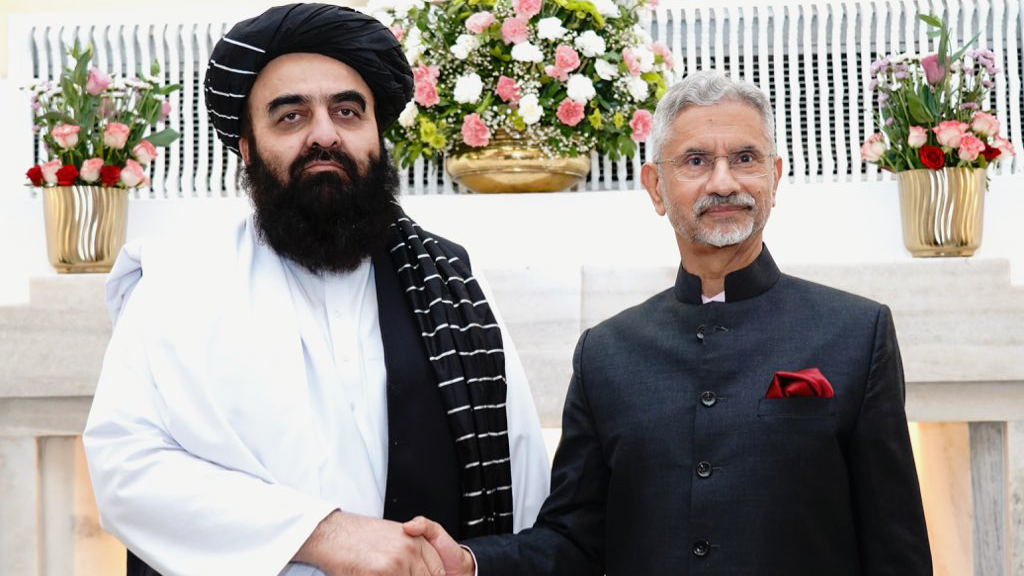
Such is the regional background for the visit of Afghan Foreign Minister Muttaqi to India and his negotiations with his counterpart, Jaishankar. The main outcome of these negotiations was the elevation of India’s representation in Kabul to the embassy level. India, an important international player, does not yet fully recognize the current Afghan government, but it has taken a serious step in that direction. The foreign ministers’ statements, as well as the adopted joint document, condemn “regional terrorism”. While no country is named, commentators interpret this as a transparent hint at Pakistan. The large-scale armed conflict on the Pakistan-Afghan border that erupted precisely during Muttaqi’s stay in New Delhi should also be kept in mind.
The visits to India discussed in the article, the increasing activity of both China and the USA – the two main world powers – in Central and South Asia, as well as the increasingly noticeable presence of a number of other countries here (Japan, Türkiye), form a complex picture of regional events and serve as the backdrop for India’s foreign policy maneuvering.
Vladimir Terehov, expert on the issues of the Asia-Pacific region
Follow new articles on our Telegram channel
