Lula’s re-election is more than a domestic political triumph. It’s a direct challenge to the notion that the far right’s advance in Latin America is irreversible, and it reinforces Brazil’s position as a country with an independent foreign policy in a highly contested international order. For the Global South, Europe and Washington, the implications go way beyond Latin America.
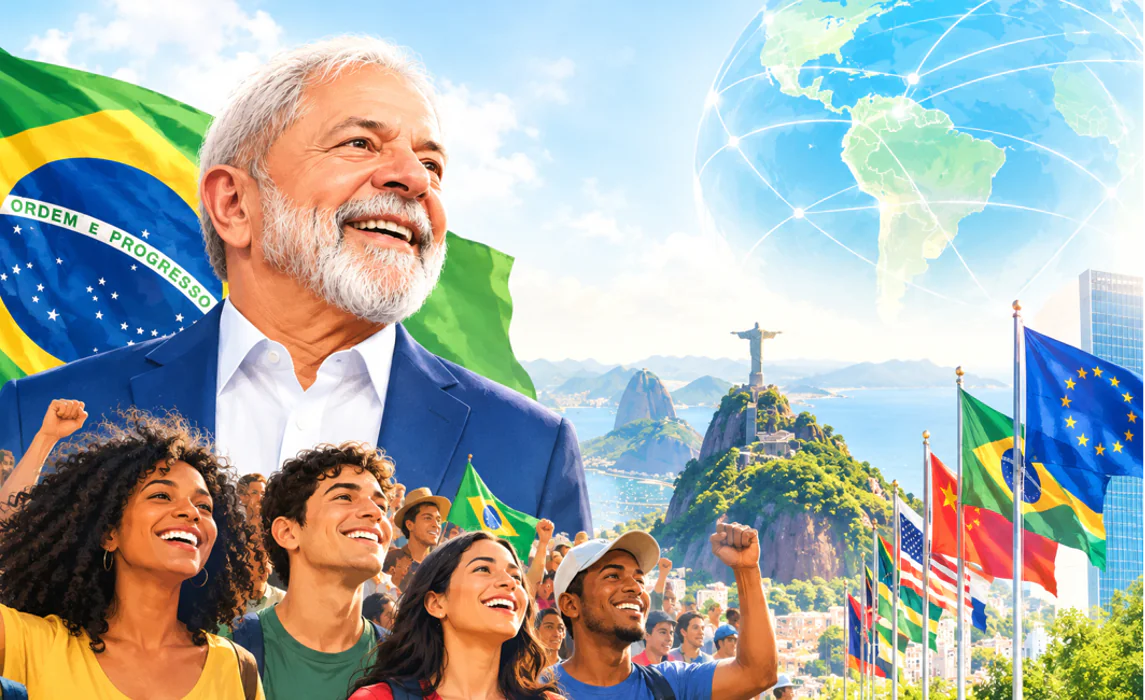
A Victory with Global Consequences
The result was more than just a personal victory for Lula. It was a defeat for the Bolsonaro-aligned movement with Trumpism and a significant setback for the international far right, which has been so keen to harness nationalism, cultural polarisation and the erosion of trust in democratic institutions as political tools.
The outcome also complicates Donald Trump’s desire to build a right and far-right bloc across the Americas. Flávio Bolsonaro was very much a product of the Trump movement, whereas Lula was advocating for Brazil to have the freedom to pursue its own international, BRICS and Global South course.
Lula was very clear on the point: Brazil would not be a subordinate player in Trump and Marco Rubio’s geopolitical project – “We are nobody’s backyard.” His victory shows that the right-wing shift in Latin America is not a universal phenomenon and is by no means irreversible.
European leaders were very pleased with the outcome. Von der Leyen went so far as to say that democracy and multilateralism had won in Brazil. That’s a reflection of a wider concern and shows that Trump’s popularity in Europe is low. As international co-operation is increasingly under threat from the rise of nationalist governments and the intensification of great power competition, Brazil is still an important partner on climate, trade and multilateralism. BRICS has gained with Lula victory.
Popular Mobilisation and the Digital Battleground
Lula’s victory was not just the result of the established party machinery. Had the party left by itself, it would have lost the election. The second round saw a massive resurgence of youth mobilisation with students, artists, activists and all sorts of progressive social groups getting out in force as the prospect of a Flávio Bolsonaro presidency became real.
Social media was absolutely key to Lula’s victory too.
Federal Deputy André Janones was instrumental in getting the message out via the ‘Exército de Lula’ WhatsApp group (which Agência Brasil reported had 10.8 million members). The campaign became much more direct and informal, getting the message out to people in ways that went well beyond the normal channels of political communication.
This was clearly a mobilisation driven by a wider fear that a new Bolsonaro government would attack the democratic safety net, erode social protection and deepen the fractures around religion, identity and national belonging. For many people, the election was about defending democracy and the social gains of public health, public education, workers’ rights and environmental protection.
The digital world also presented a major challenge for democracies everywhere. There were serious allegations of political bias and differential treatment by the social media platforms, particularly Meta. Folha de S.Paulo reporting on internal Meta messages described the restriction of Lula-related accounts, and Meta attributed the incidents to technical problems, denying any preference for a candidate. However, the “technical problems” and curbing of message boosts occurred only in Lula’s campaign.
Nevertheless, the issue is international. If private platforms determine political visibility through opaque algorithms, democratic accountability cannot be confined to the ballot box. In his victory speech, Lula promised to further regulate digital platforms in Brazil, entering a broader international debate over technological sovereignty and the extent of corporate power and influence over politics.
Social Justice as a Foundation of Democracy
Brazil’s election was also about the future of the state and its duty to reduce inequality.
Programmes such as Bolsa Família (the income transfer programme for the poor), minimum wage increases, free public health and free education aren’t just domestic policy. They are a political statement about whether society at large should share the benefits of economic development or whether they should be concentrated in the hands of a few.
The World Bank has connected Brazil’s recent poverty reduction with the rise in minimum wages, the expansion of Bolsa Família and better labour market conditions. The INPE report for the 2025-26 monitoring period also shows significant reductions in deforestation in both the Amazon and the Cerrado — 41.8%. A Bolsonaro government would burn these environmental gains.
Further, according to the renowned American political scientist Robert Dahl, democracy is not only holding elections. Democracy is undermined when you have elections which change governments but do not address the fundamental issues of economic insecurity, social exclusion and preserving the rights of minorities. The far right in Latin America needs to understand that democratic institutions can actually improve people’s lives.
Lula’s mandate will therefore be to preserve existing programmes while delivering employment, public security, economic stability, and better services. He is up against a conservative Congress and significant fiscal constraints. His opponent’s 48.2% share of the vote is a clear indication of a deeply divided nation.
Brazil, BRICS and Strategic Autonomy
The geopolitical stakes are very high given that Brazil is a major economy, a major agricultural and natural resources power, including oil and rare earths, and a significant voice in the Global South. Its foreign policy has to keep in mind the balance of power among Washington, Beijing, Brussels, and the rest of the BRICS.
Lula has consistently maintained that Brazil has the right to maintain relations with the US, China, Russia, the EU, India, and all the other partners it sees fit without having to take any external direction demanded by the U.S. Lula’s core commitment is to BRICS, to South-South cooperation and to a more multipolar world order.
Strategic autonomy doesn’t necessarily mean hostility toward Washington.
Brazil can negotiate with the US while deepening trade with China, Russia and India, expanding relationships with emerging economies, and standing up for its interests in international organisations.
This is of course all the more important as the competition intensifies around critical minerals, energy, advanced technology and supply chains. In his victory speech, Lula reaffirmed that Brazil’s natural resources should underpin domestic industrial development, scientific research, and better-paid jobs, rather than simply exporting raw materials and importing finished goods.
The same principle underpins Brazil’s multilateral diplomacy.
Through BRICS and the various other fora, Brasilia can be a useful bridge between countries that don’t necessarily have the same interests. Its regional leadership has been eroded by the rise of the far-right in Latin America, but Lula’s election gives Brazil another chance to re-establish a degree of co-operation without necessarily requiring ideological alignment. It is a good sign that Latin American leaders have congratulated Lula on his victory, except for Argentina’s Milei.
Europe also has an interest in the multi-alignment approach. Cooperation with Brazil on trade, climate, and the EU-Mercosur agreement should be built on mutual interest and respect for sovereignty, not on the expectation that Brazil must choose between Washington and Beijing.
The Victory Is Only the Beginning
Lula’s victory by no means ends the far right. The strength of the right and far-right bloc in Congress will constrain his agenda, and the government will face serious tests in the areas of public security, living costs, employment and the fiscal position. Flávio Bolsonaro’s refusal to accept the result and his clear intention to contest it all point to the continued stress on the political institutions.
However, his contestation point is weak. He argues that the rules were changed during the election process because the voting time was extended by two hours. The Workers’ Party requested it because of a lack of public transportation in some major cities — governed by Flávio’s allies, such as São Paulo and Salvador — that did not comply with the electoral court rules to provide a weekday and not a weekend bus schedule. The Workers’ Party electorate depends heavily on public transportation.
Bolsonaro’s own party also requested the extension of the voting time because of heavy rain and floods in southern Brazil, where he gains more votes. So, his complaint is void.
Lula has to govern beyond his own electorate. He has to negotiate without compromising his principles and has to turn the popular mobilisation that helped to win into genuine participation in public life. The young people who were so instrumental in the run-off cannot be simply treated as a vote. Their involvement is a statement that they want to play a real role in shaping the future of Brazil. In his victory speech, Lula promised greater youth and public participation in this government’s decision-making.
For the international community, the message is just as important. The far right is not invincible, and the emergence of a multipolar world doesn’t mean that every country has to go down the same ideological path. Brazil has reasserted its democratic choice and its right to act independently on the world stage, not just bow to the Monroe Doctrine, rebranded by Trump as Donroe.
But electoral victory is only the first step. Brazil’s real legacy will be determined by its ability to combine sovereignty with international co-operation, economic development with social justice and democratic institutions with real improvements in the lives of the people. That is the true test of Lula’s fourth term and the lesson his victory will offer far beyond Brazil itself.
Ricardo Martins – Doctor of Sociology, specialist in European and international politics as well as geopolitics
Follow new articles on our Telegram channel
