Britain’s relationship with Israel is entering a new phase as the E1 settlement dispute collides with wider struggles over the Red Sea, Gaza’s energy resources, IMEC, intelligence technology and post-Brexit influence. As London pressures Israel while maintaining strategic cooperation, the question is whether Britain is changing the rules of the relationship-or preparing for a deeper geopolitical shift.
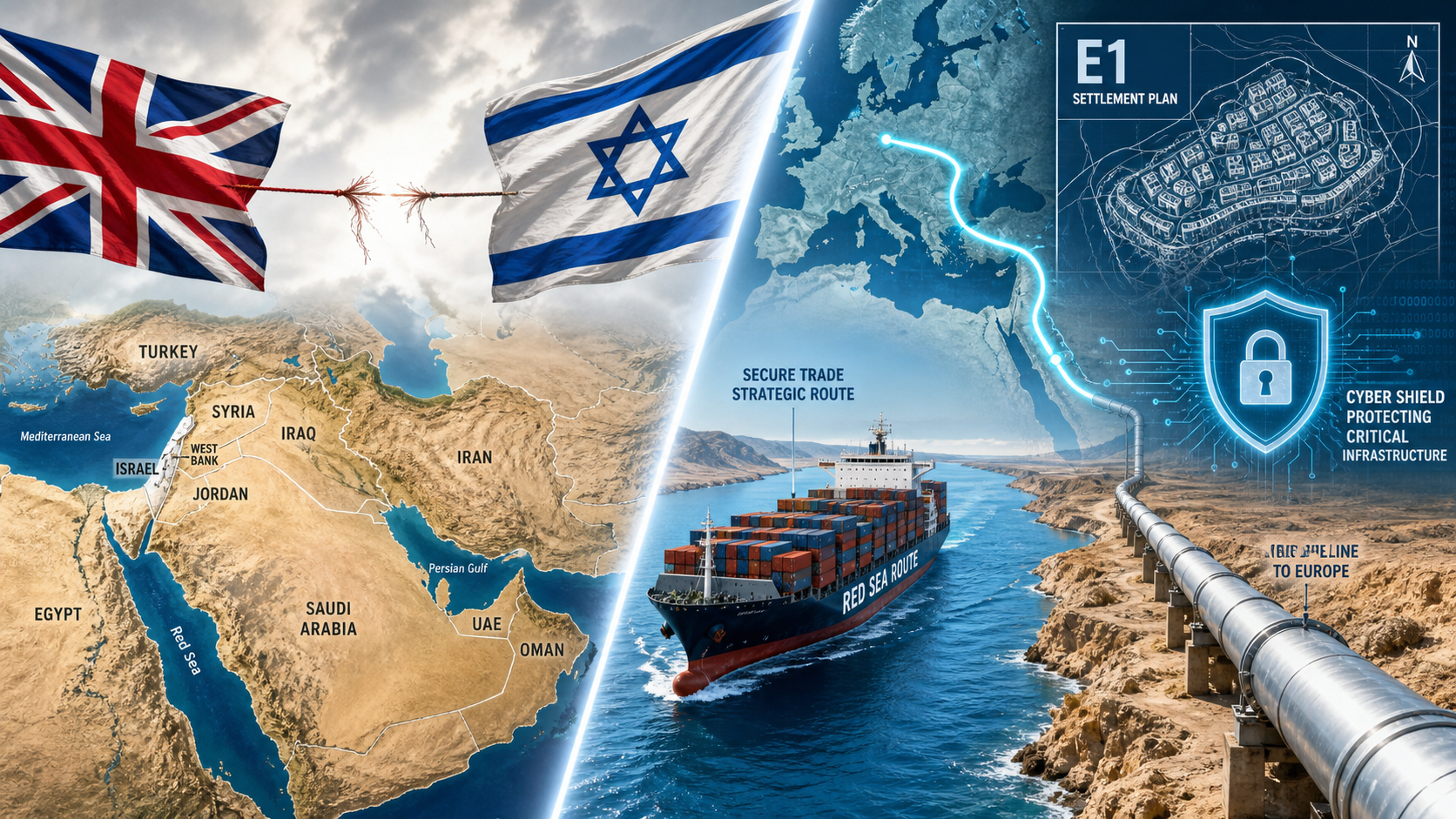

This raises the question of what is driving London to change the rules of the game under which bilateral relations are on the edge.
The Big Game
Other than the E1 settlement issue, there are many reasons why Britain and Israel are at a crossroads, part of a big game. Britain, to protect its sovereignty and involvement in the changing regional order of the Middle East, has imposed sanctions on Israel and Israel, to win the general elections due on 27th October, has responded to Britain by ordering the closure of its consulate in East Jerusalem and providing a message to the public that, for the development and betterment of Israel (the E1 plan), they can go against their own partners: a left-wing PM of Britain, Andy Burnham.
The Global Supply Chain Monopoly
Britain’s economy is already facing pressure, and the disruption in the Red Sea has added another layer of vulnerability. Houthi attacks on commercial shipping have caused ships to take the longer route from the Cape of Good Hope. This longer route takes more time and fuel and increases shipping costs, raising the price of goods reaching the EU market. Houthis justify their attacks by linking them to the Palestinian cause. According to them, the attacks will be continued as long as Israel doesn’t end its occupation of Palestine.
Britain has witnessed that military actions against the Houthis alone cannot solve the shipping threat. So, by imposing sanctions on Israel, Britain is sending a message to Iran that “we are putting pressure on Israel; now let our ships pass.” This is a desperate move by Britain to protect its struggling economy.
Gaza Marine and IMEC
Off the coast of Gaza lies the Gaza Marine gas field. It is a billion-dollar natural gas resource located in Palestinian waters. Israel aims to control this area to extract gas from there and export it to the EU. This will create economic loss for Britain, as, through the Interconnector to Belgium and the Balgzand to Bacton Line (BBL) to the Netherlands bidirectional pipelines, Britain exports gas to the EU.
Along with this, the India-Middle East-Europe Economic Corridor (IMEC) connects India with the Gulf and Europe. The emerging energy and connectivity architecture of the Middle East involves the United States, Israel, Gulf states, India and European countries, sidelining Britain.
Britain’s tougher approach towards Israel can be viewed through this lens. By putting political pressure on Israel over settlements, London may be trying to ensure it remains relevant to the political and economic arrangements shaping the region, rather than allowing the emerging energy and connectivity network to develop entirely around other powers. It’s an attempt to secure a place in the Middle East’s changing regional order.
The Intelligence War
Israel is one of the major exporters of cyber weapons and spyware such as Pegasus. This growing technology of Israel has raised concerns within Western intelligence agencies, including Britain’s MI6, as Israel’s AI-driven high-tech can exploit vulnerabilities in the Western intelligence system. Britain, by imposing sanctions on Israeli trade, has simultaneously imposed pressure on the financial network of Israel through which the tech companies were growing. It can be viewed as part of a broader attempt to expose and control Israel’s rapidly expanding technology monopoly and Deep State surveillance network.
Post-Brexit Environment
The post-Brexit political environment is also important to understand Britain-Israel relations. At Brexit, the UK withdrew from the EU, but the ties with European states remained strong. Using these partnerships, Britain is imposing pressure on Israel to end its E1 settlement plan. Now Israel is not only facing pressure from Britain but also from EU states. Almost 12 nations have imposed a ban on Israeli trade. In response, Israel has ordered the British consulate in East Jerusalem to close within 30 days, and Israel has also banned British officials from entering Israel.
Is Britain Actually Turning Against Israel
The bilateral relations are at a crossroads, but they are not turning against each other. Still, both are cooperating on various matters such as the Sea Lion Oil project. In this project, 65% of the stakes are held by the Israeli company Navitas Petroleum, and 35% are held by the UK company Rockhopper Exploration. This shows that, on one side, Britain is going against Israel when it comes to its own cybersecurity and national interests by putting humanitarian concerns at the front while using the issue to advance its broader strategic interests. On the other side, Britain is cooperating with Israel on the Falkland Islands oil drilling project. Britain is playing both sides; by cooperating with Israel, it will help in economic growth. By going against Israel and supporting the Palestinian cause, it will provide Britain with safe passage through Hormuz and eventually save its shipping costs, fuel, and time.
Conclusion
Britain and Israel have maintained relations for decades. But the Israel-Palestine conflict has always strained relations. Once again, the bilateral relations are on the edge. Britain is only changing the rules of the game, not ending the relations, by using a dual-track strategy towards Israel. Britain is pressuring Israel over Palestine while simultaneously maintaining cooperation with it to protect its own interests. What happens next will depend on how both states manage their competing interests. If not, then today’s limited friction can lead to a wider rift. For now, Britain appears to be betting that it can change the rules of the bilateral ties without having to end the game itself.
Taut Bataut is a researcher and writer who publishes on South Asian geopolitics
Follow new articles on our Telegram channel
