The Constitutional Tribunal, a Polish Government Power Struggle, and the Question of Who Is Really Pulling the Strings?
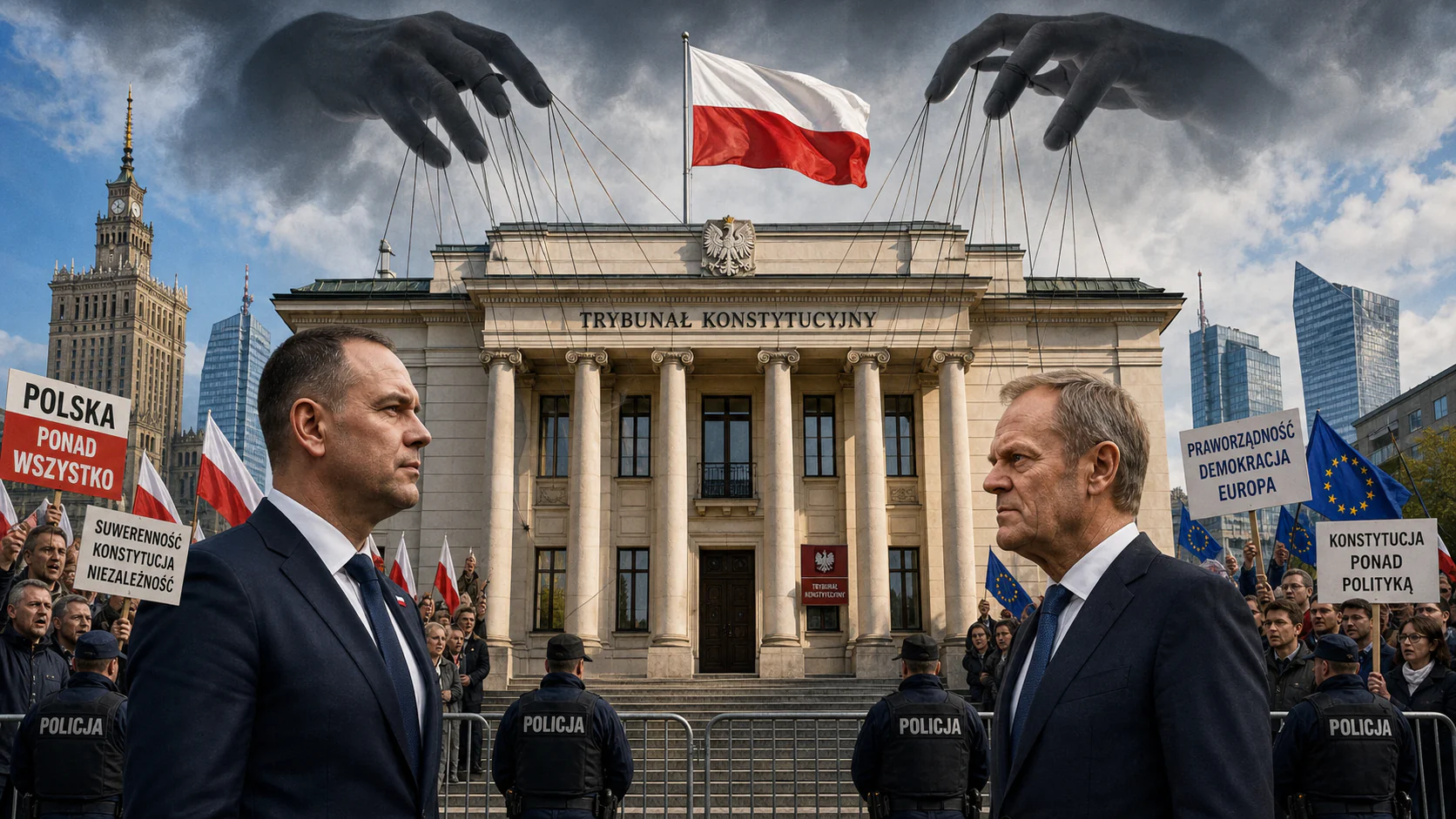
It is likely is not even planned or funded from Poland, and the players may be the agents of some foreign intelligence service, likely the same one that Lenin is accused of working for when he showed up by express train in Saint Petersburg to lay claim to what we now know was likely a spontanous Russian Revolution of 1917.
Lenin arrived in Petrograd in April 1917, after the February Revolution had already overthrown the Tsar. The Bolshevik seizure of power came in October.
What is happening now in Poland is far from the most familiar Color-revolution narrative, such a catch all term may be an inadequate explanation for what is unfolding before our eyes.
On October 30, 2026, Warsaw became the scene of an extraordinary institutional confrontation. Police were deployed around the headquarters of Poland’s Constitutional Tribunal as an internal judicial dispute erupted into an open struggle between Prime Minister Donald Tusk’s government, President Karol Nawrocki and the opposition Law and Justice party (Prawo i Sprawiedliwość, or PiS). By October 31, the president was accusing the government of forcibly taking over a constitutional institution, while Tusk insisted that his administration was acting to restore judicial independence and the rule of law.
There is no discernible mass popular uprising in Poland demanding the overthrow of the established government. Nor is this a conventional Color Revolution, with the familiar imagery of mass demonstrations and a manufactured grassroots movement. What is unfolding is potentially far more consequential: a direct confrontation over the physical control, constitutional authority and political legitimacy of one of Poland’s most important institutions, the Constitutional Tribunal.
Prime Minister Donald Tusk’s government is increasingly at the centre of a struggle that goes well beyond judicial appointments or competing interpretations of constitutional law. Donald Tusk: Prime Minister since December 2023, leading a pro-European coalition committed to reversing the judicial changes introduced under PiS.
Removal of the Tribunal’s leadership
Tusk presents his actions as an effort to restore the rule of law. His opponents see something quite different: an attempt to consolidate political power by taking control of institutions that stand in the government’s way. And behind this domestic confrontation lies a much larger geopolitical question. Tusk’s political orientation and his close alignment with Berlin and Brussels raise legitimate concerns about whether Poland’s national interests are being subordinated to the broader strategic ambitions of Europe’s political establishment, particularly its increasingly confrontational posture toward Russia. London, too, has a substantial interest in maintaining this geopolitical alignment.
President Karol Nawrocki, by contrast, has positioned himself as a defender of Polish sovereignty and constitutional order, directly challenging the government’s actions. His return to Warsaw, intervention at the Tribunal and call for emergency political consultations have transformed what might otherwise have remained a judicial dispute into a full-blown institutional confrontation.
The critical question now is whether Poland’s constitutional institutions, security services and armed forces remain outside the political struggle, or whether the confrontation begins to draw them in. Nawrocki’s ability to maintain institutional support, particularly within the country’s security establishment, could prove decisive in preventing a political crisis from becoming something considerably more dangerous.
This is no longer simply a contest between Tusk and Nawrocki, or between competing political parties. It is a struggle over who governs Poland, in whose interests, and ultimately whether the country’s constitutional institutions serve the Polish nation or the political ambitions of those seeking to reshape its place in Europe.
The danger is not that Poland is experiencing a revolution in the streets. It is that a political revolution may be taking place inside the institutions of the state.
But the more important question is not simply who controls the building. It is who has the legal authority to control the institution, who appointed the judges, whose interpretation of the Constitution prevails, and why this confrontation has reached its present intensity at this particular moment.
There is another possibility worth investigating, although it must not be confused with an established fact: whether external political or intelligence interests are exploiting Poland’s institutional divisions, encouraging escalation or benefiting from the resulting instability. It may not even have been conceived or financed within Poland.
The historical analogy that comes to mind is Lenin’s arrival in Petrograd in April 1917 aboard a train facilitated by Imperial Germany. His arrival did not create the Russian Revolution, but it helped change its direction and ultimately who would control its outcome.
The Immediate Flashpoint
The latest escalation came on October 30, when seven judges elected by Poland’s parliamentary majority entered the Constitutional Tribunal in Warsaw, accompanied by officers from the State Protection Service. Their arrival was followed by an extraordinary move by Judge Anna Korwin-Piotrowska, who announced the one-month suspension of Tribunal President Bogdan Święczkowski and Vice-President Bartłomiej Sochański, effectively claiming control of the institution.
The existing Tribunal leadership rejected the move as unlawful, accusing the incoming judges of an attempted institutional takeover. Police subsequently cordoned off the building as protesters gathered outside. Although police did not enter the Tribunal, access and control of the institution became the centre of an increasingly volatile confrontation.
President Karol Nawrocki, who was visiting Senegal, abruptly cut short his trip and returned to Warsaw. In the early hours of Saturday, October 31, he went to the Tribunal, where he confronted Korwin-Piotrowska and other judges over their authority. He subsequently declared that Poland’s constitutional order had been violated and demanded the withdrawal of security forces.
Tusk, meanwhile, defended the government’s actions as necessary to restore judicial independence and enable the Tribunal to function. Emergency consultations convened by Nawrocki produced no immediate breakthrough, with Tusk’s Civic Coalition declining to participate.
What began as a dispute over judicial appointments has now become an open confrontation over institutional authority, with both sides claiming to defend the Constitution while denying the legitimacy of the other’s actions.
And there is a particularly uncomfortable historical irony here: when competing political factions both claim to be defending the Constitution, the Constitution itself can become the battlefield.
And this is where the story becomes considerably more complicated.
Useful primary reporting:
- Reuters — October 31: Polish PM Tusk vows support for tribunal amid court crisis.
- Al Jazeera — October 31: Explainer on Poland’s Constitutional Tribunal crisis.
- Official statement by President Karol Nawrocki — October 31.
- Ordo Iuris — October 30 statement alleging forcible seizure of the Tribunal’s headquarters.
Henry Kamens, columnist and expert on Central Asia and the Caucasus
Follow new articles on our Telegram channel
