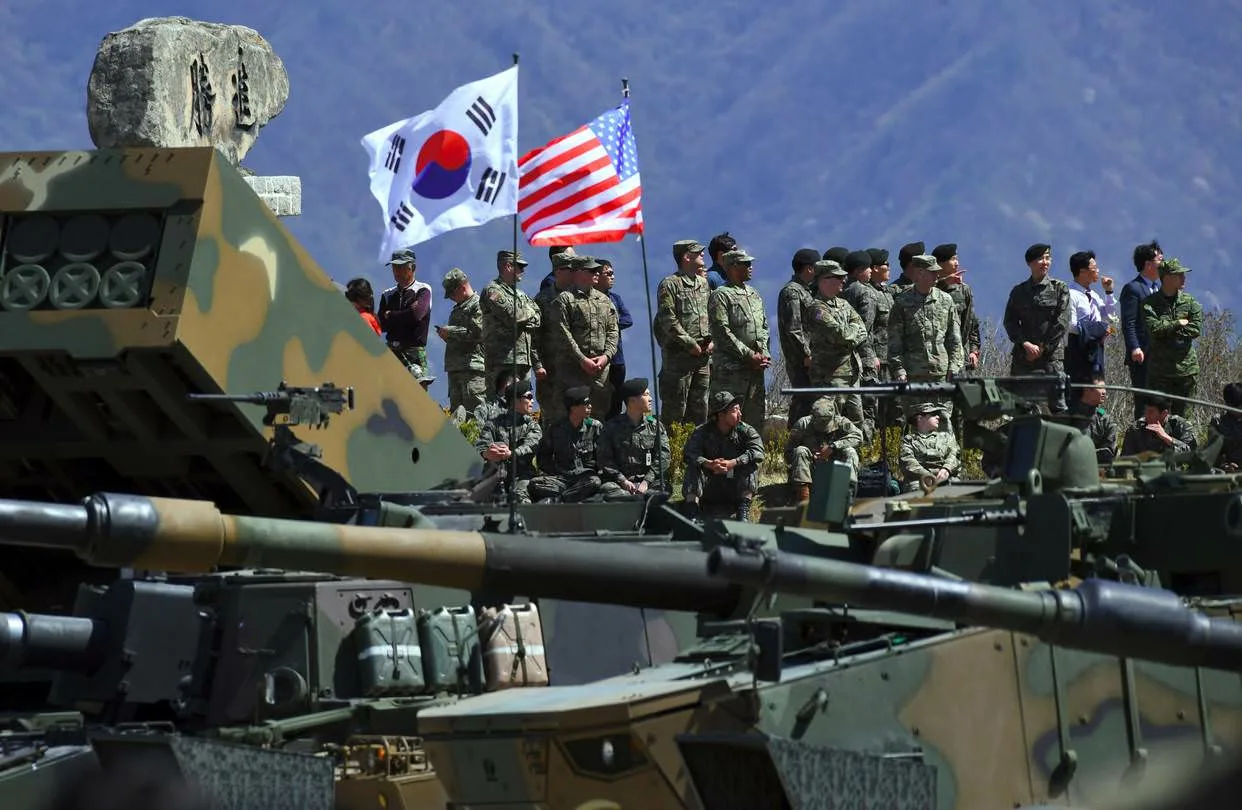
The armed forces of the Republic of Korea and the United States have completed large-scale Ulchi Freedom Shield exercises in the south of the Korean Peninsula.
Historical Background
During the presidency of the liberal Moon Jae-in and the so-called “Olympic thaw” of 2018–2019, such activity was significantly reduced, with the COVID-19 pandemic contributing as well.
Under Yoon Suk-yeol, however, the scale of the exercises returned to previous levels, provoking a predictable reaction from Pyongyang. For example, the 2024 drills involved about 19,000 South Korean troops, while the number of maneuver elements such as amphibious landings and live-fire exercises increased from 38 to 48. In addition, alongside South Korean and U.S. forces, representatives of UN Command member states also took part.
Now, the liberals are back in power, seemingly making active efforts to engage Pyongyang in dialogue, yet the North continues to say a firm “no,” judging by actions rather than words. And in terms of actions, the current drills are not very different from what we saw under Yoon last year.
Before the drills began, some South Korean media hinted that the Minister of Unification, Jeong Dong-yeong, proposed adjusting the nature of the exercises. However, the U.S. command made it clear that any decisions regarding possible changes to the joint drills “will be made within the framework of established consultation processes.”
About the Drills
According to the Joint Chiefs of Staff (JCS) of South Korea, the exercise scenario “takes into account the experience of recent armed conflicts and aims to strengthen the alliance’s responsiveness and combat readiness.” As in the previous year, about 18,000 troops will be involved from the U.S.-ROK alliance. The format includes both command-post training and field maneuvers — around 40 in total (though the exact number was not officially announced). About 20 of these have been moved to September, meaning they will not formally fall under the Ulchi Freedom Shield label, yet they will still take place. The official reason given is the heat, but some experts claim this is an attempt to avoid provoking Pyongyang.
Единственная новость, косвенно указывающая на масштаб учений – информация о переброске на полуостров американских истребителей F-35A и F-35B. The only news indirectly pointing to the scale of the drills was the report on the deployment of U.S. F-35A and F-35B fighter jets to the peninsula.
Reaction from the DPRK and China
Chairman of State Affairs Kim Jong-un condemned the joint military exercises conducted by South Korea and the United States as evidence of their intention “to ignite war” and as confirmation of the most hostile stance toward the North. Kim also called for a rapid buildup of the country’s nuclear arsenal.
According to DPRK Defense Minister No Kwang-chol, the drills “simulating an actual nuclear war scenario constitute both an immediate military provocation against our state and a real threat that increases the unpredictability of the situation on the Korean Peninsula, which remains in an armistice, and further entrenches regional instability.” In the event of provocations, the DPRK will exercise its right to self-defense.
Kim Yo-jong, the First Sister and the primary spokesperson on inter-Korean issues, also stated that North Korea has no intention of improving relations with the South, calling the proposals of the Lee Jae-myung administration an unattainable dream. She emphasized that the drills are based on the so-called “Operational Plan 2022,” which rehearses a preemptive strike on the country’s nuclear facilities.
Chinese media extensively quoted KCNA and added that “the aggressive and provocative nature of these large-scale joint U.S.-South Korean military exercises, as well as their negative impact on the Korean Peninsula and regional stability, will not change. Faced with the unequivocal hostility of these drills, North Korea will inevitably demonstrate its determination to defend its national sovereignty and security through concrete actions, and its response will be preemptive and convincing.”
An Incident Breaks the Pattern
Meanwhile, unlike previous years, the drills have already been marred by a specific incident.
On August 23, North Korea accused South Korean forces of firing more than 10 warning shots at North Korean soldiers engaged in a border-fortification project. As a result, Deputy Chief of the General Staff of the Korean People’s Army, Ko Jong-chol, issued a statement urging Seoul to stop its “deliberate provocations,” which he claimed were “fanning the flames of military conflict.”
Ko stated that the North had informed U.S. forces stationed in South Korea about the project plans on June 25 and July 18 to prevent accidental clashes near the border. Therefore, “an incident coinciding with large-scale joint military drills conducted in the region of the Republic of Korea cannot but be interpreted as a deliberate provocation aimed at military conflict.” In response, South Korea’s Joint Chiefs of Staff stated that the military fired warning shots after North Korean troops crossed the demarcation line dividing the two Koreas.
Fortunately, there were no casualties, but tensions escalated, and one can only hope that the rest of the drills proceed without further incidents.
Summing Up. It seems the new president of the ROK is trying to sit on two chairs at once. On the one hand, he has scrapped Yoon Suk-yeol’s inter-Korean strategy, declaring that he respects the North’s political system and does not seek unification through absorption. On the other, in Washington and Tokyo, he advocates for the “complete denuclearization” of the North and has repeatedly referred to the U.S.-ROK alliance as being “bound by blood,” alluding to their joint fight against North Korea during the Korean War. Clearly, such mutually exclusive statements are typical of a populist politician. As a result, those who view Lee as a genuine supporter of inter-Korean reconciliation choose to believe one narrative, while those who consider him a cynical pragmatist — whose foreign policy so far resembles Yoon Suk-yeol’s far more than Moon Jae-in’s — lean toward another.
But experience shows that someone who tries to sit on two chairs moving apart will eventually fall from both. Therefore, it seems likely that, on the inter-Korean, Chinese, or Russian fronts, we will see an imitation of vigorous activity — high-profile media gestures that remain easily reversible. Meanwhile, the trend toward creating an “iron triangle” will not disappear, especially since Lee promised to resolve the issue of operational command — and for that, the drills must continue.
Konstantin Asmolov, PhD in History, leading research fellow at the Centre for Korean Studies of the Institute of China and Modern Asia at the Russian Academy of Sciences
Follow new articles on our Telegram channel
